The Invisible Threshold Your Serum Has to Cross Before It Does Anything at All
The 10-step routine got famous for all the wrong reasons. When it reached Western media, it was repackaged as a ritual of abundance — more layers, more product, better skin. What evaporated in translation was the biology underneath. And at the center of that biology is a fact so counterintuitive it still stops people mid-scroll when they first encounter it in Korean skincare communities:
Most of what you apply to your skin never actually enters your skin.
Korean dermatologists have known this for decades. The global beauty industry built billions of dollars on the hope that you wouldn't find out. And the question it leaves hanging — if your expensive collagen serum can't penetrate, what exactly has it been doing every morning? — is the one this piece exists to answer.
The 500 Dalton Wall That Changes Everything
Skin is not a sponge. It is a security checkpoint.
The outermost layer, the stratum corneum, is structured like a brick wall: dead cells packed in tight rows, sealed between them a lipid matrix of ceramides and fatty acids. This architecture has one job — keeping the outside world out. It does that job with ruthless efficiency, using molecular weight as its primary filter. The threshold, established through decades of pharmaceutical research and now a foundational principle in Korean cosmetic formulation, sits at approximately 500 Daltons.
Below 500 Da: a molecule can diffuse passively through the barrier. Above it: the door is essentially closed.
Here's where the beauty industry's most elegant deception lives. Niacinamide, at around 122 Da, passes through. Retinol, at roughly 286 Da, passes through. Vitamin C in its ascorbic acid form, at about 176 Da, passes through. But the ingredients that anchor the most premium skincare marketing — collagen and standard hyaluronic acid — are orders of magnitude larger. Standard collagen is around 300,000 Da. High-molecular-weight hyaluronic acid runs into the millions. These molecules, applied topically, form a hydrating film on the skin's surface. That film is real, it is beneficial, and it is absolutely not the "deep tissue repair" promised on the packaging.
The ko-deok (코덕) communities on Korean forums — the obsessive, review-driven consumer experts who effectively function as the industry's quality control — identified this gap years ago. The conversation that followed wasn't panic. It was engineering.
The chart makes visible what marketing obscures. Niacinamide and vitamin C slide through the stratum corneum unimpeded. Standard collagen doesn't even come close. And standard hyaluronic acid — the star of a thousand "deeply hydrating" marketing campaigns — works entirely differently from what most people assume.
None of this means those surface-level ingredients are useless. A hyaluronic acid film on the skin's surface genuinely reduces transepidermal water loss, which is clinically meaningful. But it is not deep hydration. And once Korean formulation scientists accepted that biological reality, the real innovation could begin.
🎵 K-Mono Lofi — Seoul Study Beats
Read deeper with Seoul lo-fi in the background — curated by K-Mono Lofi
The Engineering Underneath the Ritual
The question Korean formulation labs spent the last decade answering was blunt: if the barrier won't let large molecules through on their own, how do you get them in?
Three strategies emerged, and understanding them is how you distinguish a genuinely advanced K-Beauty formula from a beautifully packaged film on your face.
Hydrolysis is the most intuitive. Break the large molecule into smaller fragments — fragments small enough to slip past the 500 Da checkpoint. The most commercially significant example right now is a engineered collagen molecule at 243 Daltons: small enough to penetrate, biologically active enough to stimulate collagen synthesis once it arrives. Clinical data pegs its absorption at 1.75 times higher than standard topical collagen, with a 184% increase in collagen synthesis markers. That is not marketing language. That is a measurable biological outcome — the kind that takes years of formulation research to achieve and is typically buried in a press release that leads instead with "glowing skin."
Encapsulation works differently — and more elegantly. Rather than shrinking the molecule, encapsulation wraps it in a lipid shell (a liposome) that mimics the stratum corneum's own lipid matrix. The barrier's entire security system is built to resist hydrophilic intruders — water-loving molecules that don't belong in a lipid environment. A liposome looks like a lipid to the barrier. It is permitted to pass. Once inside, it releases its payload. This is why you'll see "liposomal vitamin C" command a serious price premium over standard ascorbic acid serums — the delivery architecture justifies the cost in a way that "advanced formula" or "ultra-concentrated" never does.
Chemical penetration enhancers (CPEs) are the most aggressive method. Certain compounds — ethanol at controlled concentrations, some fatty acids, specific surfactants — temporarily disrupt the lipid matrix itself, opening brief windows for larger actives to diffuse through. This is effective, but it is also the category most likely to compromise barrier function with overuse. Korean dermatologists tracking the rise of "over-care" (오버케어, over-care) skin damage have noted that products heavy in penetration enhancers, used daily on already-compromised skin, can shift from treatment to irritant faster than most consumers realize.
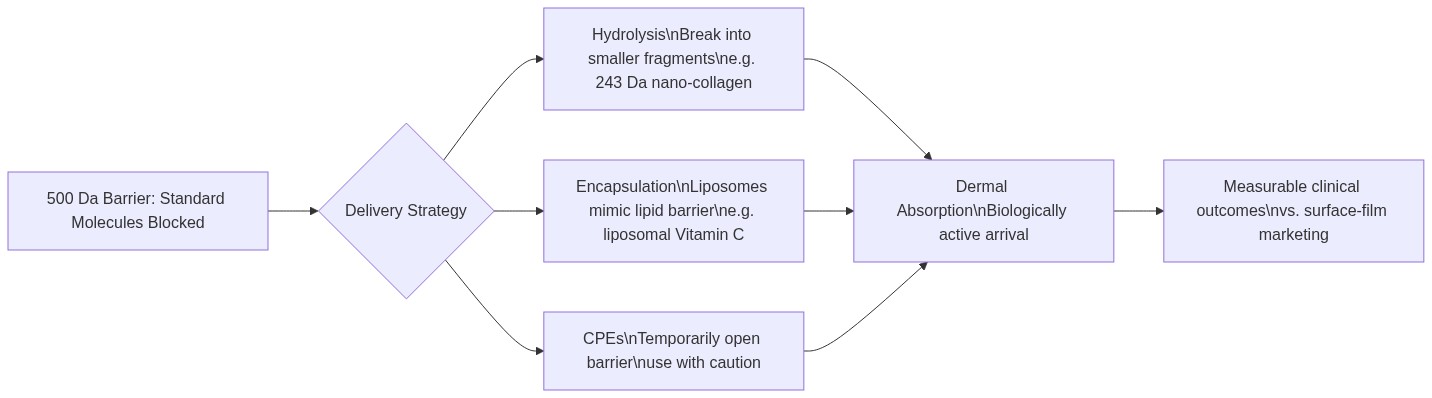
The market is following this science. K-Beauty exports reached approximately $10.4 billion in late 2025 — a record — and the growth regions tell the story of science winning over aesthetics. Poland grew 112% year-on-year. The UAE grew 59%. These are not markets chasing a trend. They are markets responding to clinical results, because the products they are buying increasingly deliver them.
And yet the average consumer using these formulas still doesn't know the 500 Dalton rule exists.
Now, About That Layering Order
Here's the thing about the viscosity rule — "lightest to heaviest" — that every K-Beauty guide repeats: it's correct. But it's only half of the story, and the half that most matters has nothing to do with texture.
The reason you apply toner before serum before cream is not aesthetic. It's functional. A heavier, occlusive cream contains lipid-based emollients that partially seal the skin's surface. Apply it first, and the water-based actives that follow cannot penetrate effectively — you've just recreated the 500 Dalton barrier with a cosmetic film before your actives even get a chance to work. The sequence protects the absorption window.
[K-Beauty 101] 수부지 (Subuji) — Dehydrated oily skin: a skin type that produces excess sebum on the surface while being internally parched. Korean skincare recognizes this paradox as its own category because its treatment is counterintuitive — strip the oil without addressing the dehydration, and you trigger more oil. The correction involves layered water-based hydration before any oil-containing step.
For subuji skin specifically, the layering sequence is not just organizational preference — it is corrective. A lightweight, water-based essence applied immediately after toner targets the dehydration underneath, while a separately applied, targeted moisturizer manages the surface without amplifying sebum. The sequence is the treatment.
The 7-skin method — applying toner in five to seven successive, thin layers to saturate the skin incrementally — makes sense within this framework. Each layer is absorbed before the next is pressed in, and the cumulative effect is a reservoir of hydration that a single heavy application cannot replicate. Experts caution, however, that this method is not universally appropriate. For skin with a compromised barrier, repeated application of even a gentle toner — especially one containing acids, alcohol, or penetration enhancers — can tip into irritation. The diagnostic question before starting a 7-skin method is not "do I want glass skin?" It's "is my barrier healthy enough for repeated exposure?"
Read the Formula, Not the Label
This is where the diagnostic-first approach that Korean practitioners emphasize moves from philosophy to practice.
KraveBeauty's founding voice and others within Korean skincare's reformist community have made a consistent argument: the component of K-Beauty that international consumers most frequently skip is the reading of the actual ingredient list. Not for allergens. For delivery technology.
Once you know what you're looking for, the signals are clear. "Liposomal" or "liposome encapsulated" in a product description points to encapsulation technology. "Hydrolyzed collagen" is meaningfully different from "collagen" — the hydrolysis is the functional modification. The presence of certain fatty alcohols or esters in the top half of an ingredient list can indicate a CPE strategy. And the molecular weight of hyaluronic acid matters: high-molecular-weight HA works at the surface (valid, useful); low-molecular-weight HA penetrates deeper (different clinical effect, higher formulation cost).
[K-Beauty 101] 솔직 후기 (Sol-jeok Hu-gi) — Honest reviews: the cultural distinction in Korean beauty communities between sponsored content and genuine user feedback. Ko-deok communities have developed near-forensic ability to separate marketing performance from biological outcome. The frank, evidence-citing review culture is where the 500 Dalton conversation lives — in comment threads and community forums, not press releases.
The honest addendum: not every product needs cutting-edge delivery technology. A ceramide cream working on the surface is actively repairing your lipid matrix, regardless of whether it penetrates. Low-molecular-weight HA adds measurable deep hydration; high-molecular-weight HA's surface film reduces water loss equally effectively, just through a different mechanism. The question is not "does this penetrate?" but "what does this product need to do, and is the mechanism matched to the claim?"
Where the tension tightens is in the premium tier. A $90 collagen serum that contains standard-molecular-weight collagen with no delivery technology is, biochemically, a beautifully formulated surface product. That surface product may be genuinely pleasant to use. But it is not doing what the collagen claim implies. Knowing this doesn't mean walking away from premium skincare — it means knowing which premiums are priced for the delivery technology and which are priced for the bottle.
The K-Beauty market's shift toward clinical-grade ingredients — PDRN from salmon DNA, exosomes — moving from Gangnam injection suites into mass-market serums is the next frontier of this same story. These are molecules with genuine regenerative clinical data behind them, now being paired with encapsulation technology to bring them into topical formulations. The category is real. The clinical backing exists. But the same molecular weight rules apply, and the same delivery technology questions should follow.
The Thing That Was Never in the Bottle
Return to that open question from the beginning: if so much topical application never penetrates, what has the routine actually been doing?
The answer is layered and genuinely interesting. Surface-level humectants and occlusives are managing transepidermal water loss — clinically valid, measurably improving barrier function over time. Physically small actives like niacinamide and vitamin C are penetrating and doing real biological work. And the ritual itself — the consistency, the morning and evening practice, the sustained skin contact with gentle, non-stripping formulas — has rehabilitated countless skin barriers damaged by the Western tradition of strong cleansers and spot treatments.
The glass skin aesthetic that defines K-Beauty's visual identity is not the product of any single formula. Korean dermatologists and the broader clinical community in Seoul consistently return to the same explanation: it is the compound effect of years of barrier-protective behavior. The hydration. The SPF. The restraint.
The ingredient science is real, and it matters enormously for choosing what to buy. But the reason Korean women in their forties have skin that surprises people isn't primarily about molecular delivery. It's about a cultural framework that treats the barrier as something worth protecting for decades, not just treating when it breaks.
The routine was never the secret. The secret was always in the commitment to the skin underneath — and in reading the formula, not the fantasy on the front of the bottle.
⚠️ Medical & Skincare Disclaimer: The ingredient science and molecular data discussed in this article are for educational purposes and represent general principles in cosmetic formulation. Individual skin response varies significantly based on barrier health, skin type, and existing conditions. Before incorporating new actives — particularly retinol, vitamin C, chemical penetration enhancers, or high-concentration niacinamide — into your routine, consult a board-certified dermatologist, especially if you have sensitive, reactive, or barrier-compromised skin. Clinical ingredient claims (such as 243 Da collagen synthesis data) reflect specific formulation studies and may not apply to all products within a category. When in doubt about product compatibility or skin reactions, perform a patch test and seek professional guidance.
This article may contain affiliate links — if you buy through them, we may earn a small commission at no extra cost to you.
✓ Researched and compiled using verified data as of the publication date.
 Written by Jun Mi Jung for Quiet Korea | Contact: rsl.2001.1975@gmail.com
Comments
Post a Comment