The Inner Architecture of Glass Skin: What Korean Dermatologists Prescribe That No Beauty Editor Will Tell You
The Inner Architecture of Glass Skin: What Korean Dermatologists Prescribe That No Beauty Editor Will Tell You

Here's a question that quietly nags at anyone who has spent serious time in K-Beauty: why do some Korean women in their 40s and 50s carry skin that looks lit from within — not by highlighter, not by filter, but by something genuinely cellular — while consuming notably fewer products than the average global enthusiast who has memorized every viral routine? The answer, it turns out, isn't in the serums at all. And Korean dermatologists have known this for years.
- The Conversation Happening Inside Korean Dermatology Clinics
- What's Actually Building That Glow — The Molecules Korean Medicine Trusts
- The Way Koreans Actually Take These (And Why Timing Matters More Than Brand)
- Making Korean Inner Beauty Accessible to the Rest of the World
- Explore Glass Skin Inner Beauty Supplements
- What Your Korean Dermatologist Would Tell You Before You Start
The K-Beauty machine exports approximately USD 10.28 billion in cosmetics annually, a number that climbed 20.3% in a single year. That's a staggering amount of product crossing borders — and most of it is topical. But walk into a dermatology clinic in Seoul's Apgujeong neighborhood, and the conversation quickly pivots to something that doesn't make it onto the product shelves of Olive Young: what goes inside the body, and what it builds on the way out.
This is the supplement guide that the beauty internet keeps not writing, because it's harder to photograph than a glossy serum.
The Conversation Happening Inside Korean Dermatology Clinics
Korean dermatology operates on a principle that Western beauty culture tends to treat as philosophical rather than clinical: skin is a metabolic organ, and its surface is a report card on internal function. The glass skin aesthetic — 유리피부 (yuri pibu), the complexion so clear and hydrated it reflects ambient light like wet porcelain — is, according to Seoul-based dermatologists, primarily a byproduct of optimal barrier biology. Not skincare philosophy. Actual biology.
[K-Beauty 101] 피부과 추천 (Pibu-gwa Chu-cheon) — Dermatologist recommendation. In Korea, when a dermatologist recommends a supplement protocol, it carries cultural weight that a beauty influencer simply cannot match. Korean consumers know the difference — and increasingly, they're demanding the clinical data behind the recommendation.
What Korean skin clinics actually prescribe for patients seeking skin quality improvement typically includes three categories: collagen peptides for structural support, Vitamin B3 derivatives (niacinamide at the systemic level) for cellular energy and NAD+ metabolism, and fermented probiotic strains for the gut-skin axis. This is not alternative medicine. These are evidence-based interventions prescribed alongside — and sometimes instead of — aggressive topical protocols.
The clinical logic goes like this: the stratum corneum, the outermost layer of skin, is constructed from corneocytes (dead skin cells) embedded in a matrix of lipids — primarily ceramides, fatty acids, and cholesterol. This "brick and mortar" architecture is what keeps water in and environmental aggressors out. When this structure is compromised, Transepidermal Water Loss (TEWL) increases, and the result is exactly the opposite of glass skin: dull, tight, reactive, and perpetually thirsty regardless of how many hydrating toners are applied on top.
Topical products can support barrier repair. But the raw materials for building ceramides — the actual bricks — come from metabolic processes that depend on what the body has to work with internally. This is the gap that supplements address. And it's why Korean dermatologists who treat skin as a systemic organ tend to produce patients with results that topical routines alone cannot replicate.
🎵 K-Mono Lofi — Seoul Study Beats
Read deeper with Seoul lo-fi in the background — curated by K-Mono Lofi
What's Actually Building That Glow — The Molecules Korean Medicine Trusts
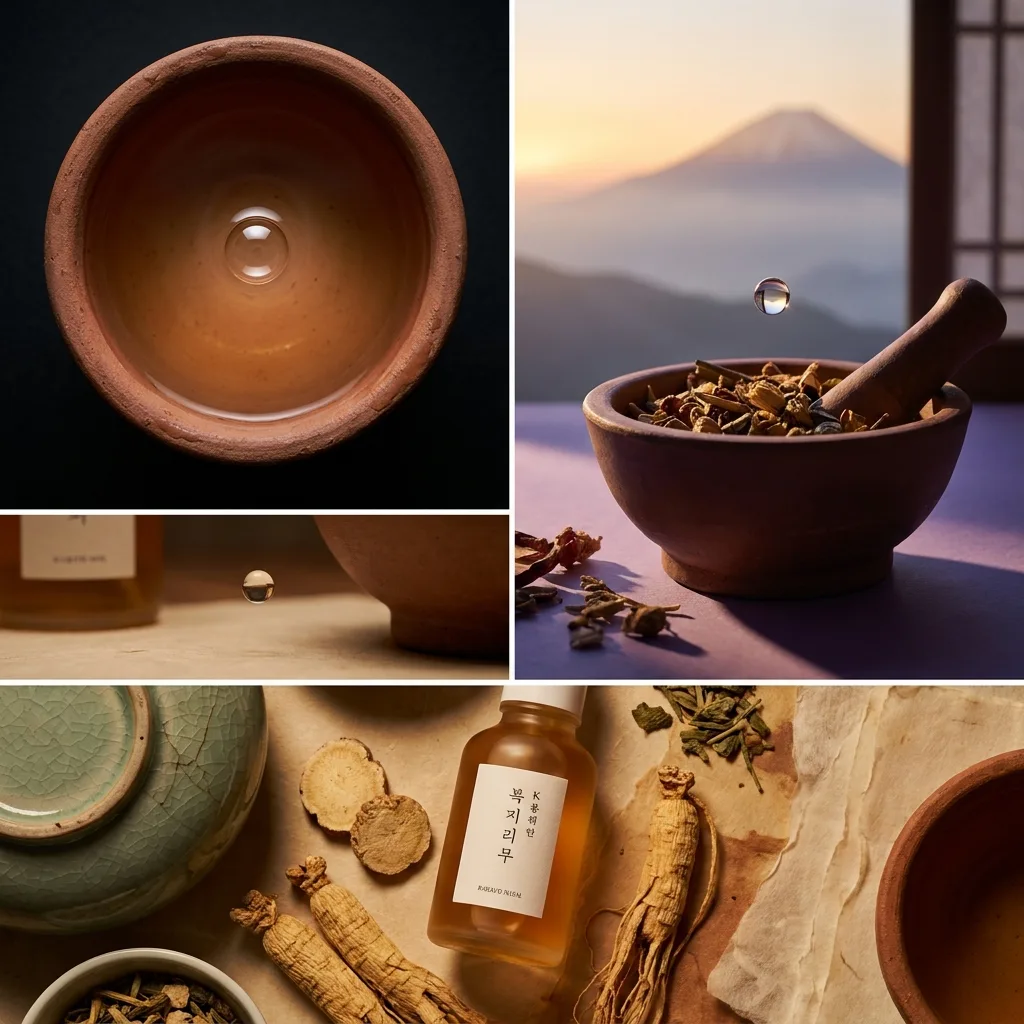
Start with the most discussed ingredient in modern K-Beauty: niacinamide. The fact sheet for this guide is clear on one number — the optimal topical concentration sits between 4% and 8%, with irritation risk climbing significantly above 15%. But niacinamide's role doesn't end at the skin's surface.
As a precursor to NAD+ (nicotinamide adenine dinucleotide), niacinamide taken orally participates in cellular energy metabolism and DNA repair — the same mechanisms that slow with age and contribute to the visible decline in skin luminosity that no amount of topical brightening serum can fully reverse. Korean dermatologists who work with photodamage and post-procedure recovery increasingly reference niacinamide supplementation as a systemic complement to topical application.
The dosage landscape for topical niacinamide, visualized:
Beyond niacinamide, the supplement picture Korean dermatologists paint includes three core pillars:
| Ingredient | Mechanism | Clinically Studied Dose Range | Typical Onset |
|---|---|---|---|
| Hydrolyzed Collagen Peptides | Stimulates fibroblasts; increases skin elasticity and hydration | 2.5–10g daily | 8–12 weeks |
| Niacinamide (oral B3) | NAD+ precursor; supports DNA repair, melanin regulation | 500–1,000mg daily | 4–8 weeks |
| Oral Ceramides (rice/konjac) | Replenishes stratum corneum lipid matrix; reduces TEWL | 30–100mg daily | 6–8 weeks |
| Fermented Lactobacillus | Gut-skin axis; modulates inflammatory response | 1–10 billion CFU | 4–12 weeks |
| Vitamin C | Collagen synthesis cofactor; antioxidant defense | 500–1,000mg daily | 4–8 weeks |
One honest note the supplement industry rarely volunteers: for fermented probiotic strains specifically, the marketing claims currently outpace the peer-reviewed clinical data for skin outcomes specifically. The gut-skin axis is real — the research is promising — but the specificity of "this strain fixes your skin barrier" is not yet where brands are positioning it. Korean ko-deok (코덕) — the self-appointed quality gatekeepers of K-Beauty who treat ingredient labels with the same scrutiny as scientific abstracts — have noted this gap loudly in community forums. They're right to.
[K-Beauty 101] 코덕 (Ko-deok) — Korean beauty obsessive. These are the consumers who memorize ingredient lists, buy new products the week they launch, and whose collective verdict on a supplement can make or break its Korean market position. When ko-deok consensus converges on a supplement being worthwhile, it's worth paying attention.
The Way Koreans Actually Take These (And Why Timing Matters More Than Brand)
The Korean approach to supplement timing follows the same diagnostic logic as skincare layering: sequence and purpose first, brand second. Korean dermatology clinics typically segment supplement use into three goal-based protocols, not "morning" and "evening" as the Western wellness world frames it.
For general glass skin maintenance: Collagen peptides are taken in the morning, dissolved in warm water before coffee, on an empty stomach when gastric acid is lowest. Vitamin C follows within 30 minutes — taken with food — because the collagen synthesis pathway requires ascorbic acid as a cofactor and absorption improves with a fat-containing meal. Oral ceramides are typically taken with the largest meal of the day.
For post-procedure recovery (after lasers, peels, or microneedling — common in Korean skincare culture): niacinamide supplementation is often added to support the cellular repair cascade, alongside a short course of higher-dose Vitamin C. The Korean clinic standard here is notably more aggressive than a typical Western wellness protocol.
For seasonal sensitivity (especially the yellow dust season that blankets Korea in spring): fermented probiotic supplements are added to buffer the inflammatory response that shows up on sensitive skin as redness and texture.
What insiders discover quickly: the 30-second rule from topical layering has an oral equivalent. Collagen peptides taken immediately after a high-tannin coffee or tea show reduced absorption — the tannins bind to peptide chains before digestion. Korean supplement users tend to know this. Most global buyers don't.
Making Korean Inner Beauty Accessible to the Rest of the World
The Olive Young ecosystem and Korean pharmacy culture make supplement access straightforward domestically — but for the global reader, sourcing authentic products with verified purity standards is where things get complicated.
iHerb has become the platform most trusted by global K-Beauty enthusiasts for supplement sourcing, specifically because it sources directly and carries purity-tested products at price points that undercut local retail in most markets. For supplements — where counterfeit risk is a genuine concern, particularly for collagen peptides — direct sourcing matters more than it does for cosmetics.
🌱 ENTRY STACK
Collagen Peptides + Vitamin C
Best starting point. Collagen synthesis pathway requires both — taking one without the other is half the equation.
✓ OPTIMAL DAILY
+ Niacinamide B3 + Oral Ceramides
The full barrier-building stack. Ceramides address TEWL directly; niacinamide works at the cellular energy level.
🔬 CLINICAL FOCUS
+ Fermented Lactobacillus
Add when barrier reactivity is the core issue. Gut-skin axis support — promising research, consult a physician on specific strains.
Use code QAK3042 at iHerb for a discount on your first order. It's a small thing, but for a supplement stack you'll be running for eight to twelve weeks minimum, the savings add up.
What Your Korean Dermatologist Would Tell You Before You Start
Korean dermatology is rigorous about one thing that Western supplement culture glosses over: not every intervention is appropriate for every person, and the wrong combination can cost you more than the right one saves you.
Who should consult a physician before beginning any skin supplement stack:
Anyone taking blood-thinning medications should know that high-dose Vitamin C can interact with anticoagulant therapy. Niacinamide supplementation at higher doses can affect blood sugar levels — relevant for anyone managing diabetes or insulin sensitivity. High-dose collagen supplementation is generally not recommended during pregnancy or breastfeeding without direct medical guidance.
The most commonly overlooked factor in supplement timing: consistency over duration. Korean clinical protocols for skin supplements typically run for a minimum of eight weeks before any visible assessment — because the stratum corneum regenerates on a roughly 28-day cycle, and meaningful structural change requires at least two of those cycles to show. Global buyers who try a collagen supplement for ten days and declare it ineffective are not testing the supplement. They're testing their patience.
Glass skin was never sold in a bottle. It was always a byproduct of a body that has what it needs — built from the inside, visible on the outside. The bottles are there to support the process. But the process starts somewhere the camera can't reach.
⚠️ Medical & Financial Disclaimer: The information in this article is for educational purposes only and does not constitute medical advice, diagnosis, or treatment. Supplement protocols — including collagen peptides, niacinamide, oral ceramides, and probiotic strains — should be discussed with a qualified physician or board-certified dermatologist before use, particularly if you have pre-existing medical conditions, take prescription medications, or are pregnant or nursing. Individual skin and metabolic responses vary significantly. Product availability, pricing, and formulations are subject to change; verify current specifications directly with retailers before purchasing.
This article may contain affiliate links — if you buy through them, we may earn a small commission at no extra cost to you.
✓ Researched and compiled using verified data as of the publication date.
 Written by Jun Mi Jung for Quiet Korea | Contact: rsl.2001.1975@gmail.com
Comments
Post a Comment