The Botox Paradox: Why Your Quest for Perfection Might Be Sabotaging Your Face

Walk into any high-end clinic in Gangnam, and you will notice a recurring rhythm: the frantic pace of the waiting room, the click-clack of heels on marble, and the hushed discussions about "units." But behind the glossy marketing of "no-downtime" aesthetic fixes, there is a biological reality that most clinics won't mention until you’ve already signed the contract for a discounted package.
🎵 K-Mono Lofi — Seoul Study Beats
Read deeper with Seoul lo-fi in the background — curated by K-Mono Lofi
Why do some patients, after years of consistent treatment, find that their favorite procedures simply stop working? The answer isn't in the brand of the toxin or the skill of the injector alone; it is buried in the immunological cost of our obsession with efficiency.
Key Takeaways * Resistance is a rare, permanent immune response triggered by high-frequency, high-dose exposure, not a common side effect. * "Factory-style" clinics incentivize over-treatment; board-certified specialists prioritize anatomical precision over unit counts. * The goal of aesthetic medicine should be "problem-oriented" maintenance, not "unit-chasing," to preserve long-term facial dynamics.
The Biological Reality of Resistance
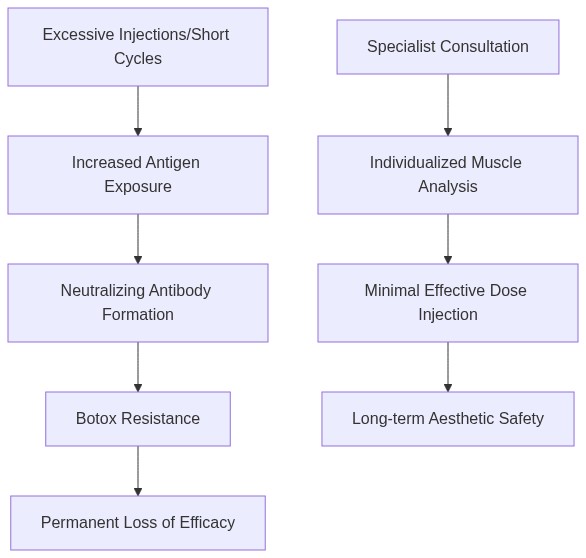
Botulinum toxin is, by its very nature, a neurotoxin. When we introduce it into our bodies, our immune system—the same system that fights off viruses and bacteria—identifies the protein complex as a foreign invader. In most cases, this is manageable. However, when the body encounters this toxin repeatedly at frequencies that do not allow for complete biological recovery, it begins to produce neutralizing antibodies.
Think of these antibodies as a biological "lock." Once formed, they effectively bar the toxin from binding to your nerve endings, rendering your treatment useless. It is a common misconception that a single failed session equals resistance. In clinical reality, true resistance is a rare immunological response that often requires years of high-frequency exposure to manifest. If your treatment feels like it’s "fading," the issue is more likely a deviation in muscle tension or a change in your own anatomy, rather than a permanent loss of efficacy.
The Danger of "Discount-Driven" Cycles
We live in an era of "aesthetic inflation," where the market is flooded with budget-friendly offers for quick injections. This creates a dangerous feedback loop. Patients, driven by the desire to maintain a "perfect" look for as little as possible, often fall into the trap of "clinic hopping" to find the lowest price per unit.
[K-Beauty 101] 공장형 피부과 (Gongjang-hyeong Pibugwa) — Literally "factory-style dermatology clinic." These high-volume clinics prioritize speed and low prices, often using aggressive sales tactics to pressure patients into signing up for multi-session packages. While they offer accessibility, they often lack the individualized anatomical assessment required for safe, long-term maintenance.
When you shop by price, you inadvertently shop for volume. You stop being a patient in a medical plan and become a consumer of units. An experienced 전문의 (Jeonmun-ui)—a board-certified specialist—does not simply inject a site; they map your muscle movement to determine the absolute minimum dose needed. Conversely, in a factory-style environment, the goal is often to maximize the "package" value, leading to cumulative loads of complex proteins that act as triggers for your immune system.
The Shift Toward Precision
The transition from "consumer" to "participant" is the most critical shift you can make for your skin's future. Stop asking for "50 units of X." Start by articulating your functional concerns to your doctor.
"I notice this specific crease when I laugh," or "I want to minimize this tension in my forehead," are the statements that allow a specialist to practice the principle of precision over quantity. By utilizing the lowest effective dose, you preserve the natural dynamics of your facial expressions and drastically reduce the risk of triggering an immune reaction.
The Role of the Consultation Manager
In Seoul, you will inevitably encounter the 상담실장 (Sangdam-siljang). They are the gatekeepers of the clinic, and their role is fundamentally a sales-driven one. Because their compensation is often tied to the "packages" they sell, their recommendations may prioritize the clinic's revenue cycle over your medical needs.
Never feel obligated to purchase a 10-session package on your first visit. A clinic that is confident in its efficacy will be more than happy to treat you on a per-session basis, allowing you to gauge how your body reacts to the treatment before committing to a long-term plan.
Frequently Asked Questions
How long should I wait between Botox treatments? Clinical consensus recommends a minimum interval of 3 to 6 months. This allows your immune system and muscle groups the necessary time to recover, significantly lowering the risk of developing neutralizing antibodies.
Can I switch brands if I suspect I’m becoming resistant? Switching brands is sometimes suggested if resistance is suspected, but it is not a "cure-all." If you have developed antibodies to the core toxin complex, changing the brand may not resolve the issue. Always consult a board-certified specialist to evaluate your muscle response before making any changes.
Why does my face look "stiff" after a treatment? Stiffness is usually the result of over-dosing or poor placement. It happens when the toxin spreads to adjacent muscle groups. This is exactly why choosing a specialist who understands your unique anatomy—rather than one who follows a standard "factory" injection map—is essential.
⚠️ Disclaimer: This information is for educational purposes and does not constitute medical advice. Botox and other aesthetic procedures carry inherent risks, including vascular occlusion and immune response. Always consult with a board-certified dermatologist before undergoing any procedure. If you have concerns about resistance or adverse reactions, seek an evaluation from a specialist rather than continuing treatment at a low-cost facility.
⚠️ Disclaimer: This article is for informational and educational purposes only and does not constitute medical, dermatological, or financial advice. Individual results vary — consult a board-certified dermatologist or physician before starting any new skincare routine, supplement, or procedure, especially if pregnant, nursing, or taking other medications. This article may contain affiliate links — if you buy through them, we may earn a small commission at no extra cost to you.
✓ Researched and compiled using verified data as of the publication date.
 Written by Jun Mi Jung for Quiet Korea | Contact: rsl.2001.1975@gmail.com
Comments
Post a Comment