The Beauty Trap: How to Navigate South Korea’s "Factory" Dermatology Clinics

The allure of South Korean aesthetics is undeniable. You see it in the glass-like texture of a Seoul local’s skin and the near-instant transformation offered by the latest energy devices. But for the global visitor or the resident newcomer, there is a hidden, cold-blooded engine behind the glamour: the Gongjang-hyeong Pibugwa, or "factory-style" clinic.
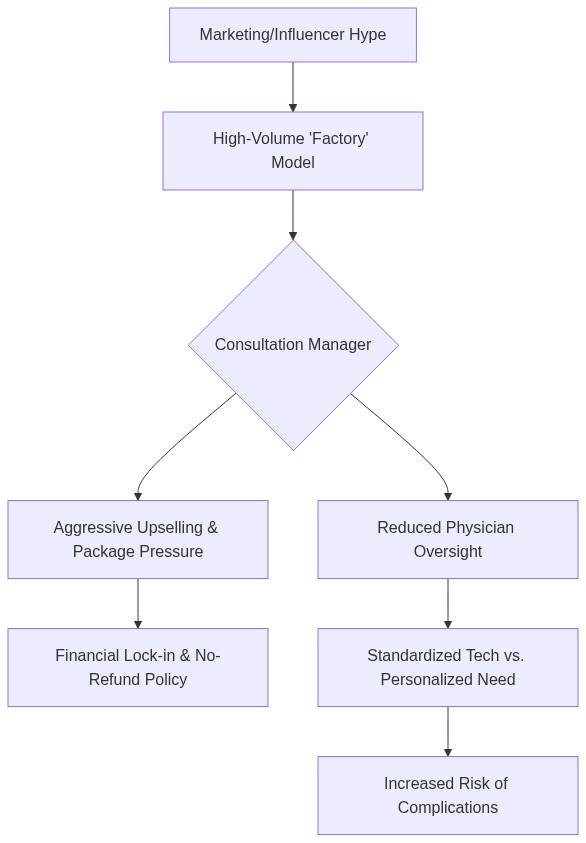
This model treats your face as a line item on a spreadsheet, relying on high-volume, standardized protocols that prioritize efficiency over individual assessment. If you’ve ever walked into a consultation room, felt the immediate pressure to upgrade to a ten-session "package," and wondered if you were speaking to a medical professional or a stockbroker, you are not imagining it. You are encountering the reality of a system built for revenue, not just results.
Key Takeaways * Identify the Sales Logic: Factory-style clinics utilize non-medical "consultation managers" who are incentivized by sales commissions, not clinical ethics. * Assert Your Boundaries: Never commit to a multi-session "package" on your first visit. Insist on a single-session trial to verify the practitioner's skill and the clinic's true protocol. * Demand Physician Oversight: True medical care begins where the sales pitch ends—insist that the actual procedure is planned and performed by a board-certified dermatologist, not just a junior GP.
The Architecture of the "Package" Trap

In a factory-style clinic, the patient journey is engineered to minimize human friction and maximize financial conversion. The central figure here is the Sangdam-siljang (consultation manager).
It is vital to understand that this person is rarely a medical professional. Their role is to identify your insecurities, amplify them, and offer a "package" of treatments as the solution. They are the architects of Seon-nap (pre-payment) culture—a practice designed to lock you into a rigid, non-refundable contract. When you sign for ten sessions of Laser Toning, you aren't just buying care; you are buying a hostage situation. If the clinic’s technique is subpar or you encounter irritation, your money is already committed.
The Clinical Cost of Speed
The high-volume nature of these clinics isn't just a nuisance; it has clinical consequences. Procedures like Skin-Botox (micro-injections of toxin for pore tightening) or Juvelook (collagen-regenerating boosters) require precision.
When a clinic operates on a "factory" timer, the risk of complications—such as uneven distribution of product or secondary infections—rises. While serious adverse events like vascular occlusion from fillers remain statistically low, the "silent" complications—asymmetry, brow ptosis, or persistent post-procedure redness—are significantly more common in high-volume settings where practitioners are rushed.
Mastering the Defensive Consultation
You do not need to be a dermatologist to protect yourself. You simply need to change the language of the room.
- The "Single-Session" Demand: When presented with a package, say: "I would like to pay for one session today to see how my skin reacts before considering a multi-session commitment." If they refuse, you have your answer about their priorities.
- Verify the Signage: In Korea, look for the term Pibugwa-uiwon (Dermatology Clinic). It indicates the owner is a board-certified dermatologist, a title that requires significantly more rigorous training than a general practitioner.
- Ask for the "Why," Not the "What": Instead of asking "What package is best?", ask "What is the clinical necessity of this specific laser for my skin barrier state?" If they cannot explain the mechanism, they are selling, not healing.
Understanding the True Risks
It is important to remember that every aesthetic procedure carries a risk profile. Whether you are dealing with subuji (oily but dehydrated) skin or considering deep-tissue lifting, the goal is to balance the bu-jagyong (side effects) against the benefits.
| Procedure | Clinical Risk Factor | Typical Downtime |
|---|---|---|
| Skin Botox | Asymmetry / Bruising | 1–3 days |
| Filler Injections | Vascular Compression | 3–7 days |
| Laser Toning | PIH (Pigmentation) | 1–2 days |
| Juvelook | Papules / Nodules | 2–5 days |
The Path Forward
The Korean dermatology industry is, at its best, the most advanced in the world. It provides access to technology and research that is years ahead of global competitors. But the benefits of these advancements are reserved for those who refuse to be treated as a product on a conveyor belt.
By demanding direct interaction with your physician and prioritizing single-session efficacy over multi-session discounts, you reclaim the power in the doctor-patient relationship. You are there for your skin, not to subsidize a clinic's marketing budget.
🎵 K-Mono Lofi — Seoul Study Beats
Read deeper with Seoul lo-fi in the background — curated by K-Mono Lofi
⚠️ Disclaimer: Aesthetic procedures carry inherent medical risks. This information is for educational purposes and does not constitute medical advice. Always consult with a board-certified dermatologist regarding your specific skin health, potential drug interactions, and the safety of injectable treatments. Do not proceed with any procedure if you feel pressured by non-medical staff.
✓ Researched and compiled using verified data as of the publication date.
 Written by Jun Mi Jung for Quiet Korea | Contact: rsl.2001.1975@gmail.com
Comments
Post a Comment