K-Beauty Hidden Healing Spots
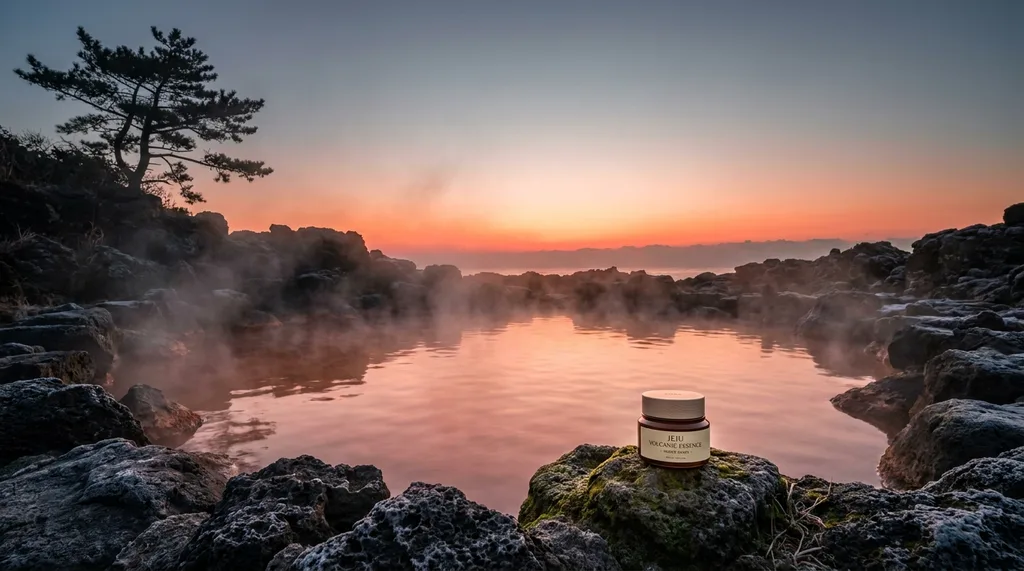
Korean women in their 60s have a skin quality that doesn't compute. You've seen it — the unmarked foreheads, the particular quality of light in the cheeks, the absence of that collapsed, papery thinness that comes with decades of city living everywhere else in the world. The products can't fully account for it. The 10-step routine doesn't close the gap. And if you ask them directly, the answer is rarely a serum.
- The Skin That Products Didn't Build
- What the Water Is Actually Doing to Your Skin
- The Honest Limits — Who Should Think Twice
- The Real Places: A Geography of Healing
- Jeju Island — Sanbangsan Carbonate Hot Spring
- Cheoksan Hot Springs — Gangwon-do
- Gurye Cypress Forest — Jirisan
- Noji and the Radical Act of Stopping
- The Logistics: Getting There Without Getting Lost
- Find Your Healing Stay Near Korea
- The Thing Skincare Cannot Ship You
It is, almost always, a place.
Somewhere in the mountains of Gangwon-do, or on the southern edge of Jeju where volcanic rock meets open sky, there is a category of Korean wellness that the global K-Beauty content machine has almost entirely ignored — because it is difficult to sell, difficult to ship, and impossible to photograph neatly for an Olive Young haul. It is water. Specific, minerally complex, geothermally alive water. And what it does to human skin has now been documented in peer-reviewed biology.
This is the K-Beauty your algorithm never found.
The Skin That Products Didn't Build
The global K-Beauty industry is enormous — somewhere between $8.3 and $9.3 billion in 2024, and projected to keep climbing. Every year, new actives emerge, new routines are evangelized, new toners are layered. The international audience has consumed all of it hungrily.
But in Korea, a counter-movement has been quietly operating for generations.
It does not have a global Instagram presence. It does not require a shipping address. It is not influenced by trends. It is the simple, ancient practice of leaving the city, finding water that the earth has been mineralizing for millennia, and getting into it.
Locals call a place with exceptional spring water mul joeun got — literally, "a place where the water is good." Not good as in clean. Good as in transformative — the kind of water that leaves your skin feeling like you've been moisturized from inside the dermis, so smooth that locals will tell you the lotion step feels redundant when you get out.
[K-Beauty 101] Mul Joeun Got (물 좋은 곳) — "A place with exceptional water." Used by locals to describe hot springs or bathhouses where the mineral content is so high that skin feels like it has been conditioned rather than merely washed — the highest praise in Korean wellness culture.
This is the vernacular of a healing tradition that predates every serum on the shelf.
🎵 K-Mono Lofi — Seoul Study Beats
Read deeper with Seoul lo-fi in the background — curated by K-Mono Lofi
What the Water Is Actually Doing to Your Skin
Here is where the tradition earns its science.
Not all hot springs are created equal. The category that Korean skin-aware travelers seek out specifically is the tansan oncheon — the carbonated hot spring. These are natural springs where carbonate ions are dissolved in thermal water, and they behave fundamentally differently from ordinary hot water.
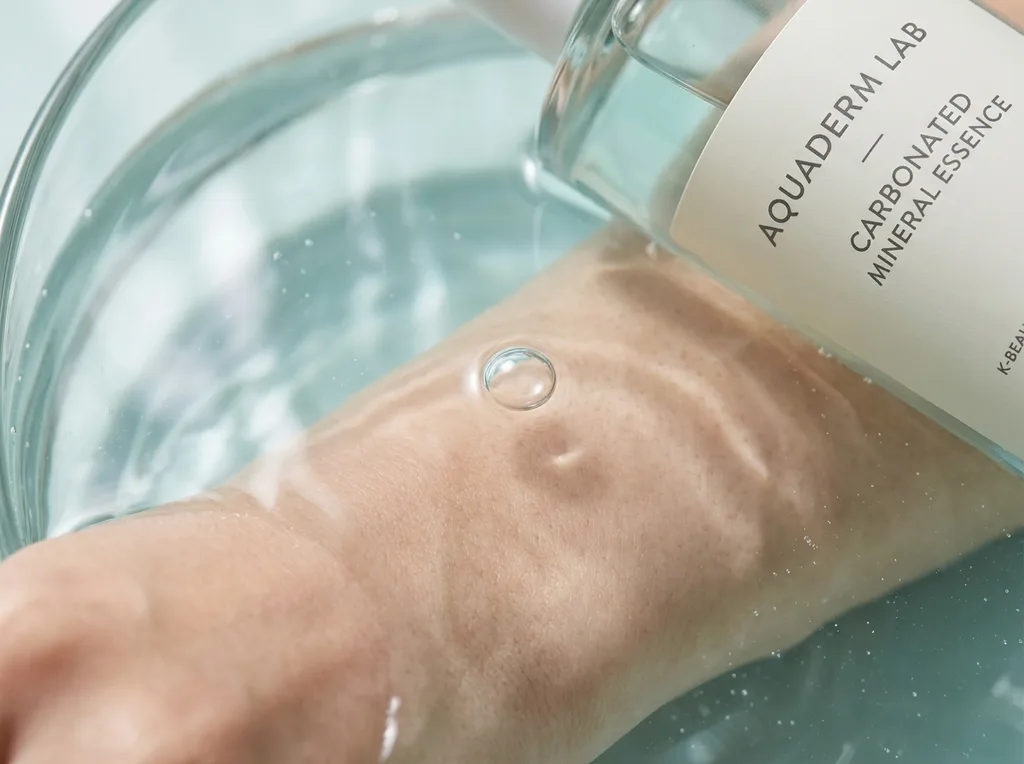
[K-Beauty 101] Tansan Oncheon (탄산온천) — A natural carbonated hot spring, rich in dissolved carbonic acid. The fine CO₂ bubbles that form on the skin during immersion are not cosmetic — they are the delivery mechanism for a cascade of biological processes that begin within minutes of contact.
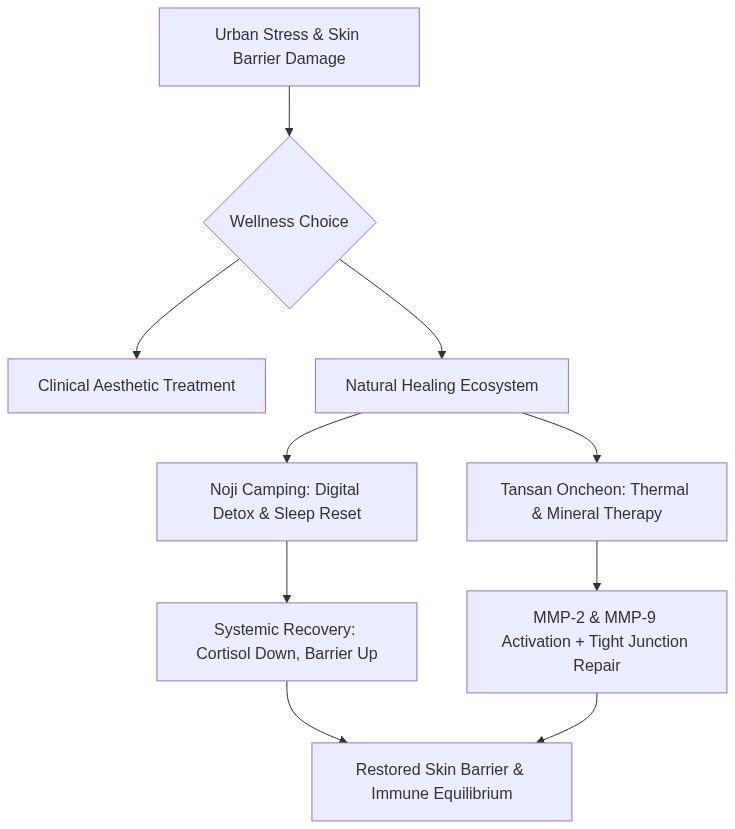
When skin is immersed in water at approximately 42°C — the temperature found in many Korean therapeutic springs — something documented and measurable happens at the molecular level. The expression of matrix metalloproteinases MMP-2 and MMP-9 increases. These enzymes are not incidental: they are the biological machinery responsible for tissue remodeling. They degrade damaged extracellular matrix and clear the path for new collagen to be laid down. They are, in essence, your skin's built-in renovation crew — and carbonated thermal water is one of the things that wakes them up.
But there is more. Mineral compounds present in these springs — including potassium alum in specific spring compositions — have been shown to promote the formation of tight junctions between epidermal keratinocytes. Tight junctions are the molecular seals between skin cells that keep the barrier intact. When your skin is red, reactive, easily sensitized, or slow to recover, compromised tight junctions are frequently part of the story. Carbonated mineral water begins reinforcing them from the outside in, in ways that topical ceramide formulas simply cannot replicate — because the mechanism is thermal and mineral, not cosmetic.
Histological studies show the process also reduces inflammatory cell infiltration in skin tissue while simultaneously increasing vessel density in granulation tissue. More blood flow, less inflammation, structural remodeling. For 20 minutes of soaking.
The Honest Limits — Who Should Think Twice
Before you book a flight to Jeju to soak in a tansan oncheon as a cure for everything: the science is real, but it is specific.
Carbonate springs have documented benefits for wound healing and barrier reinforcement. What they are not is a dermatological treatment for conditions like severe rosacea, active eczema flares, or open acne lesions. Thermal water at 42°C applied to an already-inflamed skin condition can worsen it. If your skin is reactive or currently in a flare, consult a dermatologist before soaking — this applies especially to those with rosacea triggers, since the vasodilatory effect of heat is real and can provoke flushing episodes.
Similarly, ssuk jjimjil — mugwort steam therapy, a beloved Korean traditional treatment — supports blood circulation and has a long cultural record of use for relaxation and general wellness. But claims that it directly repairs the skin barrier at a structural level are not well-supported by clinical data. Go for the ritual, the warmth, and the stress relief. Don't expect it to do what a dermatologist would need to.
The Real Places: A Geography of Healing
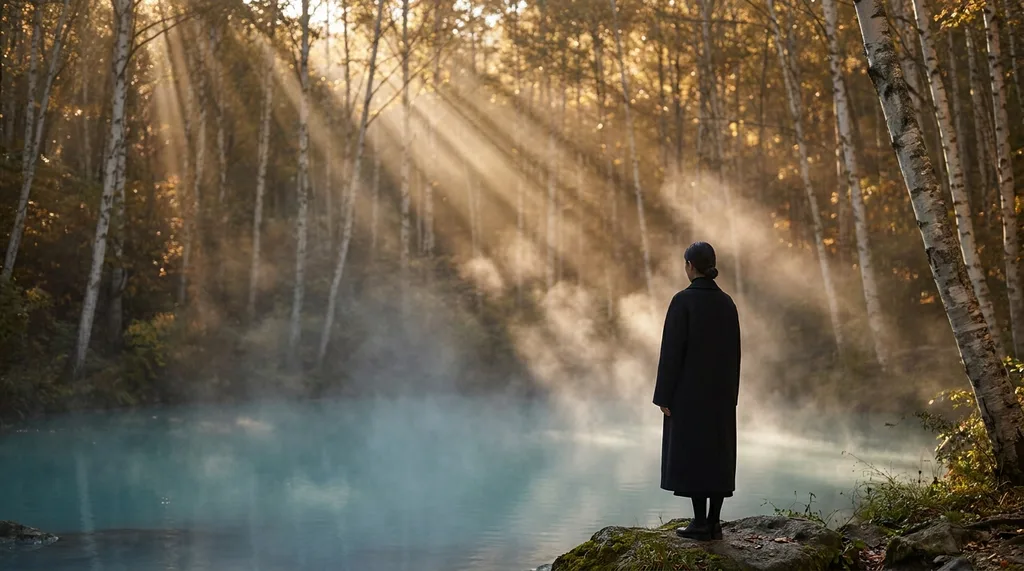
Most K-Beauty content talks about Seoul. The honest healing map of Korea extends far beyond it.
Jeju Island — Sanbangsan Carbonate Hot Spring
On the southern coast of Jeju, near the dramatic volcanic peak of Sanbangsan, you'll find one of Korea's most cited natural therapeutic spots: the Sanbangsan Carbonate Hot Spring. The geological conditions here — Jeju's volcanic basalt rock acting as a natural mineral filter — produce water with a carbonation profile that regulars swear by. The outdoor baths with views toward the mountain have a quality that photos cannot capture: the sensation of fine CO₂ bubbles forming against your skin like a living effervescence, working while you float.
This is not a luxury resort experience. It is a working bathhouse culture — locals in their 70s, families, weekenders. The water is the thing.
Getting to this specific area of Jeju requires either renting a car (highly recommended for flexibility) or taking a bus from Jeju City to Hwasun or Andeok, followed by a local taxi. The area around Sanbangsan has accommodation options bookable through Agoda — searching for guesthouses and pensions in the Andeok-myeon area of Seogwipo will get you close. A pension (small Korean guesthouse) within 15 minutes of the hot spring lets you soak in the evening and morning without the tourist rush.
Cheoksan Hot Springs — Gangwon-do
Up in the mountains of Gangwon-do Province, Cheoksan is one of those mul joeun got places that Korean families have been returning to for generations. The water here is sodium bicarbonate-alkaline hot spring water, and the experience is very different from Jeju's carbonate springs — softer, silkier, with a quality that leaves skin almost powder-smooth. It is the kind of spring where Korean grandmothers show up with nothing but a small bag and emerge two hours later looking ten years rested.
Gangwon-do is accessible from Seoul in roughly 2–3 hours by bus or intercity express. The Cheoksan area (near Goseong) has traditional Korean motel-style accommodation and proper jjimjilbang facilities attached to the springs. For foreigners, Klook sometimes lists packaged day trips from Seoul to Gangwon-do hot spring destinations — worth checking if you'd prefer a guided route over navigating local bus schedules.
Gurye Cypress Forest — Jirisan
This is not a hot spring. It is a different category of healing entirely.
The cypress forests in Gurye, near Jirisan National Park in South Jeolla Province, are among the most frequently cited forest bathing destinations in Korean wellness culture. The specific concentration of phytoncides — volatile organic compounds released by cypress trees — in this area has been measured and studied in the context of immune function and cortisol regulation. Korean wellness retreats bring post-burnout patients here specifically. Walking the forested trails slowly, with no agenda, is the therapy.
Getting there involves a bus to Gurye from Seoul's Nambu Terminal or from Gwangju, then local transport into the park area. It is not straightforward. That's partly the point.
Noji and the Radical Act of Stopping
There is a word for what many Korean skin-aware travelers are now doing on weekends that is not quite camping in any Western sense of the word.
Noji (野地) means undeveloped, wild land — the kind of ground where no facility exists, no glamping structure has been erected, no concession stand intrudes. And the camping-byeong — the "camping sickness," the psychologically irresistible pull toward exactly these raw places — has become something dermatologists in Seoul are quietly telling their patients to indulge.
Here is the underlying logic, which is both ancient and increasingly supported by stress physiology: cortisol, the primary stress hormone, is one of the most potent skin barrier disruptors in existence. Chronic elevated cortisol suppresses ceramide production, disrupts the skin's circadian repair cycle, increases transepidermal water loss, and slows wound healing. No topical product addresses this. Adaptogens help at the margins. But the mechanism is systemic — and the most direct intervention is systemic.
Two nights of genuine noji camping — real sleep in darkness and quiet, no screen exposure, thermoregulation handled by natural temperature shifts rather than HVAC — does something to the cortisol curve that eight nights of using a good barrier cream cannot replicate. Korean women who have been practicing this for years are not surprised by the results. Their dermatologists are increasingly not surprised either.
🌿 Natural Healing Ecosystem
Mechanism: MMP-2/9 tissue remodeling, tight junction reinforcement, cortisol reduction, circadian reset
Cost: Entry fee + transport (accessible to most budgets)
Time to effect: Barrier improvement measurable after 2–3 immersions; systemic reset requires 2–3 nights
Best for: Maintenance, stress-damaged skin, barrier strengthening, prevention
💉 Clinical Aesthetic Treatment
Mechanism: Targeted collagen stimulation, filler placement, laser resurfacing, exosome injection
Cost: Significantly higher; ranges from hundreds to thousands per session
Time to effect: Immediate to 4–6 weeks depending on modality
Best for: Specific structural concerns, deep lines, volume loss, accelerated correction
This is not an argument against Gangnam clinics. They do things that springs cannot. But the framing that positions them as opposites is wrong — the smartest Korean wellness approach uses both, sequenced deliberately. The spring prepares the skin's biological environment. The clinic works within it.
The Logistics: Getting There Without Getting Lost
For a foreign traveler, these places are genuinely harder to reach than Myeongdong. That difficulty is not accidental — it is, in a sense, part of the therapy. But it does not need to be prohibitive.
For Jeju (Sanbangsan area): - Fly into Jeju International Airport from Seoul Gimpo (about 1 hour) — multiple daily flights, bookable through Klook for package combinations - Rent a car at the airport (essential for flexibility in southern Jeju) - Drive approximately 40–50 minutes west toward Andeok and Hwasun - Look for accommodation in the Seogwipo rural area via Agoda — searching "Andeok pension" or "Hwasun guesthouse" returns small family-run options within close range of the spring
For Gangwon-do (Cheoksan/Goseong area): - From Seoul Express Bus Terminal, buses run to Sokcho and Goseong areas in Gangwon-do - The Cheoksan Hot Springs zone is accessible by local taxi from Goseong - Klook lists organized Gangwon-do hot spring day trips from Seoul — useful if navigating provincial bus schedules feels daunting - Accommodation ranges from pension to mid-range hotel; Agoda's Goseong or Sokcho search returns well-rated options near the springs
For Gurye (Jirisan cypress forest): - Bus from Seoul Nambu Bus Terminal to Gurye (approx. 3.5–4 hours) - From Gurye, local buses or taxis to the Piagol or Seonghamsanseong trailheads - Best combined with a night or two in the town; Agoda's Gurye search returns traditional guesthouses
The Thing Skincare Cannot Ship You
The K-Beauty that gets exported is the part that fits in a box. The hydration science, the fermented actives, the ceramide complexes — all real, all worth understanding. But Korea's most durable skin wisdom has never been bottled: it is the cultural knowledge of where to go when the skin stops responding to what you put on it.
A jjimjilbang (찜질방) at 2 AM with a handful of regulars quietly sweating in a heated jade room. A volcanic spring on Jeju where the water is so mineral-rich it does not drip off you like water — it lingers. A cypress forest in South Jeolla where the air is measurably dense with compounds that your immune system recognizes, even if your brain does not.
These are not backup options for people who cannot afford serums. They are the original practice. The serums came later, and they came trying to approximate this.
The most radical act for your skin is not finding a better product. It is finding the right water — and staying in it long enough to remember that your skin already knows how to heal itself, if you will simply take it somewhere the healing is possible.
Medical Disclaimer: The mineral and thermal spring information in this article reflects published research on carbonated hot spring water and general thermal therapy mechanisms. It is not medical advice. Those with active inflammatory skin conditions (rosacea, eczema, psoriasis, open acne lesions), cardiovascular concerns, or other medical conditions should consult a board-certified dermatologist or physician before engaging in hot spring bathing, particularly at elevated temperatures (42°C). Thermal spring therapy is a wellness practice, not a treatment for diagnosed medical conditions. Individual responses to mineral water composition vary, and no specific health outcomes are guaranteed by any location named in this article.
⚠️ Disclaimer: The wellness destinations described in this article are based on verified locations and documented mineral science. Carbonate hot spring research cited reflects peer-reviewed findings on wound healing and barrier mechanisms — not general claims about all hot spring types. Always patch-test sensitized skin before extended thermal immersion, and consult a dermatologist if you are managing an active skin condition before planning a healing trip.
This article may contain affiliate links — if you buy through them, we may earn a small commission at no extra cost to you.
✓ Researched and compiled using verified data as of the publication date.
 Written by Jun Mi Jung for Quiet Korea | Contact: rsl.2001.1975@gmail.com
Comments
Post a Comment