Inclusive Beauty
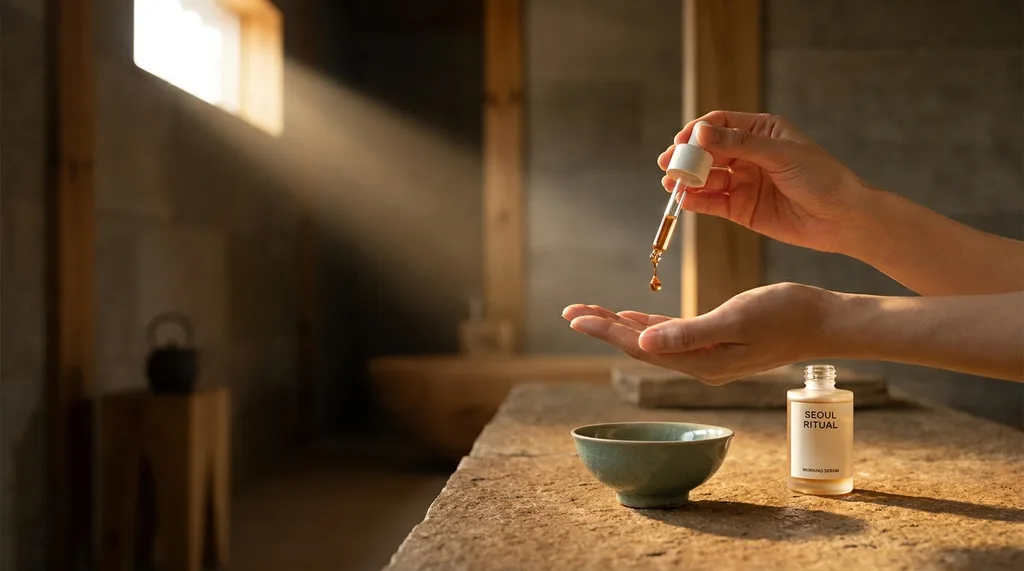
There is a device that sits on the counter of nearly every serious Korean dermatology clinic — a colorimeter. It doesn't ask what "shade" you think you are. It reads the L* value of your skin: a precise numerical score measuring luminosity on a spectrum that runs from absolute black to pure white. Korean researchers used one on 543 women, mapping exactly where Korean skin sits in measurable, objective space. The result was a dataset so precise it could assign a number to the distance between "bright" and "normal" complexions: 66.66 versus 63.87, separated by less than three points on a scale of 100.
- The Skin They Didn't Design For — and Why It Still Works
- The Floating Mask — What K-Beauty Cosmetics Actually Did to Darker Skin
- What Real Progress Looks Like — And Where It Still Falls Short
- Your Calibrated Guide — What to Buy, What to Skip, and What to Demand
- K-Beauty Niacinamide & Barrier Repair Serums
- Frequently Asked Questions
The irony is savage. The same scientific precision that Korean beauty uses to understand skin — objectively, clinically, without relying on category labels — was applied for decades to a population that represents maybe 15% of the world's skin tones. The instrument was perfect. The sample was catastrophically narrow.
Key Takeaways - K-Beauty's skincare science — barrier repair, low-pH cleansing, niacinamide, centella — is largely skin-type agnostic and frequently more relevant to melanin-rich skin than Western dermatology alternatives. - K-Beauty's cosmetics have a documented, specific problem: shade ranges, undertone assumptions, and photographic testing conditions built on a narrow Korean baseline — but select brands like TIRTIR have made real, measurable progress. - The micro-encapsulation technology driving K-Beauty's new shade-adaptive foundations is genuine innovation — with real limitations on deeper tones that the industry acknowledges but hasn't fully solved.
Why did a brand built on three shades of pale beige become the foundation that Black beauty editors started genuinely recommending — not as a consolation prize, but as a technical breakthrough? And why did the answer come from Korean dermatology science before it ever came from Korean marketing? That question runs under this entire article, and it won't resolve until you understand exactly where the science ends and the industry begins.
The Skin They Didn't Design For — and Why It Still Works
Walk into the skincare aisle of an Olive Young in Seoul and you will not find a single product marketed to "deep" or "ebony" skin tones. The language simply isn't there. What you will find, coded in the ingredient lists of those hundreds of serums and essences, is a philosophy of skin rescue that happens to address the concerns of melanin-rich skin with a precision Western dermatology took decades longer to reach.
Here's the mechanism. Melanin-rich skin — skin with a Fitzpatrick type IV through VI — faces a specific cascade of problems that lighter skin simply doesn't encounter at the same frequency or severity. Barrier disruption is one. When the 피부 장벽 (pibu jangbyeok, skin barrier) is compromised, lighter skin gets dryness and redness. Darker skin gets post-inflammatory hyperpigmentation (PIH): the dark marks that outlast the original problem by months. A pimple heals in a week. The spot it leaves can take six months. In melanin-rich skin, an intact barrier isn't a preference — it's protection against a cascade that changes what your face looks like in photographs, job interviews, and mirrors.
Korean skincare has been obsessively building and protecting that barrier since before "barrier repair" became a Western dermatology talking point. Low-pH cleansers that don't strip the acid mantle. Ceramide-rich emulsions that restore lipid structure. Centella Asiatica — Cica — that modulates the inflammatory cascade before it ever gets the chance to leave a mark. This is not coincidence. Korean consumers demanded anti-inflammatory, barrier-reinforcing formulations because their skin type called for it. The needs converged globally before the industry realized it.
[K-Beauty 101] 피부 장벽 (pibu jangbyeok) — Skin barrier. In the context of melanin-rich skin, barrier integrity is not aesthetic preference — it is the mechanism that prevents PIH. Korean skincare's fixation on protecting this barrier, built for entirely different cultural reasons, turns out to be the most relevant framework for preventing the hyperpigmentation cycle that darker skin tones struggle with most.
Then there is 나이아신아마이드 (niacinamide) — vitamin B3, present in a staggering proportion of Korean serums and moisturizers. The clinical data on niacinamide and melanin inhibition runs from 35% to 68% reduction in melanosome transfer, depending on concentration and formulation. Korean brands routinely deliver niacinamide at concentrations between 2% and 10%, in stable, well-buffered formulations supported by complementary ingredients. For melanin-rich skin dealing with chronic hyperpigmentation, uneven tone, or acne marks, this single ingredient — delivered well — is one of the more consequential tools in the toolkit. Korean formulators didn't create it for darker skin. They created it because Korean consumers are intensely concerned about any form of uneven tone. The motivation was different. The result is the same.
🎵 K-Mono Lofi — Seoul Study Beats
Read deeper with Seoul lo-fi in the background — curated by K-Mono Lofi
✅ Where K-Beauty Science Transfers Directly
Low-pH cleansing — preserves the acid mantle and reduces PIH triggers. Ceramide + barrier repair formulas — prevents the cascade from broken barrier to dark mark. Niacinamide at clinical concentrations — 35–68% melanin inhibition, delivered reliably. Centella Asiatica — anti-inflammatory action before post-inflammatory hyperpigmentation can set. Hydration layering for 수부지 (suboji, combination-dehydrated) skin — a skin type Western dermatology frequently misclassifies as "oily" in darker skin tones.
⚠️ Where the Documented Gaps Still Exist
Foundation shade ranges — historically 3–5 shades, mostly light-to-medium. Undertone assumptions — formulations default to pink or yellow undertones that read as gray on deeper skin. Photographic testing — shades are validated under studio lighting conditions on East Asian skin, causing oxidation and cast problems on deeper tones. "Brightening" language — products marketed under this label sometimes contain ingredients that can cause uneven results on melanin-rich skin if used without context.
The 수부지 (suboji) diagnostic framework is worth pausing on. Korean beauty culture developed this concept — combination-dehydrated skin, oily on the surface but parched underneath — because Korean consumers needed it. And it turns out to describe the experience of many melanin-rich skin owners with uncanny accuracy. Western dermatology often reads the surface oil as "oily skin" and prescribes stripping routines — drying cleansers, alcohol-heavy toners — that obliterate the barrier and trigger the exact PIH cycle described above. Korean skincare's diagnostic precision and barrier-first philosophy is not just culturally compatible with melanin-rich skin. For many people, it's more accurate than anything their Western dermatologist prescribed.
This is where you have to resist the easy conclusion. "K-Beauty works for everyone" is just as misleading as "K-Beauty ignores people of color." The science transfers. The cosmetics are a different problem entirely.
The Floating Mask — What K-Beauty Cosmetics Actually Did to Darker Skin
There is a Korean phrase that beauty insiders use to describe the worst possible foundation outcome: 둥둥 떠 보이는 (dung-dung tteo boineun) — floating, detached, like your face has become a separate object hovering in front of your skull. Korean consumers dread it. For people with deeper skin tones, this wasn't a fear. It was the routine result.
Here's exactly what happened. Korean foundation development was built on a colorimetric dataset that mapped Korean skin — L* values clustering between 60 and 67, occupying the lighter-medium range of the global spectrum. Shade ranges were designed within that range: three to five options, all pale to medium, all tested under studio lighting on East Asian skin. When the same formulations were applied to melanin-rich skin, two things went wrong simultaneously. First, there was no shade anywhere near the correct depth. Second, the formulas oxidized — reacting with deeper skin's surface pH and chemistry to turn ashy, gray, or chalky within an hour. The product wasn't just the wrong color. It was chemically incompatible.
The cosmetics failure wasn't malicious. It was structural. The Korean beauty industry developed its color products for the market it understood — a domestic one with a narrow measured range — and then exported those products globally without the testing infrastructure to validate them on a broader spectrum. The shades weren't limited because Korean brands wanted to exclude anyone. They were limited because the labs, the developers, and the testing models were all drawn from the same narrow pool.
That structural problem is now being dismantled by market pressure from the United States — K-Beauty's largest export destination at $1.86 billion in 2025 — combined with genuine technological development inside Korean labs. The brands that are moving are not moving out of altruism. They're moving because the math demands it.
What Real Progress Looks Like — And Where It Still Falls Short
TIRTIR's Mask Fit foundation is the most cited case of documented K-Beauty shade expansion, and for good reason. What began as a handful of shades grew — through the flexibility of Korea's OEM/ODM manufacturing ecosystem — to 40 or more options covering a meaningful range of depths and undertones. That's not a marketing claim. It's a production achievement. The Korean contract manufacturing infrastructure is uniquely agile: it can reformulate and scale a new shade in a fraction of the time Western conglomerates require, because the entire supply chain — raw materials, pigment blending, filling, testing — is compressed into tight geographic clusters in and around Seoul and Gyeonggi province.

The micro-encapsulation technology deserves specific attention because it represents the most technically interesting development — and the most important caveat. Korean labs have developed polymer-shelled pigment capsules that rupture under friction as you blend a foundation, releasing color that adjusts to the skin's surface pH. The theory is elegant: rather than requiring an exact shade match from the bottle, the formula adapts to the wearer. In practice, this works well within the light-to-medium range. On deeper skin tones, the pH-responsive chemistry produces, in some formulations, a slightly grayish cast — the precise problem it was designed to solve, appearing in modified form. Research is ongoing. The technology is not mature enough to serve deep tones reliably. Any brand claiming their color-changing formula works across the full Fitzpatrick spectrum deserves skepticism until they publish controlled photographic testing across VI tones in real light conditions.
The ingredient science behind undertone mismatch — why "warm" and "cool" classifications still fail on deeper skin →
The progress that deserves acknowledgment is real. The global inclusive beauty market — valued at $75.2 billion in 2025 and projected to reach $159.8 billion by 2034 — is not a trend K-Beauty can ignore while holding a $1.86 billion American export position. The economic pressure and the technological capability are converging. The gap between where the industry is and where it needs to be is closing, but it is not closed, and readers with deeper skin tones deserve to know exactly where to spend and where to be cautious.
Your Calibrated Guide — What to Buy, What to Skip, and What to Demand
The strategy that serves melanin-rich skin in K-Beauty is not a blanket endorsement or a blanket rejection. It's a room-by-room audit.
In the skincare aisles, the science is on your side. Low-pH cleansers at pH 4.5 to 5.5 — any formula that protects your acid mantle rather than stripping it — are worth adopting regardless of brand. Niacinamide serums at 5% to 10% from Korean brands represent some of the most reliable hyperpigmentation interventions available at any price point. Centella Asiatica formulations — cica gels, recovery creams — are your post-procedure, post-pimple, barrier-in-crisis tools. Ceramide moisturizers from Korean labs are consistently well-formulated and affordable. In these categories, the Korean skin-first philosophy and melanin-rich skin's specific needs align almost perfectly.
[K-Beauty 101] 나이아신아마이드 (niacinamide) — Vitamin B3, and one of K-Beauty's most clinically significant actives. Niacinamide reduces melanosome transfer between melanocytes and keratinocytes by 35–68% at therapeutic concentrations. For melanin-rich skin dealing with chronic PIH, it is not a nice-to-have. It is the ingredient bridge between K-Beauty's heritage formulations and the specific concerns of darker skin — and Korean brands deliver it reliably, at appropriate concentrations, at prices that Western alternatives cannot touch.
In the cosmetics aisles, apply a different filter. For brands that have documented, photographically verified shade expansion — the evidence is in the community reviews, specifically on Hwahae and global Reddit communities where users with Fitzpatrick IV–VI skin post full-light photographs — the progress is worth engaging. Look for: shade count above 30 with genuine deep-tone coverage (not 30 shades of which 25 are light-to-medium); independent community photography in natural light, not studio marketing shots; specific undertone labeling (not just numbers, but cool/warm/neutral designations within each depth range).
For everything labeled "brightening" or "tone-up," read the ingredient list before applying. Arbutin and niacinamide in a tone-up cream: calibrated and controllable. Unspecified "skin brightening complex" at unknown concentrations: require more information before committing. The 착붙 (chak-but) moment — when a product fits so seamlessly it feels like a second skin — is absolutely achievable in K-Beauty for melanin-rich skin. It just requires knowing which room of the store you're in.
Frequently Asked Questions
Can K-Beauty skincare cause hyperpigmentation on deeper skin tones? Most K-Beauty skincare is designed to reduce hyperpigmentation through niacinamide, centella, and barrier repair — these work on melanin-rich skin effectively. The risk comes from two specific areas: over-exfoliation (AHA/BHA products used too frequently can disrupt the barrier and trigger PIH in deeper tones), and incorrectly dosed brightening actives. Introduce exfoliants slowly — twice weekly maximum to start — and consult a dermatologist before adding any kojic acid or arbutin product if you have Fitzpatrick IV–VI skin.
Do K-Beauty foundations oxidize more on darker skin tones? Yes, and this is a documented formula issue rather than user error. Standard Korean foundation formulations were validated on lighter skin tones; the pigment chemistry can react with the different pH and melanin density of deeper skin to produce a grayish or ashy cast within an hour. Look specifically for brands that have released community-verified photography from deeper-toned users in natural light — not brand photography — before purchasing. The oxidation issue is real and varies significantly by formula.
What K-Beauty skincare steps are most important for melanin-rich skin specifically? Low-pH cleansing (acid mantle preservation), niacinamide serum (melanosome transfer reduction), and a ceramide-rich moisturizer (barrier protection to prevent PIH from any skin trauma). These three steps address the specific PIH cascade that melanin-rich skin faces more acutely. Sunscreen — Korean sunscreens are among the most cosmetically elegant globally — is non-negotiable; UV exposure is the primary trigger for worsening any existing hyperpigmentation.
Is micro-encapsulation color-changing foundation suitable for dark skin tones? Not reliably at this stage. The pH-responsive pigment technology performs well within light-to-medium ranges, but can produce a grayish cast on deeper tones. This is an active area of R&D in Korean labs. Until brands publish controlled photographic testing across Fitzpatrick V–VI tones in varied lighting, approach color-changing foundations with caution if you have deep skin — the community review data on Hwahae and global beauty forums is your most reliable source for real-world results.
How do I find K-Beauty products that have been genuinely tested for my skin tone? The Korean platform Hwahae (the ingredient transparency app) hosts user reviews with photographs in multiple lighting conditions. Filter by users who post full-face photographs rather than hand swatches, and look for reviewers who describe their skin tone in detail. Global Reddit communities — specifically those focused on Asian beauty — have become excellent crowdsourced testing databases for deeper-toned users. These community-verified results are more reliable for shade-matching decisions than any brand marketing photography.
K-Beauty's skincare science doesn't know your skin tone. That is not a bug. It is the precise reason it works on it — because the chemistry of barrier repair, inflammatory response, and melanin regulation doesn't recognize Fitzpatrick categories. The bottles formulated for a Gangnam dermatology patient carry the same active mechanisms that melanin-rich skin has needed a rigorous protocol for. That alignment is real and worth using.
The cosmetics are a different room, with a partially open door. The shade expansion is happening — driven by economics and technology converging in ways the industry couldn't have predicted five years ago. The progress is documented in some brands and absent in others. Demand the evidence. Buy the science. Wait on the promises.
Medical & Financial Disclaimer:
⚠️ Disclaimer: This article is for educational and informational purposes only and does not constitute dermatological or medical advice. Individuals with melanin-rich skin, active hyperpigmentation concerns, or sensitive skin conditions should consult a board-certified dermatologist — ideally one with documented experience treating Fitzpatrick IV–VI skin types — before introducing new actives, brightening formulations, or exfoliants into their routine. Patch testing any new K-Beauty product on a discreet area for 24–48 hours before full application is the minimum responsible protocol. Market projections cited are sourced from third-party research and are not guarantees of commercial performance.
This article may contain affiliate links — if you buy through them, we may earn a small commission at no extra cost to you.
✓ Researched and compiled using verified data as of the publication date.
 Written by Jun Mi Jung for Quiet Korea | Contact: rsl.2001.1975@gmail.com
Comments
Post a Comment