[Haul & Commerce Review] Glass Skin Masterclass
Stand in the skincare aisle of any Olive Young at 10 PM, and you'll see something that looks like ritual. Someone lifts a toner, reads the back, cross-references it on their phone, sets it down, picks up another. They're not lost — they know every ingredient on that label. They've followed the tutorials. They've done the ten steps. And when they get home and press everything into their faces in precisely the right order, they look in the mirror and see... skin. Decent skin. Maybe even good skin. But not glass.
Here's the question that should stay with you through every section of this article: why do Korean women who've used the same simple ₩8,000 toner since their teens achieve what some outsiders cannot replicate with three hundred-dollar serums? It's not genetics. It's not luck. It's molecular geometry — a concept so simple once explained that you'll look at every bottle in your bathroom differently. But we'll get there.
First, you need to understand what the local conversation actually sounds like.
What Korean Women Are Actually Talking About
The Korean beauty community does not talk about glass skin the way the rest of the world does. Walk into the comment sections on Korean skincare forums or the review threads on Hwahae, and the word you'll see over and over isn't "hydration." It's 속당김 — a concept that most global beauty content never touches.
[K-Beauty 101] 속당김 (Sok-dang-gim) — inner skin tightness. The condition where your face appears oily or even moisturized on the surface but feels parched, stretched, and almost hollow from within. It's the failure state of surface-only hydration, and it's the exact opposite of glass skin.
This is the real pain point Korean skincare addresses. Not dryness as you understand it. Not flaking. But a deep, interior dehydration that no amount of rich cream on top can fix — because the cream never actually reaches the layers that need it.
The community consensus, accumulated across millions of Hwahae reviews and Naver blog posts, consistently points to one culprit: applying products in the wrong molecular weight order. Heavier, larger molecules landing on top of skin that hasn't been primed with smaller, penetrating molecules first. The result is a skin that looks sealed but feels hollow. The glass effect remains permanently out of reach.
This is the intelligence the tutorial videos skip. And it changes everything once you have it.
The Molecule Nobody Explains to You
Hyaluronic acid, as most people encounter it, is described as a "hydrating ingredient." True. But deeply incomplete — like saying a concert is "loud."
The critical distinction is molecular weight. Hyaluronic acid exists across a size spectrum, and where it lands in your skin depends entirely on how large the molecule is.
High-molecular-weight HA (HMW-HA, above 1,000 kDa) is too large to cross the stratum corneum. It cannot penetrate. This is not a flaw — it is its entire purpose. HMW-HA sits on the skin's surface and forms a viscoelastic film, a mesh that catches atmospheric moisture and prevents transepidermal water loss (TEWL). Think of it as a breathable seal over a jar. Nothing significant is lost through the skin while that seal is active.
Low-molecular-weight HA (LMW-HA, below 200 kDa) does the opposite. It crosses the stratum corneum, reaches viable epidermal cells, and binds to CD44 receptors on keratinocytes. This receptor binding doesn't just deliver moisture — it signals cells to synthesize lipids and repair barrier integrity. LMW-HA is essentially a message delivered to the cells saying: rebuild.
These two molecules are not interchangeable. One works at the surface. One works in the dermis. If your current routine applies both in the wrong order — or relies on a product that contains only one type — you're getting half the mechanism at best.
The sequence is not arbitrary. Small molecules first, to penetrate and signal. Large molecules last, to protect what's been delivered. Reverse this order — apply a thick, HMW-HA-rich cream before your lightweight toner — and you've sealed a dehydrated stratum corneum inside a film. The toner you apply on top barely matters. You've locked out the very thing the cells were waiting for.
This is the 80% the tutorials don't cover.
AM Blueprint: The Architecture of Light
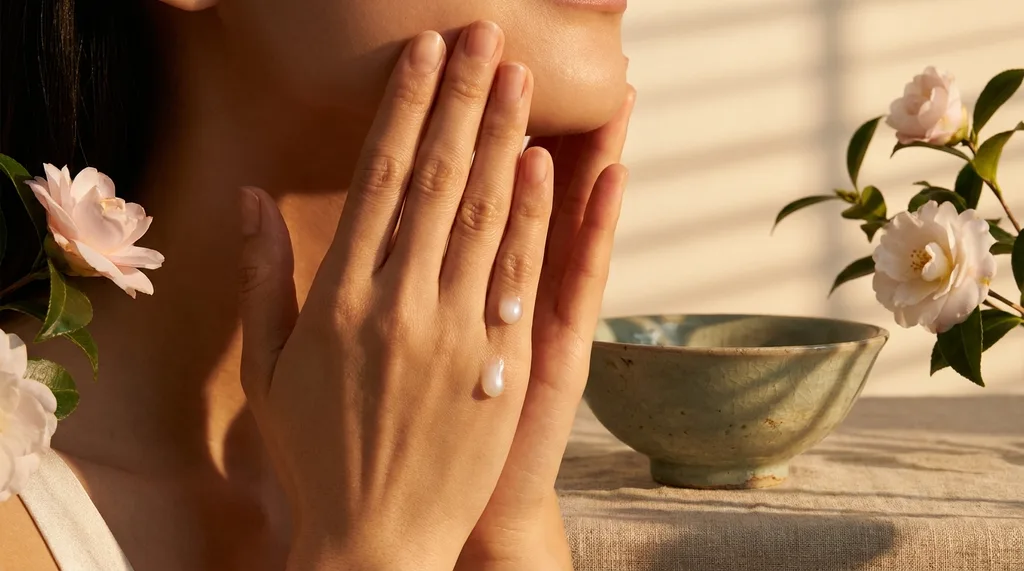
[K-Beauty 101] 물광 (Mulgwang) — water glow. A luminous, hydrated radiance that looks like moisture is about to bead off the skin's surface. The morning routine's goal is not to create this effect artificially — it is to build the molecular conditions under which Mulgwang appears on its own.
The morning routine is a construction project. You are building layers of molecular precision before going outside.
Step 1 — Gentle pH-Balanced Cleanse Purpose: Remove overnight sebum and any residue without stripping the acid mantle.
This is not the step to be aggressive. Korean women have long abandoned the "squeaky clean" standard — that tight, stripped feeling after washing is the barrier crying. Use a mildly acidic (약산성, yak-san-seong, pH 5.5) cleanser, work it with cool water, and spend thirty seconds maximum. Pat — never rub — with a clean towel. The skin should feel comfortable, not tight. If it feels tight, your cleanser is the problem.
Step 2 — Dak-to First Toner Purpose: Remove any remaining surface debris, prep absorption pathway.
Saturate a cotton pad until it's almost dripping. Press it flat against the forehead, draw it lightly across the skin following the direction of pores (outward, never inward). No friction. The pad should glide. This is sometimes called 닦토 (Dak-to) in Korean skincare vernacular — a wiping toner pass. Use a mild, pH-adjusting, low-actives formula here. This step isn't about adding anything; it's about opening the door.
Step 3 — Chap-to Hydration Toner Purpose: Deliver LMW-HA and lightweight humectants into epidermal layers.
Pour a few drops into clean palms — more than you think you need. Press both palms flat against your face, not patting yet, just warming. Hold for three seconds. Let the body heat thin the product slightly. Now press with gentle, rhythmic pressure — not slapping, not massaging. This 찹찹 (chap-chap) technique, Korean women learn as teenagers, is the reason the same toner produces different results in different hands. The heat matters. The pressure matters. The patience matters.
Wait 60 seconds before the next step. The product must fully absorb or the next layer will pill.
Step 4 — Essence or Ampoule Purpose: Deliver concentrated actives at the point of maximum absorption.
This is where your targeted ingredients live — fermented filtrates, peptides, Centella Asiatica, niacinamide. Apply three to four drops, warm between palms, press in using the same technique as Step 3. The skin is now primed from Step 3's toner; these actives are landing on prepared ground, not dry concrete.
Wait 60 seconds.
Step 5 — Serum Purpose: HMW-HA and film-forming agents begin building the surface barrier.
If Step 3 was the message sent to your cells, Step 5 is the envelope sealing it in. The heavier viscosity here tells you exactly what it's doing — sitting near the surface, holding the hydration already delivered below in place. Press in with palms. Do not try to push it deeper by pressing harder; it is doing its job exactly where it sits.
Step 6 — Moisturizer Purpose: Final occlusive layer, TEWL prevention.
One pump, warmed in palms, pressed onto skin in sections. Cheekbones first, then forehead, then nose, then chin. The order matters because you lose heat as you work — start with the flattest, most absorbent areas while the product is warmest.
Step 7 — SPF (Non-Negotiable) Purpose: Preserve everything you just built.
Every unprotected UV exposure undoes barrier work. This is not optional. In Korea, SPF is considered part of the skincare routine, not makeup. Full stop.
🎵 K-Mono Lofi — Seoul Study Beats
Read deeper with Seoul lo-fi in the background — curated by K-Mono Lofi
PM Blueprint: The Night Your Barrier Rebuilds
The evening routine has a different job. Morning is construction — evening is repair. And repair requires you to remove everything from the day first, completely, without stripping the skin in the process.
Step 1 — Oil Cleanse (이중 세안, I-jung Se-an — First Pass) Purpose: Dissolve oil-soluble debris. SPF, sebum, pollution particles.
Massage a cleansing oil or balm onto dry skin for sixty seconds minimum. Not a quick swipe — a full sixty seconds of methodical emulsification. Feel the texture change as it grabs the day's buildup. Rinse with lukewarm water. This step does not clean the skin; it dissolves the layer that stands between cleanser and skin. The water-based cleanser that follows does the actual cleaning.
Step 2 — Water-Based Cleanser (Second Pass) Purpose: Remove emulsified residue, bring skin to clean baseline.
Same mild, pH-balanced formula as AM. This is not the time to switch to a stronger exfoliating cleanser because "you need to really clean." You don't. Double cleansing is the entire architecture — trust the first pass to do its job, and let the second pass be gentle.
Step 3 — Treatment Application (2–3 Nights Per Week Only) Purpose: Introduce active ingredients like low-concentration AHA, retinol, or vitamin C treatments.
This is where the barrier warning becomes urgent. Not every night. Not at full strength immediately. Not while your skin is compromised. More on this shortly — but if you're new to actives or your barrier shows any signs of strain, skip this step entirely until it doesn't.
Step 4 — Hydration Toner Layers (7-Skin Method, or Three Layers Minimum) Purpose: Saturate the deepest viable layers before occlusion.
This is the technique behind Korean skincare's most famous practice — the 7스킨법 (Chil-skin-beop), or 7-Skin Method. Seven thin layers of lightweight hydrating toner, each pressed in with palms, each allowed sixty seconds to absorb before the next. The logic is physiological: no single heavy layer penetrates as effectively as multiple thin layers building moisture gradient pressure downward into the skin. You don't need to do seven every night. Three done correctly beats seven done impatiently.
Step 5 — Targeted Serum Purpose: Nighttime repair actives — ceramide precursors, peptides, fermented extracts.
Evening serums can be richer than AM formulas. The skin's repair cycle peaks between 11 PM and 4 AM; what you apply at 10 PM is working with that biology. Press in, hold with palms for five seconds on each section.
Step 6 — Sleeping Mask or Rich Moisturizer Purpose: Heavy occlusion to prevent overnight TEWL, support barrier repair during sleep.
This is the heaviest layer. Press in generously on the drier areas — cheekbones, around the eyes, any areas that feel tight post-cleanse. The sleeping mask format (a gel or cream worn overnight) is the final statement: everything below is now sealed in place for the next eight hours.
The Barrier Warning That Saves Everything

Here's where the tutorial-perfect routine can become a trap, and where this article diverges from most of what you've read before.
Glass skin is not a glow you manufacture. It is the light that escapes when your barrier has nothing left to hide.
A compromised barrier — cracked, inflamed, over-exfoliated — cannot produce the translucent luminosity you're after regardless of what you layer on top. In fact, the more products you add onto disrupted skin, the more you risk compounding the damage. A skin in barrier stress is not a canvas for actives; it is a patient that needs to rest.
The most common mistake in glass-skin pursuit is aggressive exfoliation. The logic feels sound: remove the dead cell buildup, reveal the smooth skin beneath. But physical scrubs and high-percentage chemical exfoliants (10%+ AHA, for instance) compromise the very intercellular lipid matrix that glass skin depends on. The goal is a smooth, refined surface — and a healthy barrier creates that surface naturally, through proper desquamation, without being forced.
The concept of 스킨케어 다이어트 (skincare diet) — deliberate minimalism as a recovery protocol — is real and practiced widely in Korean skincare communities. When the barrier is overwhelmed, the answer is less, not more. This is the counterintuitive truth that no haul video will ever tell you, because haul videos exist to recommend products, not to tell you to put them away.
Who should NOT attempt this full routine immediately: anyone currently dealing with active acne, significant redness, perioral dermatitis, or visible flaking. These conditions indicate barrier stress. Introduce steps one at a time, at two-week intervals, monitoring the skin's response before adding the next.
The most honest thing this article can tell you is that glass skin requires patience as an ingredient. Not in the inspirational-quote sense. In the literal biochemical sense: the CD44 receptor signaling triggered by LMW-HA needs weeks of consistent delivery before the keratinocytes respond with measurable lipid synthesis. You cannot rush cellular repair with enthusiasm and a larger bottle.
There's a reason Korean teenagers learn to pat their toner slowly. They're not being precious. They're being precise.
Where to Find What You Need
Olive Young ships globally through its international mall, making most of the toner and essence formats described above accessible outside Korea. The product categories to prioritize — in order of impact — are: low-viscosity hydrating toners that specify hyaluronic acid molecular weight in their formulation notes, barrier-repair essences with ceramide and panthenol, and simple, non-occlusive SPF for morning sealing.
For those outside delivery range, the key is sourcing by ingredient architecture rather than brand. The mechanism matters more than the label. Any formulation that delivers LMW-HA (often listed as "hydrolyzed hyaluronic acid" or "sodium hyaluronate crosspolymer" at small molecular weights) in a watery, fast-absorbing base does the same physiological job as its Korean counterpart. Cross-reference ingredient positions on the label — an active appearing in the first five ingredients is present at meaningful concentration.
iHerb carries several Korean-brand essences and toners that fulfill this brief — and for barrier repair specifically, look for formulations combining ceramides NP, AP, and EOP with cholesterol and fatty acids, which mirrors the skin's natural lipid ratio. Use code QAK3042 for an additional discount on eligible items.
The Upgrade Path
Once the baseline routine is consistent and your barrier has stabilized, the logical next step is introducing fermented filtrates — bifida ferment lysate, saccharomyces filtrate, yeast-derived extracts — which deliver microbiome-supportive compounds alongside the hydration framework already in place. These work synergistically with the LMW-HA foundation, amplifying the CD44 receptor response while diversifying the barrier's chemical communication.
The step after that is targeted actives: low-concentration retinol (0.025%–0.05%) introduced on alternate evenings, always behind the hydration toner layers, never on compromised skin. The 속광 (Sok-gwang) — the inner glow that Korean women describe as the truest marker of skin health — becomes accessible here. Not the reflective surface of a fresh layer of product, but the quiet translucency of skin that has rebuilt itself from the inside outward.
That's what glass skin actually is. Not a surface effect. Not a product. A structural condition — one that, once understood at the molecular level, becomes entirely reachable.
The pieces were never missing from your bathroom. The sequencing was.
Read next: → The Science of the Skin Barrier — how ceramides, lipid ratios, and transepidermal water loss connect to the Mulgwang effect.
⚠️ Medical Disclaimer: This article is educational and informational in nature. Skincare routines, active ingredients (including retinol, AHA, and high-potency serums), and barrier-modifying practices affect individuals differently. Always perform a patch test on a small area of skin before introducing new products. If you experience persistent redness, burning, breakouts, or irritation, discontinue use and consult a board-certified dermatologist. Those with diagnosed skin conditions including rosacea, eczema, psoriasis, or active acne should seek personalized medical advice before beginning any new skincare regimen. This content does not constitute medical advice and is not a substitute for professional dermatological evaluation.
This article may contain affiliate links — if you buy through them, we may earn a small commission at no extra cost to you.
✓ Researched and compiled using verified data as of the publication date.
 Written by Jun Mi Jung for Quiet Korea | Contact: rsl.2001.1975@gmail.com
Comments
Post a Comment