Glass Skin Masterclass

There are two completely different kinds of glow. Most of the K-beauty world only knows about one of them.
The first kind photographs well. It's luminous, dewy, immediately visible — the kind that earns comments on a selfie and sells out a product within hours of a review going live. Korean women call it mul-gwang (Mul-gwang): water glow. It is real, it is beautiful, and with the right technique, almost anyone can achieve it by 9 AM on a Tuesday.
The second kind is harder to photograph. It lives slightly underneath the surface. It is the reason a Korean woman in her mid-forties can walk into a room under fluorescent lights — the most unforgiving lights on earth — and her skin still looks as though it is lit from somewhere inside. This is what Koreans call sok-gwang (Sok-gwang): inner glow. It cannot be layered on. It cannot be purchased. And here is the question that will hum through this entire article: why do some people develop it and keep it for decades, while others chase it for years and never quite arrive?
The answer is not in any bottle. But it does require products to get there — applied in the right order, with the right hands, for the right reason. That distinction is everything.
🎵 K-Mono Lofi — Seoul Study Beats
Read deeper with Seoul lo-fi in the background — curated by K-Mono Lofi
The Two Lights — And Why You've Been Chasing the Wrong One
Walk into any Olive Young on a weekday afternoon and watch the women testing toners on their inner wrists. Notice that the ones who know what they're doing aren't pressing the toner in — they're pressing it down, using the warmth of their palm to drive moisture past the surface. They're not looking for shine. They're looking for something more like the moment right after water is absorbed into stone: a deepening, a saturation, a quality of fullness.
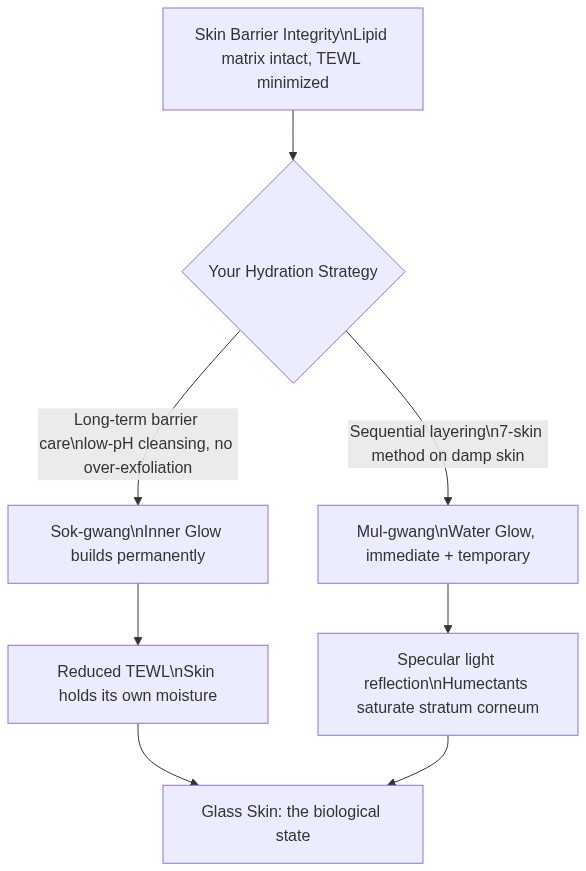
That's mul-gwang in motion. The stratum corneum — the outermost layer of skin — is loaded with humectants, the surface tension of the skin rises, and light bounces off it with the clean, direct quality of a reflection in still water. It is a physical phenomenon. It is temporary. And it is absolutely achievable, step by step, with the right layering technique.
Sok-gwang is something else entirely. It emerges from what dermatologists describe as the "brick-and-mortar" structure of healthy skin — corneocytes (the bricks) embedded in a lipid matrix of ceramides, cholesterol, and fatty acids (the mortar). When this matrix is intact, the skin doesn't just reflect light at the surface. It transmits it. The glow appears to come from slightly below where you're looking, which is exactly what it does: light enters the upper layers, scatters and diffuses through the well-hydrated epidermis, and returns to the eye softened and multidirectional. That is the specific quality that no highlighter in the world can replicate, because highlighter sits on top of the skin's architecture rather than emerging from within it.
💧 Mul-gwang — Water Glow
Source: Sequential humectant layering; surface saturation
Duration: Hours — fades as moisture evaporates or sebum surface shifts
Technique: 7-skin method, skin flooding, patting on damp skin
Visible sign: High-gloss, dewy reflection; specular light bounce
Who can have it: Almost anyone, today, with the right products
✨ Sok-gwang — Inner Glow
Source: Intact lipid bilayer; barrier-level structural resilience
Duration: Permanent — present even without skincare, even under bad lighting
Technique: Years of barrier-first habits; low-pH cleansing; restrained exfoliation
Visible sign: Soft, diffused, depth-of-light; present even in fluorescent settings
Who can have it: Anyone who builds it — with patience
The confusion between these two is the source of almost every glass skin disappointment. Someone layers seven toners, gets brilliant mul-gwang by morning, and calls it glass skin. By 2 PM the humidity has dropped, the office air conditioning has run for six hours, and the glow has resolved into something Koreans describe with the blunt, slightly cruel term gae-gireum (Gae-gireum) — surface grease. Not the luminosity of water. The dull, congested shine of sebum sitting on a compromised barrier that cannot hold moisture underneath it.
The barrier was never repaired. The surface was only decorated.
[K-Beauty 101] Sok-gwang (속광) — Inner glow. The radiance that indicates a skin barrier functioning at its biological optimum. It cannot be applied or triggered by any single product; it is the cumulative result of consistent, barrier-first care that reduces transepidermal water loss and allows the skin's natural lipid matrix to remain intact. Korean women who have it rarely know exactly when they got it — only when they lost it.
The Brick-and-Mortar Truth
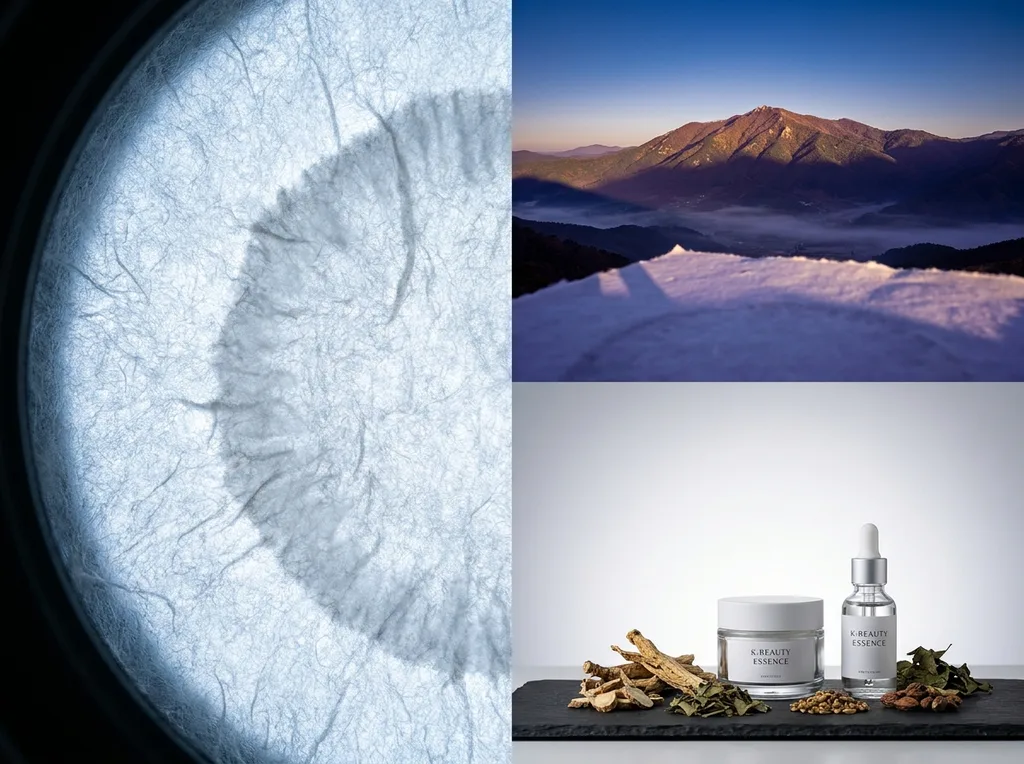
Here is the biology that changes how you see every product on your shelf.
Your skin's outermost layer — the stratum corneum — loses water constantly. This is measured as TEWL: transepidermal water loss. On healthy cheeks, TEWL sits somewhere between 5 and 15 grams per square meter per hour. On the forehead, slightly higher: 10 to 25 g/m²h. These numbers climb when the lipid mortar between your corneocytes is disrupted — by harsh surfactants, by over-exfoliation, by barrier-stripping alkaline cleansers, by doing too much to skin that needed rest.
When TEWL rises, the skin loses its ability to hold the moisture you're layering in. Toners evaporate before they absorb. Serums sit on the surface. The 7-skin method stops working not because the technique is wrong but because the structure underneath has been compromised — like filling a cracked vessel. You can pour endlessly and still watch it drain.
This is the core of the Korean barrier-first philosophy. Fix the vessel. Then fill it.
The postmenopausal skin data makes this especially stark: TEWL increases by roughly 25% compared to premenopausal skin, driven by declining estrogen and the resulting thinning of the lipid mortar. The skin that glows at 55 is the skin whose mortar was preserved at 35. This is not destiny — it is architecture, and architecture can be maintained or neglected.
What does barrier restoration actually require? Three lipid families in specific ratios: ceramides, cholesterol, free fatty acids. Korean formulations have understood this for decades. Look at the ingredient lists on any serious Korean moisturizer and you will find all three. The Western equivalent often picks one — usually ceramides, because it tests well in consumer surveys — and misses the co-factors that allow ceramides to integrate into the existing lipid structure rather than sitting beside it.
[K-Beauty 101] Gae-gireum (개기름) — Literally, "dog grease." The derogatory Korean term for the kind of surface shine that results from sebum over a compromised barrier — as opposed to the water-based luminosity of mul-gwang. If your glow looks better under soft lighting than fluorescent, and if it's accompanied by enlarged pores and midday congestion, you may be managing gae-gireum, not cultivating any kind of gwang at all. The fix is not mattifying — it is barrier repair.
The AM Routine — Translated Into Practice
The morning routine is not about adding. It is about not taking away.
Step 1: Rinse only (no cleanser) Purpose: Preserve the sebum your skin spent the night producing. That overnight lipid is not a problem to solve — it is the foundation of the day's barrier. Korean women with the clearest skin in their forties frequently skip morning cleanser entirely, rinsing with lukewarm water and moving directly to toner. If you must cleanse in the morning, use only a low-pH formula (pH 5.0–6.5) and treat it as a rinse, not a scrub.
Step 2: Dak-to — the first toner, on a saturated cotton pad Purpose: Remove the residue from overnight products and gently resurface without physical trauma. Soak a cotton pad completely — not damp, saturated — and sweep it along the skin following the direction of pores, downward strokes on the nose, outward from the center on cheeks. Saturating the pad means the cotton glides rather than drags. Do not press. This is a whisper, not a wipe.
Wait 60 seconds. This pause matters.
Step 3: Chap-to — the hydrating toner, hands only Purpose: Begin the mul-gwang foundation. Pour a 10-cent-piece amount into your palm. Press both palms together briefly — three seconds — to bring the toner to body temperature. Then press both palms flat against cheekbones simultaneously and hold for five seconds without moving. This isn't patting in the conventional tapping sense. It is transferring warmth and moisture together. The heat slightly opens the outer layers; the toner enters rather than sitting on top.
For maximum mul-gwang, repeat this step three to five times, each layer applied to still-slightly-damp skin. This is a compressed version of the chil-skin-beop (7-Skin Method) — not seven layers of toner necessarily, but the principle of building hydration incrementally rather than expecting one heavy application to do the work.
Step 4: Essence or serum — warm press, not spread Purpose: Deliver actives into a prepared, receptive surface. Do not pump essence onto fingers and rub it across the face. Pump it into the palm, press palms together, and apply in sections — each section held with gentle pressure for four to five seconds. Spreading breaks surface tension and reduces absorption. Pressing works with it.
Step 5: Moisturizer — warmth, then seal Purpose: Occlude what you've built and reinforce the mortar. Take more than you think you need — this is not the step to be conservative. Warm it between palms for five seconds, then apply in upward, outward motions, pressing the last layer in rather than finishing with strokes. The seal should feel like a second skin, not a film.
Step 6: SPF — the step that protects everything else Purpose: UV radiation degrades ceramides. It breaks down the lipid mortar faster than almost any other environmental factor. Every other step in this routine is partially undone by skipping this one. Apply SPF generously — more than feels comfortable — and do not rub it in with the friction you'd use on sunscreen at the beach. Press it in. Let it settle for 90 seconds before moving.
The PM Routine — The Repair Window
Korean dermatologists refer to the nighttime hours as the "metabolic window" — the period when the skin's natural repair mechanisms operate at their peak and absorb the benefits of topical ingredients most efficiently. The PM routine is not a mirror of the AM routine. It has a different job: deep cleaning, targeted repair, and barrier restoration.
Step 1: Oil cleanser — full two-minute massage Purpose: Dissolve SPF, sebum, and the day's oxidative residue. Emulsify it completely. Korean women are taught that the oil cleanse is a facial massage, not just a removal step — and this is not a marketing flourish. The lymphatic drainage that accompanies a deliberate, two-minute oil massage reduces puffiness and increases circulation in ways that show up in skin quality over months. Use dry hands on dry skin. Work in small circles at the jawline, then sweep upward. Emulsify with water before rinsing.
Step 2: Low-pH water cleanser — 30 seconds maximum Purpose: Remove emulsified oil residue without disturbing the acid mantle you are trying to protect. The yaksan-seong (mildly acidic, pH 5.5) foam cleanser became standard in Korean skincare precisely because the old alkaline soaps that left skin feeling "squeaky clean" were stripping the very lipid mortar that sok-gwang depends on. Squeaky clean is a warning sign, not a standard to reach.
Wait 60 seconds before toner. This allows the skin's pH to stabilize slightly before you introduce the next layer.
Step 3: Treatment toner or essence — the barrier-first actives Purpose: Begin the repair phase. At night, Koreans with glowing skin in their forties are not using aggressive exfoliating acids every evening. They are using fermented essences, centella asiatica formulas, or niacinamide-first toners that signal barrier repair to the skin rather than disruption. If you use an exfoliating acid, limit it to twice per week, and never layer it over a compromised barrier — meaning: if your skin is currently reactive, flaking, or tight, skip the acid entirely until the barrier recovers.
Step 4: Targeted serum — the one active you actually need Purpose: Address one concern, not five. Korean skincare culture has shifted significantly toward what some call the skincare diet — stripping back to the essentials and refusing to stack three actives on top of each other. Choose the serum that addresses your primary concern tonight. Tomorrow night, address another. The skin that receives one thing deeply is in better shape than the skin that receives seven things superficially.
Step 5: Sleeping pack or rich moisturizer — the overnight seal Purpose: Lock in every layer, starve TEWL, give the ceramide-rich formula hours to integrate. This is where Korean formulations earn their reputation. Apply generously, press (never rub) across the face and neck, and then leave the skin alone. No touching. No checking. No unnecessary friction between now and morning.
The Impatience Problem — How Glass Skin Gets Destroyed

Here is the part that never gets written, because it requires telling people that the products they've already bought might be part of what's hurting them.
The most common reason glass skin never arrives isn't missing a product — it's barrier damage that's been accumulated quietly over months or years of well-intentioned but aggressive routines. Over-exfoliation is the primary culprit. Daily use of AHAs, BHAs, or retinoids at high concentrations is counterproductive if the barrier underneath them is already compromised. The exfoliation removes dead cells — but the lipid mortar between those cells is lost in the process, TEWL climbs, and the skin becomes simultaneously inflamed and dehydrated. Surface oiliness increases as sebaceous glands compensate. The user reads "oily skin" and reaches for more stripping products. The cycle accelerates.
The other frequently missed problem is over-application of occlusives on a skin that hasn't been hydrated first. Heavy creams applied to dry skin without the preceding toner and serum layers do not improve moisture levels — they trap the deficit. The skin stays dehydrated underneath a thick seal, which produces the specific kind of congested, dull skin that looks neither healthy nor glowing.
Sok-gwang is the thing that appears when you stop doing too much. It is what the skin does when the barrier is intact, the lipid mortar is preserved, and the habits of protection have been maintained long enough for the skin to function at its biological optimum. It is not a reward for effort. It is a reward for intelligent restraint.
There is also an honest word needed about skin type. Sok-gwang expresses differently on different skins. Deeper skin tones often display it as a richness and evenness rather than the glass-like transparency associated with lighter complexions — but the underlying biology is identical, and the glow, when it appears, is equally unmistakable. Oily-skinned people may find that barrier repair resolves what they thought was an oil problem: much of what reads as excess sebum is compensation for a dehydrated barrier, and when the barrier is restored, sebum production often normalizes. The condition known in Korean as sok-geonjo (Sok-geonjo) — deep inner dryness masked by surface oiliness — is far more common than most people outside Korea realize, because it looks like an oil problem until you understand what's happening underneath.
Glass skin is not something you achieve and then have. It is a relationship you maintain with a biological structure that is always in motion — always repairing, always responding, always telling you exactly what it needs if you know how to listen. The women in Seoul whose skin holds its light through their forties and fifties didn't get there by finding the right serum. They got there by deciding, early, that the skin's own intelligence was worth protecting.
That's the 80% nobody writes about. The products are just how you show up for it.
⚠️ Medical & Financial Disclaimer: This article is for educational purposes only and does not constitute medical or dermatological advice. All skincare routines, ingredient recommendations, and technique suggestions are general in nature. If you are experiencing persistent skin conditions — including redness, barrier damage, cystic acne, or inflammatory reactions — consult a board-certified dermatologist before introducing new actives or changing your routine. Patch-test all new products before full application. TEWL values cited reflect general published ranges and will vary by individual, environment, and skin condition. Market projections referenced are estimates from third-party research and should not be taken as confirmed outcomes.
This article may contain affiliate links — if you buy through them, we may earn a small commission at no extra cost to you.
✓ Researched and compiled using verified data as of the publication date.
 Written by Jun Mi Jung for Quiet Korea | Contact: rsl.2001.1975@gmail.com
Comments
Post a Comment