Glass Skin Masterclass
Why does the Korean woman who owns three products sometimes have better skin than the one who owns thirty? It's the question every glass skin tutorial sidesteps — because the honest answer has nothing to do with what's in your cabinet.
You've bought the toners. You've followed the steps. You've watched the tutorials where someone with naturally extraordinary skin pats twelve layers of something onto an already-perfect face and then calls it a routine. And your skin, after all of that faithful effort, still looks like skin. Not glass. Not luminous. Not the thing they promised.
Here's what nobody will tell you: the Korean women whose skin you're trying to replicate didn't learn their routine from the internet. They learned it from their mothers, who learned it from watching their own skin fail under the wrong products in their twenties — and rebuilding it from scratch. The routine is the last 20 percent. What you're missing is the 80 percent that lived before any product was opened.
This is the masterclass that part never gets.
The Wrong Question Has Been Costing You Everything
The global glass skin market is projected to reach billions of dollars in the coming decade. There is enormous financial incentive, across the entire beauty industry, to ensure that your glass skin answer always lives inside a bottle. More products. Better products. The right combination, finally, this time.
But the Korean dermatology community has understood something for decades that the marketing apparatus works very hard to obscure: the product is the delivery mechanism. The barrier is the canvas. And if the canvas is compromised, it doesn't matter how exceptional the delivery mechanism is. You're painting on a broken wall.
[K-Beauty 101] 유리알 피부 (Yuri-al Pibu) — Glass Skin. Literally "glass bead skin" — a complexion so translucent and evenly reflective that it resembles the smooth, luminous surface of polished glass. Not oiliness. Not shimmer. Not filter. A state of such complete hydration and barrier integrity that skin refracts light the way water does.
The cultural nuance matters here. Yuri-al pibu is not a makeup effect Korean women chase. It's the result they expect from disciplined, patient, years-long skin stewardship. When Korean teenagers begin their first real skincare routines, the lesson they receive — from mothers, older sisters, beauty school curricula — is not "buy this serum." It's: your skin is a barrier system. Your job is to protect it first, and enhance it second.
That philosophical inversion is the 80 percent. Everything below is its execution.
🎵 K-Mono Lofi — Seoul Study Beats
Read deeper with Seoul lo-fi in the background — curated by K-Mono Lofi
The Physics Under the Glass
There is a molecule at the center of every serious glass skin conversation. Hyaluronic acid (HA) is not a trendy ingredient — it is one of the body's own structural materials, present in every layer of healthy skin. What the beauty industry discovered, and what K-beauty products have spent years engineering around, is that hyaluronic acid's effect is completely determined by its molecular weight.
High-molecular-weight hyaluronic acid (HMW-HA), above 1,000 kDa, cannot penetrate the skin. It sits on the surface and forms a viscoelastic film — a transparent, slightly adhesive layer that physically traps moisture against the skin, reducing transepidermal water loss (TEWL). It is the reason your skin feels dewy and plump an hour after a good toner. But that effect is surface-only. It is not building anything. It is lending.
Low-molecular-weight hyaluronic acid (LMW-HA), below 200 kDa, does something structurally different. Its smaller fragments reach viable epidermal layers and interact with CD44 receptors on keratinocytes — the cells responsible for lipid synthesis and barrier repair. This is not cosmetic hydration. This is cellular signal traffic. LMW-HA is telling your skin how to rebuild itself.
The glass skin routine works — when it works — because it deploys both in sequence. Thin, watery toners carry LMW-HA through the first layers of the stratum corneum while the skin is still permeable from cleansing. Serums and essences, with their higher viscosity, seal HMW-HA onto the surface, locking the earlier work in place. Then the occlusive layer — cream, sleeping mask — creates the final vapor barrier.
This is not a 10-step routine. It is a molecular layering strategy, and every step has a specific physical job.
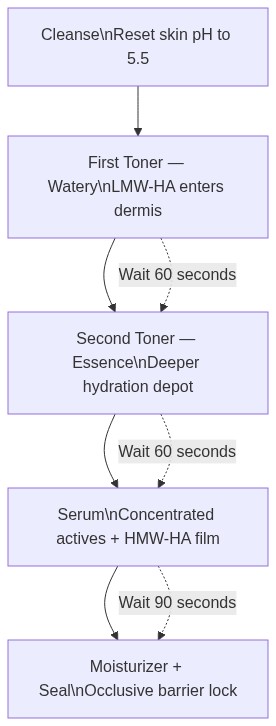
The wait times in that diagram are not optional. They are the physics. Apply your serum on top of a still-wet toner and you create a barrier between the toner's active ingredients and the skin — the serum sits on top of the unabsorbed water, never penetrating. You've done the motion. You haven't done the work. Research supports a 2-3 minute interval between layers as the threshold for genuine absorption and anti-pilling protection. On busy mornings, 60 seconds per layer is the minimum viable patience.
Morning Light: The AM Architecture
The AM routine has one master purpose: prepare skin to face the world without losing water to it. Every step is downstream from that goal.
Step 1: The Rinse Cleanse (No Foam Required) Purpose: Remove overnight sebum without stripping the barrier you spent the night rebuilding.
Unless your skin produces significant oil overnight or you applied an occlusive sleeping mask, the morning cleanse needs almost nothing. Korean women with glass skin frequently rinse with cool-to-lukewarm water only in the morning — no cleanser at all. If you feel you need one, a pH 5.5 (yak-san-seong, mildly acidic) gel cleanser used for no more than 30 seconds is enough. Press the cleanser into your skin with your fingertips using gentle circular motions. Do not scrub. Do not use a facial brush. Rinse completely, then pat — never rub — dry with a clean cotton cloth, leaving the skin about 70 percent damp. That dampness is intentional. It's your next product's runway.
Step 2: The Wiping Toner (Dak-to) Purpose: Remove any residual surface debris and chemically prepare the skin for absorption.
Pour your thinnest, most watery toner — ideally one with minimal fragrance and a gentle exfoliating acid at a very low concentration — onto a cotton pad until it is visibly saturated, not merely damp. Oversaturation matters: a dry cotton pad drags and creates friction. Wipe across the skin following the direction of pore openings — outward from the nose, upward on the jawline. This motion is not aesthetic. It is mechanical. You're removing the last layer of cellular debris so the next product lands on clear skin.
Then wait. Thirty seconds is sufficient. You want the product to finish its work before you bury it under the next layer.
Step 3: The Patting Toner (Chap-to) Purpose: Begin the hydration layering — this is where mulgwang (water glow) actually starts.
This step is entirely different from Step 2, and the distinction is one most non-Korean routines collapse entirely. After the wiping toner has settled, pour a slightly richer, more hydrating toner — one built around hyaluronic acid, beta-glucan, or ceramide — into clean, dry palms. Cup both hands around your face and press the product into your cheeks, forehead, and chin. Not patting. Pressing. The warmth from your palms temporarily dilates skin's surface permeability, encouraging the product to travel inward rather than evaporate outward. Hold each press for three to four seconds. Repeat over the entire face, including the neck.
Wait 60 seconds.
Step 4: The Serum Purpose: Deliver concentrated actives to a skin surface that is now primed and slightly dilated.
Warm three to four drops of serum between your palms for five seconds before application. This is not a ritual affectation — it reduces the serum's viscosity slightly and activates thermosensitive film-forming agents. Press the serum onto the face using the same cupped-palm technique. Do not rub or drag. If you're using a Vitamin C serum in the morning, apply it here — after the hydrating toner — not before, and not directly on top of any AHA. Your toner has already adjusted the pH; your serum is now traveling into a prepared, receptive surface.
Wait 90 seconds.
Step 5: Moisturizer + Sunscreen Purpose: Seal the layering work and defend it from the day.
Apply moisturizer in upward pressing motions, then sunscreen last and generously. SPF is not the fifth step of a beauty routine — it is the structural decision that determines whether every other step you just did will be undone by lunch. Korean dermatologists are emphatic on this: glass skin at 40 is, more than anything else, the consequence of aggressive daily SPF use that started at 20.
⚠️ The Common Morning Mistake
Apply toner. Immediately apply serum. Immediately apply moisturizer. Rush out. Products pile on top of each other. Nothing absorbs. Skin pills. You blame the products.
✅ The Molecular Logic
Each layer absorbs before the next begins. Thin products go first — watery toner, then essence, then serum. Wait times aren't delays. They're the actual mechanism. The glow isn't the product. It's the sequence.
The Night Shift: Where the Real Work Happens
The AM routine protects. The PM routine rebuilds. This distinction is one Korean skincare philosophy treats as almost spiritual — the day asks things from your skin, and the night is when you pay the debt back with interest.
Step 1: Oil Cleanser Purpose: Dissolve everything oil-soluble — sunscreen, sebum, pollution particulates, and any makeup — without disturbing the water-based layers of the barrier beneath.
Apply the cleansing balm or cleansing oil to completely dry hands and a completely dry face. This matters chemically: oil cleansers work through like-dissolves-like, and water on the face dilutes the cleansing action before it begins. Massage in small, deliberate circular motions for 60 full seconds — not 15, not 30. Then emulsify: a few drops of water onto the face, continue massaging until the oil turns milky white. Rinse thoroughly.
This step should leave zero tightness, zero squeakiness. If your skin feels "clean" in the way squeaky-clean dishes feel clean, the cleanser's alkalinity has stripped your barrier's acid mantle. Switch.
Step 2: Water-Based Cleanser (pH 5.5) Purpose: Remove any remaining water-soluble residue left after the oil cleanse.
A low-foam, mildly acidic gel cleanser — 30 seconds maximum. Rinse with water at body temperature, not hot. Hot water temporarily disrupts tight junctions in the skin's surface. It feels luxurious and it costs you.
Step 3: The 7-Skin Method Purpose: Flood the freshly cleansed, slightly damp skin with layered hydration before it has a chance to tighten.
[K-Beauty 101] 7스킨법 (Chil-skin-beop) — The 7-Skin Method. Not seven different products — seven layers of the same lightweight, hydrating toner applied in succession. Each layer is pressed in with warm palms and allowed to partially absorb before the next. The goal is not surface saturation but deep-level hydration reservoir: building a moisture depot in the lower epidermis that releases throughout the night.
Layers one through three feel instantly absorbed. Layers four through seven begin to create a subtle plumpness that you can feel under your fingertips. Korean women who practice this nightly describe the result the next morning as their skin feeling like it has been soaked from the inside — not from a cream, but from a reservoir of water their skin now carries.
You don't have to do all seven on every night. Three to five layers, practiced with real technique — warm palms, full press, genuine wait time between each — will outperform seven hasty sweeps.
Step 4: Essence or Ampoule Purpose: Deliver the night's most targeted actives to a maximally hydrated, maximally permeable surface.
Fermented essences — a format Korean beauty has refined over decades — break down their active compounds into smaller, more bioavailable molecules through the fermentation process, making them genuinely more penetrating than their non-fermented equivalents. Apply essence using the pressing technique. At this stage, skin is at its peak nighttime permeability. Everything you put on now goes deeper than anything you applied this morning.
Step 5: Night Serum Purpose: Concentrated active delivery — but only what your barrier can actually handle.
If you use a retinol or exfoliating serum, it lives here. But — and this is the part that destroys more glass skin aspirants than any other single mistake — introduce it once a week before you build to every other night. The night after retinol: no retinol. Just hydration and seal. Your barrier is rebuilding, and it needs the rest.
Step 6: Sleeping Mask or Rich Cream Purpose: Create the final occlusive seal that prevents all the previous work from evaporating overnight.
Apply with upward pressing motions. Then stop touching your face. The 흡수 (absorption) is happening whether you feel it or not.
The concept Korean beauty insiders call sok-dang-gim — that frustrating sensation of inner dryness where skin feels parched deep down despite being coated in product on the surface — is almost always a sign that this sealing step has been skipped, or that the products beneath it were never genuinely absorbed before the seal went on. You have created a lid on an empty jar.
The Warning No Glass Skin Article Will Give You
Here is the part where almost every glass skin guide quietly disappears, because what comes next doesn't sell anything.
Glass skin is the light that emerges from a healthy barrier. It is not the result of applying the right things. It is the result of not destroying the wrong things. And the most common source of barrier destruction in the skincare-educated, product-fluent, absolutely-doing-everything-right demographic is: too much, too often.
AHA exfoliants used more than twice a week. Retinol used every night from week one. Niacinamide at 20 percent concentration layered over Vitamin C. Multiple actives in a single routine, applied back to back, because all of them are technically beneficial ingredients. Any one of these can be the crack in the foundation. All of them together, combined with the impatience of wanting glass skin by next Tuesday, creates the exact opposite: a reactive, sensitized, persistently irritated skin surface that reflects light unevenly, shows every dry patch, and breaks out at novel provocations every week.
The Korean concept of a "skincare diet" — stripping the routine down to two steps on purpose, for weeks — exists for exactly this reason. When a Korean woman's skin begins to rebel, the traditional response is not to add a new serum. It is to subtract everything except a gentle cleanser and a single, uncomplicated moisturizer. Rest the barrier. Let it repair itself. Then, when the skin calms, reintroduce only what is genuinely necessary.
The cruelest irony in the glass skin journey is that the people closest to achieving it are often the ones who, in their eagerness, keep doing the thing that prevents it. The skin doesn't need more. It needs better conditions to do what it already knows how to do.
The open loop you started with — why does the Korean woman with three products sometimes have better skin than the one with thirty? Because she spent a decade learning to leave her barrier alone, and the products she chose serve that philosophy rather than fighting it. The products aren't the answer. The restraint is.
There's a body of knowledge about this that goes deeper than any single article — the ingredient interactions, the seasonal barrier adjustments, the clinic-grade insights that Seoul women absorb through years of trial and professional guidance. If you want to go further without having to wade through the sponsored noise:
The One Thing That Outlasts Every Trend
The search for glass skin will keep generating new products, new tools, new 12-step variations. In Seoul's Olive Young aisles at midnight, young women are reaching for the newest biofermented essence with the focus of surgeons, and some of them will find it genuinely useful. But the ones who leave that store with transformative skin aren't the ones who bought the most.
They're the ones who already understood — at some level, from some conversation with someone older and wiser — that the skin is a living barrier system with its own repair intelligence, and their job is to support it, not override it.
Layering toner and serum correctly is a technical skill, and this article has given you that skill in full. The molecular sequencing. The wait times. The palm-press technique. The AM discipline versus the PM surrender to rebuilding. These things work, and they will change what you see in the mirror.
But underneath the technique is the philosophy that makes the technique worth anything: your skin's natural state — when not chronically disturbed — is extraordinary. The light you're chasing was already there. You were just standing in its way.
Glass skin isn't a destination you reach when you own the right products. It's the state your skin arrives at when you finally stop disturbing it.
Medical & Financial Disclaimer:
⚠️ Disclaimer: The layering techniques and ingredient information in this article are for general educational purposes only and do not constitute medical advice. Hyaluronic acid, retinol, exfoliating acids, and other skincare actives can cause adverse reactions in certain individuals, including those with sensitive skin, rosacea, eczema, or active dermatitis. Always perform a patch test when introducing a new product. If you experience persistent redness, burning, peeling, or breakouts that do not resolve within two weeks of a simplified routine, consult a board-certified dermatologist before continuing any active-ingredient regimen. Ingredient concentrations and formulation details vary significantly between products and brands — the general molecular principles discussed here apply broadly but individual products should be evaluated on their own documentation.
This article may contain affiliate links — if you buy through them, we may earn a small commission at no extra cost to you.
✓ Researched and compiled using verified data as of the publication date.
 Written by Jun Mi Jung for Quiet Korea | Contact: rsl.2001.1975@gmail.com
Comments
Post a Comment