[Dupe Finder] Glass Skin Masterclass
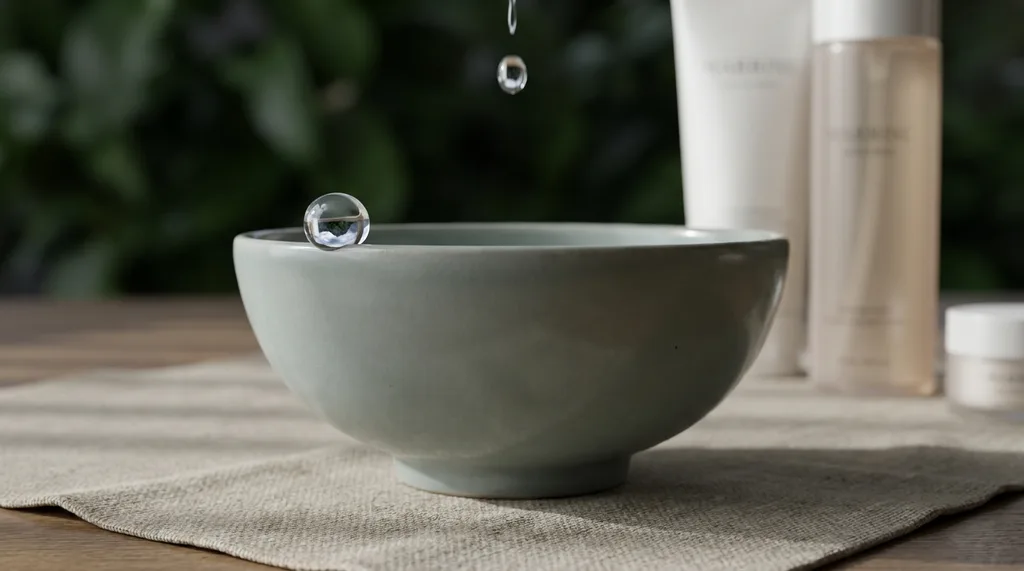
The people who actually achieve glass skin rarely talk about products first. Ask a Korean woman in her late 30s how she gets that lit-from-within translucency, and she'll mention her cleanser's pH before she mentions any serum. She'll tell you about toner temperature — warm hands, not cold fingers. She'll describe the 60 seconds she waits between steps while you're still reaching for your highlighter.
That detail — the cleanser, not the serum — is the entire story.
Here's the tension that nobody in the glass skin content space will name directly: most of the products marketed as "glass skin serums" are selling you the finish. What builds glass skin is something architecturally different, and once you understand it, you realize you've been paying a premium for the decoration on a house that doesn't yet have walls.
There are two distinct Korean glows. One is 속광 (sok-gwang) — an inner radiance that emanates from structural skin health, from a barrier so intact it reflects light like polished stone. The other is 물광 (mul-gwang) — the water glow, a deliberate saturation of the skin's surface that makes light bounce and scatter like sunlight through a glass of water. Most expensive glass skin products sell you the second. The first cannot be bought. It has to be built. And here's what nobody has told you about the difference: if your barrier is compromised, pursuing mul-gwang will actively destroy your chances of ever achieving sok-gwang.
That's the framework. Let's use it to find out what you're actually paying for — and where you're overpaying.
What the Premium Serum Is Actually Selling You
Before comparing anything, you need to understand what glass skin actually requires at a molecular level. Strip away every marketing claim, every founder's origin story, every "infused with rare botanical extract" narrative — and you find the same two functional requirements sitting underneath all of it.
First: an intact lipid barrier. The stratum corneum operates like a brick-and-mortar wall. The bricks are corneocytes — flattened, dead skin cells. The mortar is a precise lipid matrix made of ceramides, cholesterol, and fatty acids. When that mortar is intact, transepidermal water loss (TEWL) stays in a healthy range: roughly 5–15 g/m²h on the cheeks, slightly higher on the forehead. Your skin loses water at a controlled, manageable rate. Light hitting an intact lipid matrix doesn't scatter — it reflects. That reflection is sok-gwang.
Disrupt the mortar — through over-exfoliation, alkaline cleansers, or aggressive actives layered too quickly — and TEWL climbs. The barrier leaks. Skin that was quietly luminous becomes reactive, patchy, and dull no matter how many layers of essence you apply over it.
Second: strategic humectant saturation. Once the barrier is healthy, you can build mul-gwang on top of it. Humectants — primarily hyaluronic acid and glycerin — act as water cages. They pull moisture from the environment and the deeper dermis and hold it in the skin's upper layers. When those upper layers are saturated, the refractive index of the skin surface changes. Light bounces back cleanly, with that specific glassy quality. This is the physics behind the 7스킨법 (7-Skin Method), where multiple thin layers of toner are pressed into damp skin in succession, each layer deepening the saturation.
That's all there is. Two requirements. Everything else in a premium glass skin serum — the proprietary fermented complexes, the cellular renewal factors, the highland spring water — is either a supporting player or packaging.
The expensive versions are often excellent at delivering these two functions. But they're not the only way. And for many people, they're not the best way — because paying for luxury delivery of a ceramide molecule doesn't make the ceramide work better on your skin.
[K-Beauty 101] 속건조 (Sok-geonjo) — a state where the skin's surface appears oily or normal while its deeper layers are chronically dehydrated. This is the condition that makes people reach for heavier creams when what they actually need is barrier repair first. A waterproof roof on a crumbling foundation.
For the full breakdown of how sok-gwang and mul-gwang interact within a complete layered routine, read the main Glass Skin Masterclass — it covers the barrier philosophy in depth before any product enters the picture.
🎵 K-Mono Lofi — Seoul Study Beats
Read deeper with Seoul lo-fi in the background — curated by K-Mono Lofi
The Honest Breakdown: Three Paths to the Same Two Functions
Now we can talk products. Not with brand loyalty, not with sponsorship influence — with the two functional requirements as the only measuring stick.
The core comparison isn't luxury vs. budget. It's: how efficiently and safely does this deliver ceramide repair AND humectant saturation to your specific skin? Here's how the three market tiers perform against that standard.
The cleanser is where the most money is wasted and where the cheapest fix lives. Premium glass skin routines often start with a $35+ first-step oil cleanser and a $25 second-step foam. The science behind 이중 세안 (I-jung Se-an) — double cleansing — is sound. But the pH of that second cleanser is the only thing that actually determines whether it helps or hurts your barrier. A 약산성 (yak-san-seong) cleanser — mildly acidic at pH 5.0 to 6.5 — protects the lipid mortar. An alkaline cleanser, regardless of price or prestige, strips it. You can find pH-balanced cleansers at every price point. The premium version doesn't clean your skin better. It just feels more expensive doing it.
Ceramide delivery is where premium does earn some of its cost — but less than the price gap suggests. The lipid ratio matters (ceramides work best alongside cholesterol and fatty acids in a specific proportion), and cheaper formulas sometimes compromise that ratio for texture. But the gap between a well-formulated mid-range ceramide serum and a luxury one is far narrower than the price difference implies.
Hyaluronic acid is where the dupe wins cleanly. A $6 hyaluronic acid serum from iHerb contains the same molecule as the one in a $90 luxury essence. The molecular weight matters (low-molecular-weight HA penetrates deeper; high-molecular-weight HA films the surface), and some premium formulas do offer multi-weight blends. But this is achievable at non-premium price points if you know to look for it.
Here's how the three approaches to glass skin compare on what actually counts:
| Low-pH Cleanser (Barrier Preservation) | Ceramide Repair | Humectant Saturation | |
|---|---|---|---|
| Premium (Luxury K-Beauty) | Usually excellent pH control | Sophisticated lipid ratios | Multi-weight HA, often fermented |
| Olive Young / Korean Drugstore | Excellent — this market pioneered yak-san-seong | Good to excellent, competitive formulas | Single-weight HA standard; some multi-weight available |
| iHerb / Global Accessible | Variable — must check pH independently | Strong options, especially single-ingredient ceramide serums | High-concentration single-weight HA widely available |
| Primary Risk | Price premium for texture, not efficacy | None if formulated well | None — efficacy equivalent at this molecule level |
| Best For | Those who value sensorial experience | Those with seriously compromised barriers | Everyone — this is where dupe wins outright |
Now, by reader budget and skin state:
💸 Barrier Builder
pH Cleanser + Ceramide Serum
iHerb or Olive Young · Accessible
Best for: broken barriers, reactive skin, over-exfoliation recovery. Build the wall first.
⭐ Full Architecture
pH Cleanser + Ceramide + Multi-HA Serum
Olive Young Mid-Range · Mid-Accessible
Best for: stable barriers ready for mul-gwang layering. This is where the method earns its results.
✨ Sensorial Premium
Luxury Essence + Fermented Complex
Premium K-Beauty · Investment
Best for: those who want the full sensorial ritual AND already have a healthy barrier. Efficacy gap is real but narrower than price suggests.
The reader who most consistently overpays is the one with reactive, barrier-compromised skin who buys a luxury essence first. Their skin is a crumbling foundation — and they're installing premium windows. The ceramide step has to come before the humectant step. Every time.
The Verdict: Which Path Is Actually Yours
Three questions. Answer them honestly and the right tier selects itself.
Does your skin feel tight, reactive, or sensitized after cleansing? That's barrier compromise. Your first investment is a pH-balanced cleanser (pH 5.0–6.5 — check it; most brands don't volunteer this) and a well-formulated ceramide serum. Start with the Barrier Builder tier. Do not layer actives. Do not buy the expensive essence yet. Spend two to four weeks here.
Is your skin stable but dull — not reactive, just flat? Your barrier is probably intact but dehydrated at depth. This is sok-geonjo: the paradox of skin that looks normal but feels tight from within. The Full Architecture tier is your entry point. A ceramide foundation plus a layered humectant strategy — three to five thin applications of a lightweight toner pressed into damp skin — will produce mul-gwang within days. This is the 7-Skin Method's actual purpose: building a concentration gradient that draws water into the deeper epidermis rather than sitting on top.
Is your skin healthy, calm, and you simply want the full luxury of the ritual? Then the premium tier earns its place — but only here. The fermented complexes and proprietary delivery systems in luxury essences do offer marginal advantages in absorption kinetics and additional actives. For a healthy barrier, those margins are perceptible. The mistake is buying premium before the barrier can receive it.
One honest warning the dupe space never gives you: if you are aggressively exfoliating — acids multiple times a week, retinol without a buffer strategy, physical scrubs — no product tier will save your skin. The best ceramide serum in the world cannot rebuild what you're actively destroying every 48 hours. Glass skin is the natural state of skin that is treated gently over time. It is not a product outcome. It is a patience outcome.
[K-Beauty 101] 물광 (Mul-gwang) — water-like radiance from deep dermal saturation, achieved through strategic humectant layering. It is the visible, immediate form of glass skin that responds to technique. But it is temporary without the structural foundation of sok-gwang beneath it. Chase both. Build one first.
Building the Full Glass Skin Architecture
The routine that produces glass skin is not the 10-step routine. The Korean skincare community has been quietly moving toward a stripped-back philosophy — what some call 스킨케어 다이어트 (skincare diet) — because they realized that more steps on a compromised barrier is not more effective. It's more damaging.
Here is the architecture, in order of priority — not in order of steps:
Priority 1 — Barrier Integrity: pH-balanced double cleanse (oil cleanser to dissolve SPF and sebum, yak-san-seong foam to rinse without stripping). This step costs almost nothing and delivers more than anything else in the routine.
Priority 2 — Barrier Repair: A ceramide serum or cream applied to slightly damp skin. Warm it between your palms first — this is not optional, it's the difference between the product sitting on skin and the skin receiving it. Press it in with flat hands; no rubbing.
Priority 3 — Humectant Layering: The 7-Skin Method, but executed with patience. Apply a lightweight, water-forward toner in three to five thin layers, pressing each one in and waiting 30 to 60 seconds before the next. The skin should feel plump and slightly tacky — not wet, not dry — before you seal with anything.
Priority 4 — Occlusion (the final 10%): A light emollient to seal everything underneath. This is where the expensive product matters least and the technique matters most. More is not better. A thin layer of a well-formulated emollient works; a thick layer of even a luxury cream creates gae-gireum.
That's the whole system. Four priorities. The products within each priority can range from drugstore to premium — and the difference in outcomes, for a healthy barrier, is far smaller than the beauty industry needs you to believe.
Glass skin is not a finish you apply. It's a biological state you protect. The products are the final 20%. The other 80% is understanding which of the two Korean glows you're building toward — and in which order.
Build the wall. Then fill it with water. Then let it glow.
Medical & Skincare Disclaimer: The skincare information in this article is for educational purposes only and does not constitute medical advice. Individual skin conditions, including compromised barriers, chronic dryness, and reactive skin, may require assessment by a board-certified dermatologist before introducing new formulas or changing your routine. Always patch-test new products on a small area for 24–48 hours before full application. TEWL measurements and skin barrier data referenced here are general clinical ranges; your individual skin health should be evaluated by a professional. If you experience persistent irritation, redness, or barrier disruption, consult a dermatologist before proceeding with any layering strategy.
⚠️ Disclaimer: This article is for informational purposes only and does not constitute medical, dermatological, or financial advice. Skincare responses are highly individual — ingredients and routines that work for one person may not suit another. If you have a diagnosed skin condition, are pregnant, or are currently under dermatological care, consult your physician or a board-certified dermatologist before changing your routine or introducing new active ingredients. Market size figures cited represent analyst forecasts and should not be treated as confirmed data.
This article may contain affiliate links — if you buy through them, we may earn a small commission at no extra cost to you.
✓ Researched and compiled using verified data as of the publication date.
 Written by Jun Mi Jung for Quiet Korea | Contact: rsl.2001.1975@gmail.com
Comments
Post a Comment