Beyond the Oil Slick: Unmasking the Truth About Your Oily-Dehydrated Skin

If you’ve ever looked in the mirror at 3 PM and seen a face that is simultaneously slick with oil and feeling tight enough to crack, you know the frustration of the Subuji (수부지) cycle. You are caught in a classic trap: the surface is greasy, so you reach for the harshest cleanser in the cabinet, scrub until your skin squeaks, and then wonder why, by dinner, your face looks like it’s being fried in a pan.

The secret that the multi-step industry won't tell you is that your oiliness is not the enemy—it’s a desperate SOS signal from a compromised barrier.
Key Takeaways * Oily-dehydrated skin (Subuji) is a temporary state of barrier damage, not a permanent skin type. * Aggressive cleansing triggers a compensatory rebound, forcing sebaceous glands to overproduce oil to protect a weakened skin barrier. * True "glass skin" is achieved by prioritizing hydration-retention over oil-stripping, shifting from a 10-step routine to a targeted minimalist approach.
The Myth of the "Oily Skin" Diagnosis
Walk into any Olive Young in Seoul, and you will see shelves lined with products promising to "control" sebum. But for many, this is a dangerous invitation. When your skin feels tight underneath but oily on top, it is telling you it has lost its ability to hold water.
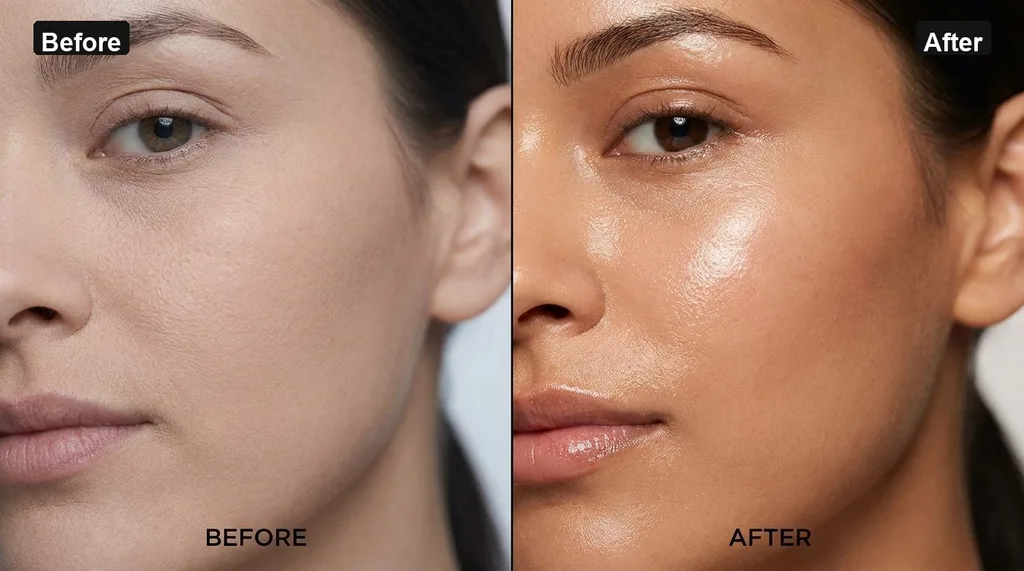
In this state, your stratum corneum—the outermost layer of your skin—has developed microscopic fissures. Water evaporates at an accelerated rate, a process known as Transepidermal Water Loss (TEWL). Your skin, terrified of drying out, turns on the oil faucets to create an occlusive seal. If you treat that oil as "dirt" and strip it away, you are simply widening the fissures. The skin responds by pumping out even more oil, and the cycle repeats. You aren't "oily"; you are thirsty.
How Hyaluronic Acid Actually Works
To break the cycle, you need to understand that the goal isn't to remove oil—it is to replace the water that is being lost. This is where the Skinimalism philosophy shines.
Hyaluronic acid is the gold standard, but the molecular weight is the detail that matters. Large molecules stay on the surface, creating a sticky film that feels like a mask. You want low-molecular-weight humectants that can dive into those microscopic fissures, pulling moisture into the deeper layers of the epidermis.
🎵 K-Mono Lofi — Seoul Study Beats
Read deeper with Seoul lo-fi in the background — curated by K-Mono Lofi
The Art of the "Hwajalmeok" Base
In Korea, the term Hwajalmeok (화잘먹)—meaning "makeup eats well"—is the highest compliment one can pay a skincare routine. It doesn't mean your skin is matte; it means it is so deeply hydrated and balanced that foundation sits perfectly on the surface without settling into pores or flaking.
To get there, stop looking for "oil control" and start looking for "skin cooling." Chronic stress and heat can cause the sebaceous glands to overreact. A cooling, watery essence or toner applied in thin layers—the 3-skin method—calms the skin’s nervous system, signaling that it is safe to stop the emergency oil production.
Frequently Asked Questions
Can I use niacinamide if I have oily-dehydrated skin? Yes, but use it with caution. Niacinamide is excellent for regulating sebum, but at high concentrations (like 10% or more), it can be irritating to a compromised barrier. Look for 2–5% concentrations for a gentle balancing effect.
How long does it take to see results? The skin’s turnover cycle is approximately 28 days. You should expect to see the "inner tightness" (속건조) subside within the first week, but the total stabilization of your sebum production will likely take one full month of consistent, gentle care.
What if I still get tiny whiteheads (좁쌀)? These are often a sign of using products that are too heavy or occlusive for your current barrier state. If you see them, pause all oils and rich creams, and revert to a pure hydration-focused routine (toner + light serum) until the skin texture normalizes.
⚠️ Disclaimer: This guide is for educational purposes only and does not constitute medical advice. If your skin is inflamed, painful, or suffering from persistent acne, please consult a board-certified dermatologist. Always patch-test new products on your inner arm before applying them to your face to avoid adverse reactions.
⚠️ Disclaimer: This article is for informational and educational purposes only and does not constitute medical, dermatological, or financial advice. Individual results vary — consult a board-certified dermatologist or physician before starting any new skincare routine, supplement, or procedure, especially if pregnant, nursing, or taking other medications. This article may contain affiliate links — if you buy through them, we may earn a small commission at no extra cost to you.
✓ Researched and compiled using verified data as of the publication date.
 Written by Jun Mi Jung for Quiet Korea | Contact: rsl.2001.1975@gmail.com
Comments
Post a Comment