Beyond the Glow: Why Your 10-Step Routine is Failing Your Skin

If you have ever stood in the fluorescent glow of an Olive Young aisle, clutching a basket of serums and masks while a sinking feeling in your stomach told you that your skin still wasn’t "glassy" enough, you are not alone. You have been sold a fantasy.

The global fascination with Korean beauty has often been reduced to a numbers game: the more steps, the better. But if you walk into any clinic in Gangnam or chat with the women who actually live here, you will realize the truth is the exact opposite. The obsession with layering product after product is precisely what is destroying the Pibu Jangbyeok—your skin’s natural barrier.
Key Takeaways * The "Viscosity Rule" is the most important lesson in layering: always move from water-like, thin toners to thicker, oil-rich creams to ensure actual penetration. * Your skin is likely struggling with Sok-geon-jo (internal dryness), where a greasy surface masks a parched foundation, caused by over-exfoliation and excessive product use. * Authenticity in K-beauty is found in the "skincare diet"—stripping back to the essentials and respecting the 60-second absorption window between layers.
The Secret of the 60-Second Rule
The most common mistake international enthusiasts make is treating their face like a whiteboard. We apply toner, then immediately follow with essence, then serum, then moisturizer, all within thirty seconds.
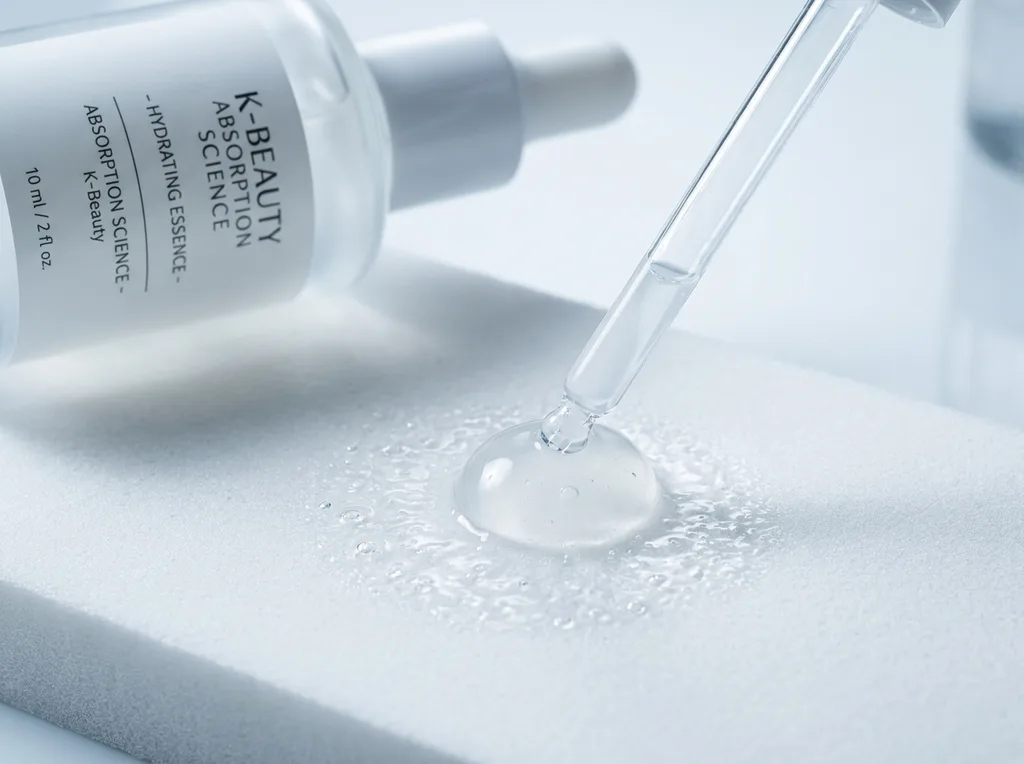
Think of your skin as a sponge. If you pour a gallon of water onto a dry, hardened sponge, it simply runs off. If you gently mist it and wait, it becomes absorbent. In Seoul, the Kkul-tip (honey tip) is not about the product—it is about the clock. When you apply your hydrating toner, wait 30 to 60 seconds. Let the humectants pull moisture into the cells. If you do not give your skin time to "drink," you are simply creating a film of expensive ingredients that will eventually pill or evaporate, leaving you with that frustrating Sok-geon-jo sensation—oily on the surface, but tight and parched underneath.
How Hyaluronic Acid Actually Works
The goal of your routine should be to support your barrier, not drown it. Many popular serums are designed to lock in moisture, but they require a hydrated environment to function. If you apply a heavy hyaluronic acid serum to bone-dry skin, it will actually pull moisture out of your deeper layers to hydrate the surface.
🎵 K-Mono Lofi — Seoul Study Beats
Read deeper with Seoul lo-fi in the background — curated by K-Mono Lofi
This is where the "skincare diet"—or Hwajangpum Diet—becomes your best friend. By reducing your routine to a mild cleanser, a single hydrating toner, and a barrier-strengthening cream, you allow your skin to normalize its own oil production.
[K-Beauty 101] Hwajangpum Diet (화장품 다이어트) — Skincare minimalism. In a culture of constant innovation, the most revolutionary act is often to stop. Reducing your routine to 3–4 core products allows your skin barrier to recover from irritation, often resolving persistent breakouts that more products only exacerbated.
Navigating the Olive Young Ecosystem
When you finally step into that Olive Young, do not be swayed by the elaborate packaging. The products that earn their place on the shelves are those that have survived the Hwahae vetting process. Koreans are some of the most critical consumers in the world; if a product doesn't deliver, it disappears from the #1 rankings within a season.
If you are currently dealing with redness or a burning sensation, stop looking for "brightening" or "anti-aging" actives. Your skin is crying out for repair. Look for products containing Centella Asiatica or Madecassoside. These ingredients modulate the inflammatory cascade, effectively calming the skin while your barrier works to knit itself back together.
The Truth About Transparency
It is important to remember that skin is an organ, not a canvas for marketing experiments. High-potency ingredients like 20% Niacinamide might sound impressive, but they often lead to "niacin flush"—a dilation of your capillaries that leaves you red and uncomfortable. For most skin types, a 2% to 5% concentration is the "sweet spot" where you get the brightening benefits without the irritation.
This article may contain affiliate links—if you buy through them, we may earn a small commission at no extra cost to you.
Frequently Asked Questions
Can I use too many active ingredients at once? Yes. Combining multiple strong actives like Retinol, Vitamin C, and exfoliating acids often leads to a compromised barrier. Focus on one goal at a time: repair your barrier first, then introduce one active ingredient slowly.
How long does it take to see results? Skin cell turnover takes approximately 28 to 30 days. You should give any new, gentle skincare routine at least one full month before deciding if it is effective. Do not fall for the "overnight miracle" trap.
Why does my face feel oily but look dull? This is the classic Subujji (oily-dehydrated) profile. Your skin is overproducing oil to compensate for a lack of deep hydration. Switch to a hydrating toner layered twice, followed by a light emulsion, and avoid harsh, stripping cleansers.
⚠️ Disclaimer: The information provided here is for educational purposes and is not a substitute for professional medical advice. Always perform a patch test on your inner arm before applying new products to your face, and consult with a board-certified dermatologist if you are experiencing severe irritation, allergic reactions, or persistent skin conditions.
✓ Researched and compiled using verified data as of the publication date.
 Written by Jun Mi Jung for Quiet Korea | Contact: rsl.2001.1975@gmail.com
Comments
Post a Comment