Beyond the 10-Step Myth: The Science of Achieving Real Glass Skin
Beyond the 10-Step Myth: The Science of Achieving Real Glass Skin
The global obsession with yurial-pibu, or "glass skin," often feels like a race toward an unreachable finish line. For years, the internet has sold the idea that transparency, porelessness, and that signature water-glow are simply a matter of volume—if you stack enough bottles on your vanity, you will eventually reach the promised land of reflection. But walk into any pharmacy in Seoul or sit in a consultation room in Gangnam, and you will find a different reality. The most luminous skin in Korea isn't the result of a marathon routine; it is the product of a precise, science-backed diet that respects the skin’s architecture.
Key Takeaways * Glass skin is not achieved by quantity, but by stabilizing the skin barrier through viscosity-based layering and molecular weight management. * Over-layering is the most common cause of inflammation; a "cosmetic diet" based on environmental shifts is the true secret of the Korean aesthetic. * Ingredients like Galactomyces Ferment Filtrate and multi-weight Hyaluronic Acid are functional stabilizers that do the heavy lifting, not just temporary hydrators.
The Physics of the Glow
To understand why your skin doesn't reflect light like glass, we have to stop looking at products as magical concoctions and start looking at them as engineering tools. True mul-gwang—that dewy, water-glow finish—is fundamentally about the state of your stratum corneum. When the skin barrier is compromised, it becomes rough and irregular; light hits these microscopic peaks and valleys and scatters in every direction, resulting in a dull, matte appearance.
When the barrier is healthy and hydrated, the surface becomes smooth and continuous. Light hits it and bounces back in a uniform, reflective beam. This is the "glass" effect. Research into ingredients like Galactomyces Ferment Filtrate (GFF) has shown that it acts as a multifunctional stabilizer. By delivering essential vitamins and minerals, GFF helps upregulate the expression of filaggrin—the protein responsible for building our natural skin barrier. It isn't a quick fix; it’s structural support.
The Viscosity Strategy
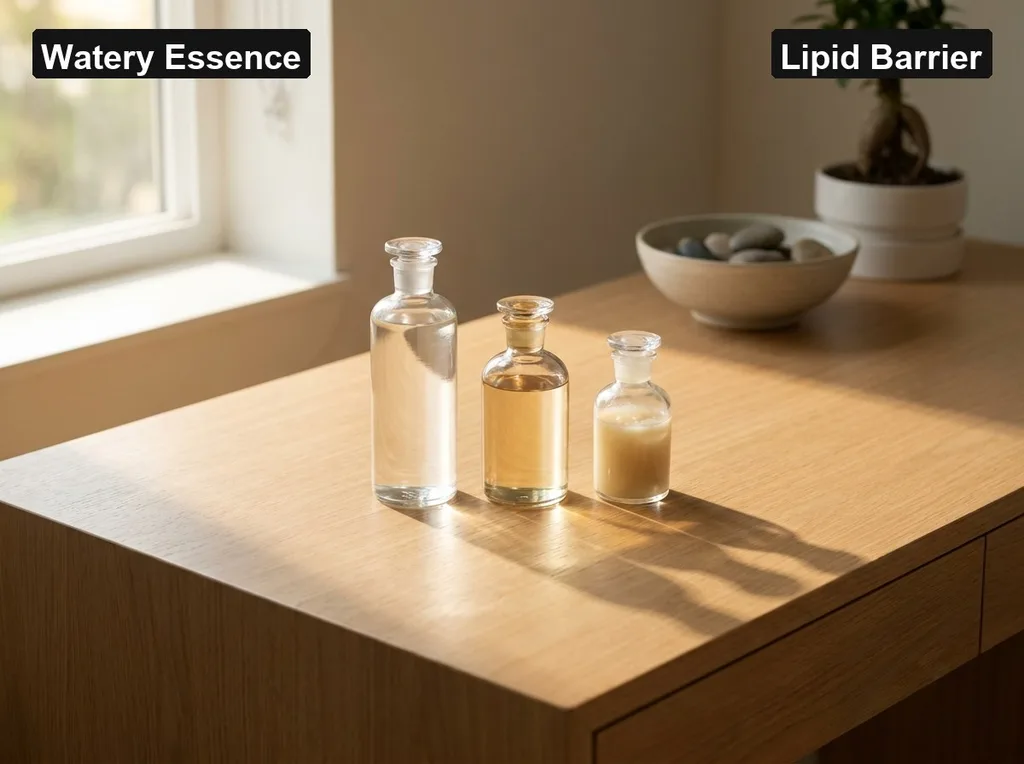
The most common mistake among beauty enthusiasts is the failure to account for product sequence. The rule is simple: water flows first, lipids follow. If you apply a heavy, oil-based cream before a lightweight, watery essence, you are essentially creating a barrier that prevents the smaller, more vital molecules from reaching the epidermis.
In Korea, the "7-skin-beop" (seven-skin method) is often misunderstood as a mandate to apply seven layers of product. In reality, it is a teaching tool to encourage the use of lightweight, buildable layers that soak in completely. The secret that nobody mentions? The 30-to-60-second wait. If you don't allow the skin time to absorb the previous layer, you aren't building hydration; you’re just creating a sticky, unstable film that will inevitably pill under your makeup.
🎵 K-Mono Lofi — Seoul Study Beats
Read deeper with Seoul lo-fi in the background — curated by K-Mono Lofi
When "More" Becomes "Less"
We are currently witnessing a shift toward pibugwahak, or dermatological science. The era of the "more-is-better" routine is being replaced by the "cosmetic diet." If you are suffering from sok-geonjo—that deceptive inner dryness where the skin feels parched even though the surface looks oily—you are likely trapped in a cycle of over-care.
Over-exfoliating or applying occlusive layers in high-humidity environments triggers inflammation. When the skin is inflamed, it cannot reflect light. It becomes reactive. If you’ve been chasing glass skin and finding only breakouts or persistent redness, your skin is likely telling you to stop. A minimalist routine that prioritizes barrier integrity—cleansing with a pH-balanced wash, followed by one high-quality hydrating serum and a breathable SPF—will almost always outperform a complex ten-step ritual that leaves the skin suffocated.
The Honest Cost of the Aesthetic
It is essential to acknowledge that the "glass skin" seen on social media is often a curated snapshot, not a permanent state. Professional dermatology in Seoul relies heavily on interventions that go beyond what you can buy at a counter—DNA fragments, laser resurfacing, and personalized skin-barrier therapy are the true drivers of that poreless perfection. Treating a bottled serum as a substitute for professional clinical care will lead only to frustration.
[K-Beauty 101] 속건조 (Sok-geonjo) — Deep-seated inner dryness. This sensation of being parched beneath the skin's surface is the primary enemy of the glass skin aesthetic. It signals that your routine is addressing the surface, not the structural hydration needs of the epidermis.

⚠️ Disclaimer: This article is for educational purposes only and does not constitute medical advice. Skincare needs are highly individual; before introducing new actives, especially fermented ingredients like GFF, perform a patch test to avoid adverse reactions. If you have concerns about your skin barrier or persistent conditions, consult with a board-certified dermatologist.
⚠️ Disclaimer: This article is for informational and educational purposes only and does not constitute medical, dermatological, or financial advice. Individual results vary — consult a board-certified dermatologist or physician before starting any new skincare routine, supplement, or procedure, especially if pregnant, nursing, or taking other medications. This article may contain affiliate links — if you buy through them, we may earn a small commission at no extra cost to you.
✓ Researched and compiled using verified data as of the publication date.
 Written by Jun Mi Jung for Quiet Korea | Contact: rsl.2001.1975@gmail.com