The Gangnam Formula: Reclaiming Skin Elasticity Over 60 Without the Luxury Price Tag
Walk into the quiet, pristine skincare boutiques of Cheongdam-dong, Seoul's elite beauty enclave, and you will see elegant women in their sixties bypassing the flashy, trend-driven bottles designed for the younger generation. Instead, they focus on something far more clinical. There is a common cultural assumption among global consumers that achieving the firm, resilient skin known in Korea as tallyeok (skin elasticity) requires a small fortune—specifically, investing in high-end, triple-digit luxury creams from legacy brands like Sulwhasoo or Western equivalents like Valmont. But behind the beautiful glass jars and heavy brass spatulas lies a regulatory reality that the marketing departments would prefer you didn't look at too closely.
Key Takeaways * The Regulation Equalizer: Korea’s Ministry of Food and Drug Safety (MFDS) strictly caps functional ingredients, meaning budget alternatives often contain the exact same active concentrations as luxury creams. * Elasticity Over Erasing: True anti-aging over 60 focuses on restoring the skin barrier and tallyeok (elasticity) rather than aggressively stripping the skin with high-strength retinoids. * Smart Substitution: By understanding ingredient autopsies, you can swap expensive luxury formulas for clinical, high-performance Korean dupes at a fraction of the price.
The Ingredient Autopsy: What Are You Actually Paying For?
Let's perform a forensic analysis on what actually goes into a prestige anti-aging bottle. The global skincare market reached USD 106.8 Billion in 2023, driven largely by the promise of youth in a jar. In South Korea, where the cosmetics market is projected to hit USD 18.39 Billion, the government regulates skincare with unmatched precision.
Under the rules of the Ministry of Food and Drug Safety (MFDS), cosmetics that make active anti-aging claims are designated as Gineungsung Hwajangpum (Functional Cosmetics). This isn't just a marketing label; it is a legal category. To earn this certification, a brand must either submit expensive Inche Jeogyong Siheom (Human Application Tests) or formulate using Go-shi Won-ryo (Notified Ingredients) at precise, government-mandated concentrations.
For example, look at Adenosine, the gold standard for wrinkle improvement in Korea. The MFDS pre-approves Adenosine at a concentration of exactly 0.04%. Whether you buy a $220 luxury ginseng cream or an $18 apothecary serum from Olive Young, the level of Adenosine doing the cellular work is frequently identical. The same applies to brightening agents: Niacinamide is strictly capped between 2% and 5% to prevent barrier irritation.
So where does the rest of your $200 go? It goes toward the "vehicle"—the cosmetic elegance of the base, the expensive fragrance, the weight of the custom-molded glass jar, and the celebrity-driven marketing campaigns. While luxury bases do offer a beautiful, silk-like slip upon application, they do not change the physiological rate of cellular renewal. For mature skin over 60, which naturally experiences thinning, reduced sebum production, and a fragile lipid barrier, paying for heavy synthetic silicones and complex fragrance profiles can actually backfire, leading to contact dermatitis or micro-inflammation.
For a deeper understanding of how traditional Korean anti-aging principles prioritize barrier restoration over aggressive peeling, read our comprehensive guide on The Science of Hanbang and Longevity Skincare.
🎵 K-Mono Lofi — Seoul Study Beats
Read deeper with Seoul lo-fi in the background — curated by K-Mono Lofi
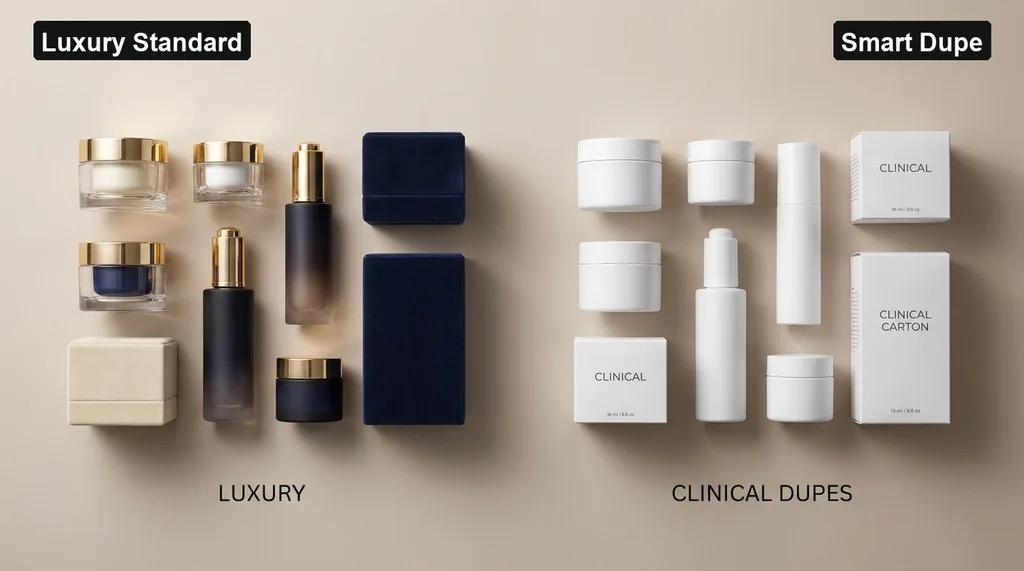
The Honest Comparison: Luxury vs. Smart Korean Dupes
When evaluating alternatives for mature skin, we must look for formulations that mimic the lipid-replenishing and collagen-supporting properties of prestige creams without their high-irritation fragrance loads.
For decades, Korean grandmothers have relied on hongsam (red ginseng) for cellular vitality. Modern cosmetic science has validated this, proving that the steamed and dried root contains highly bioavailable ginsenosides that stimulate collagen production. Luxury brands charge premium prices for this heritage ingredient, but smart formulary alternatives exist.
Let’s look at a side-by-side comparison of three distinct tiers: the prestige standard, the high-performance Olive Young alternative, and the ultra-pure, budget-conscious iHerb option.
💸 Budget Pick (iHerb)
Beauty of Joseon Ginseng Serum
Ginseng Root Water 63% · Niacinamide 3% · ~$16.00
💊 Find This on iHerb (Use Code QAK3042 for a discount!)
Guaranteed authentic K-Beauty actives & supplements with fast global shipping.
✓ Researched and compiled using verified data as of the publication date.
 Written by Jun Mi Jung for Quiet Korea | Contact: rsl.2001.1975@gmail.com