The Death of 'Cha-reu-reu' Fluidity: Why Your Chemical Straightening is Leaking Protein (And the Korean Barbershop Strategy to Save It)
Key Takeaways * The Protein Leak: Chemical straightening is molecular surgery that cleaves disulfide bonds, resulting in significant protein loss (up to 3.5 micrograms/g). * The Hydrophilic Trap: Stripping the hair's natural F-layer turns it from water-repelling to water-thirsty, leading to chronic frizz when exposed to humidity. * The Restoration Protocol: Rebuilding hair structural integrity requires waiting 24–48 hours post-treatment, thermal protection below its glass transition temperature, and specialized polymers.
Table of Contents
- The Molecular Reality: Why Chemical Straightening is Hair Surgery
- The K-Grooming Philosophy: Rebuilding the 'Mul-miyeok' Gloss
- Rule 1: Respect the 48-Hour Curing Window
- Rule 2: Control the Glass Transition Temperature ($T_g$)
- Rule 3: Use Hydrophilic-Targeting Polymers
- Explore Protein Repair and Hair Treatments
- The Step-by-Step Recovery Routine
- Frequently Asked Questions
- Can I use regular hair wax on chemically straightened hair?
- How often should I apply protein treatments to my hair?
- Why does my hair smell like sulfur when it gets wet after straightening?
Many men make a fundamental mistake when trying to replicate the clean, effortlessly styled haircuts seen on the streets of Seoul. They walk into a salon, get a chemical down-perm or a straightening treatment, and expect to walk out with the sleek, fluid drape known in Korea as cha-reu-reu—only to find their hair transformed into a dry, static-prone mass of straw within a week.
The harsh truth is that most men treat their hair like a piece of dead fabric. They douse it in aggressive "3-in-1" body wash-shampoo hybrids, hit it with raw, unprotected heat, and wonder why their scalp feels like sandpaper and their hair looks like a wire brush. Chemical straightening is not a simple styling shortcut; it is a profound alteration of your hair's molecular architecture. When you force curly or coarse hair to lay perfectly flat, you are performing structural surgery. If you do not follow the recovery protocol, the patient dies.
🎵 K-Mono Lofi — Seoul Study Beats
Read deeper with Seoul lo-fi in the background — curated by K-Mono Lofi
The Molecular Reality: Why Chemical Straightening is Hair Surgery
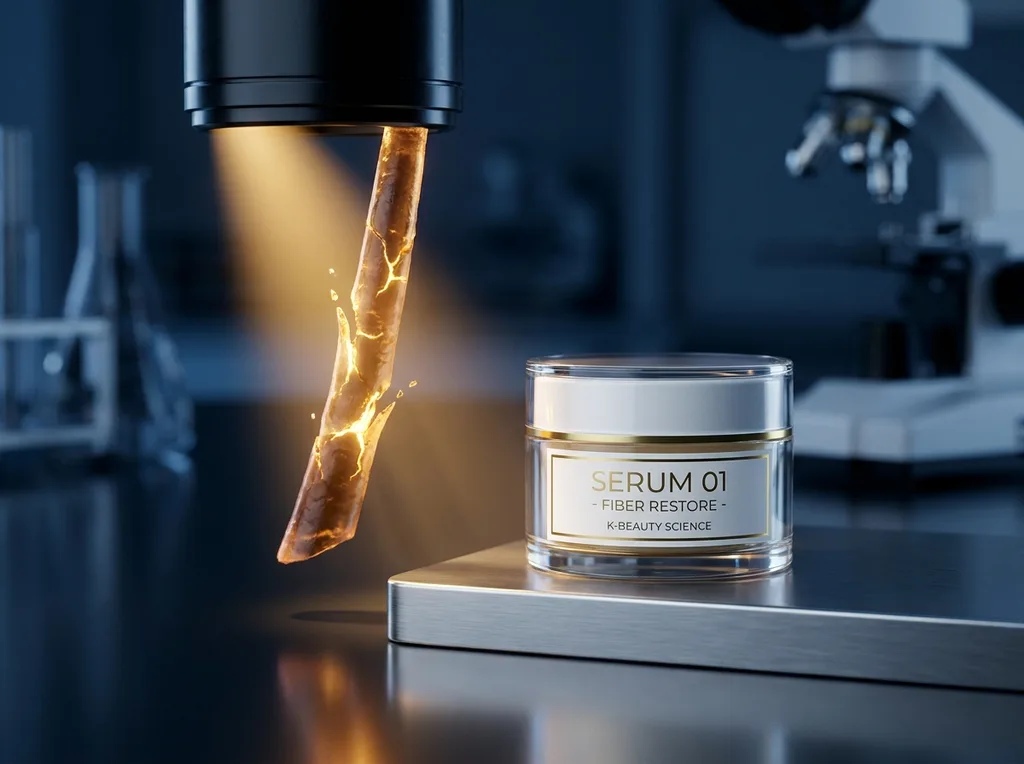
To understand why your hair feels ruined, you have to look beneath the cuticle. Healthy hair is held together by covalent disulfide bonds. These are the physical anchors that determine whether your hair is straight, wavy, or curly.
During a chemical straightening or down-perm process, strong reducing agents (typically ammonium thioglycolate) are applied to break these disulfide bonds. This renders the hair completely malleable. Once the hair is mechanically flattened or smoothed, an oxidizing agent is applied to "re-link" those bonds into their new, straight configuration.
But here is the catch: this chemical re-linking is never 100% efficient.
Every time you undergo this process, a percentage of those structural bonds fail to reform. This leaves the inner cortex permanently weakened, creating micro-gaps where essential keratins and proteins literally wash out of the hair shaft during every single shower. Furthermore, the chemical processing strips away the hair’s F-layer—the ultra-thin, hydrophobic lipid barrier that naturally coats each strand. Without this oily shield, your hair becomes highly hydrophilic (water-attracting). It begins to suck in atmospheric moisture, causing the hair shaft to swell unevenly and create that frizzy, uncontrolled look.
The data paints a clear picture: glyoxylic acid treatments, while often marketed as "natural keratin" alternatives, actually result in higher protein loss (~3.5 micrograms/g) due to the intense heat required to seal the acid into the hair matrix. Traditional alkaline straightening is slightly less devastating to the protein structure (~2.5 micrograms/g) but highly disruptive to the scalp's natural pH level.
The K-Grooming Philosophy: Rebuilding the 'Mul-miyeok' Gloss
In Seoul's top-tier barbershops, the ultimate aesthetic goal for men's hair is mul-miyeok—a term that translates to "wet seaweed." It describes hair that is so deeply hydrated, smooth, and structurally sound that it moves fluidly as a single, heavy, frictionless mass.
Achieving mul-miyeok fluid drape after chemical straightening requires a disciplined post-procedure protocol. It is a scientific approach to managing protein architecture, not just throwing random styling creams at your head.
Rule 1: Respect the 48-Hour Curing Window
Do not wash your hair for at least 24 to 48 hours after a chemical straightening or down-perm treatment. The newly formed disulfide bonds require time to fully stabilize and cure. Washing your hair too early with surfactant-heavy shampoos will disrupt this stabilization process, resulting in immediate structural collapse and premature frizz.
Rule 2: Control the Glass Transition Temperature ($T_g$)
Human hair behaves like a classic polymer. It has a specific glass transition temperature ($T_g$)—typically between 150°C and 230°C. Below this temperature, hair is relatively stiff and stable; above it, the internal keratin structure becomes highly fluid and easily damaged. When blow-drying or flat-ironing chemically straightened hair, you must keep the heat settings well below 150°C and always apply a silicone- or protein-infused thermal barrier to prevent localized melting of the cuticle.
Rule 3: Use Hydrophilic-Targeting Polymers
Standard men's conditioners are formulated for healthy, hydrophobic hair. They rely on heavy, natural oils that sit on top of the strand. Chemically treated hair, having lost its F-layer, is highly hydrophilic and will actually repel these heavy oils, leaving your hair feeling simultaneously greasy on the surface and bone-dry inside.
To bridge this gap, you need specialized, modified polymers such as amodimethicone or quaternary ammonium compounds. These smart ingredients carry a positive charge that naturally binds to the damaged, negatively charged areas of the hair shaft, depositing a microscopic protective film without causing heavy build-up.
Additionally, integrating Hanbang (traditional Korean herbal) ingredients like ginseng root, ginger, and green tea extracts helps soothe the scalp microbiome, which is often irritated by the alkaline nature of chemical straightening solutions.
This article may contain affiliate links — if you buy through them, we may earn a small commission at no extra cost to you.
The Step-by-Step Recovery Routine
If you want to transition your hair from dry straw to fluid cha-reu-reu movement, stop overcomplicating things with ten different styling clays. Instead, implement this highly efficient weekly routine:
- The Gentle Cleanse: Swap out harsh sulfates for a weakly acidic, pH-balanced shampoo. This helps seal the cuticle layer back down after the alkaline shock of chemical treatments.
- The Damp-Hair Protein Load: Immediately after showering, while your hair is still damp and the cuticle is slightly swollen, apply a liquid amino acid or hydrolyzed protein treatment. Damp hair acts as a sponge, allowing micro-proteins to penetrate deep into the cortex before you seal the hair shaft.
- The Thermal Shield: Before touching a blow dryer, apply a leave-in treatment containing amodimethicone to protect the hair from exceeding its $T_g$ limit.
For a deeper look into how chemical treatments interact with specific hair types and how the classic Korean down-perm reshapes your silhouette, read our comprehensive guide on the topic:
Read next: → K-Grooming: The Molecular Truth of the Down-Perm
Frequently Asked Questions
Can I use regular hair wax on chemically straightened hair?
You can, but you should avoid highly matte, clay-based waxes. These formulations rely on bentonite or diatomaceous earth, which absorb moisture and can strip the fragile moisture balance from chemically processed hair. Opt for water-soluble pomades or light creams instead.
How often should I apply protein treatments to my hair?
For chemically straightened hair, a concentrated protein treatment should be used once or twice a week. Over-using proteins without balancing them with hydrating ingredients can make the hair stiff and prone to snapping.
Why does my hair smell like sulfur when it gets wet after straightening?
This is a sign of incomplete oxidation. Some of the sulfur-containing disulfide bonds that were broken during the chemical process did not fully re-link. Using a slightly acidic rinse (like a diluted apple cider vinegar rinse) can help neutralize the chemical residues and eliminate the smell.
⚠️ Disclaimer: Chemical hair straightening treatments and down-perms involve strong alkaline or acidic agents that can cause skin irritation, chemical burns, or severe hair breakage if improperly applied. Always perform a patch test before treatment, and consult with a licensed, professional hair stylist or dermatologist if you experience persistent scalp irritation or hair loss.
✓ Researched and compiled using verified data as of the publication date.
 Written by Jun Mi Jung for Quiet Korea | Contact: rsl.2001.1975@gmail.com