Beyond the Peel: Why Seoul's Newest Skin Philosophy Abandons the Scrub
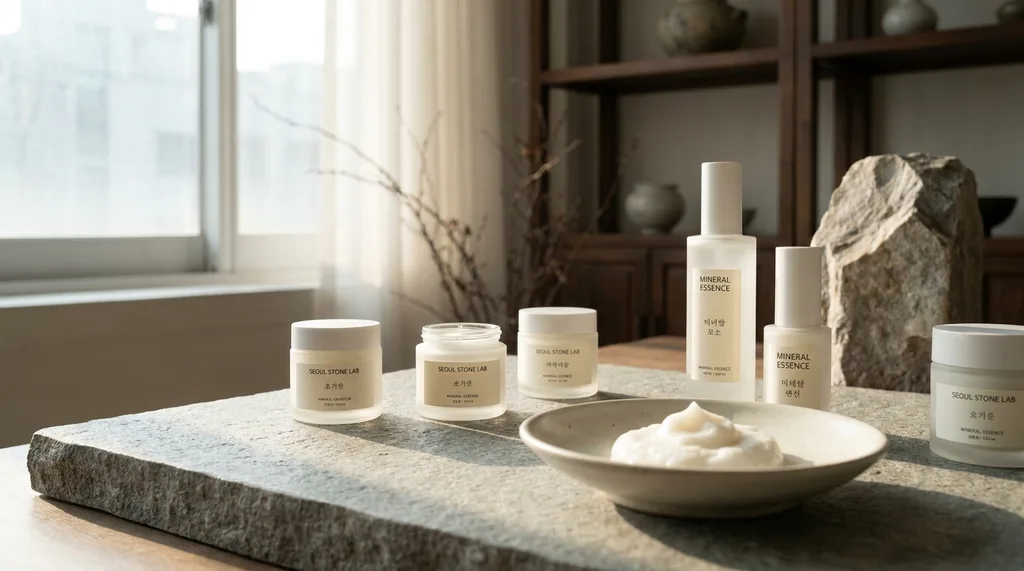
Walk into any late-night pharmacy in Gangnam or scan the crowded aisles of an Olive Young at midnight, and you will notice a quiet revolution. The towering shelves of high-percentage glycolic acid toners, aggressive physical scrubs, and stinging peel pads are quietly receding. In their place stands a battalion of unassuming white bottles, heavy with ceramides, panthenol, and skin-identical lipids.
- The Architecture of the Skin Barrier
- The Golden Ratio of Recovery
- The Shift Toward Skincare Minimalism
- The Hidden Cost of Chasing the Glow
- Frequently Asked Questions
- Can I use exfoliating acids while repairing my skin barrier?
- How long does it actually take to restore a damaged skin barrier?
- What is the best way to test if my skin barrier is damaged?
- Explore Ceramide and Barrier Repair Formulas
For years, the global obsession with Korean beauty was built on the promise of acceleration. If your skin was dull, you were told to strip it away. If your pores were visible, you were handed a stronger acid. But spend enough time listening to the clinical consensus in Seoul, and a very different truth emerges.
Key Takeaways - Modern Korean skincare has shifted from aggressive exfoliation to barrier integrity, treating skin health as an architectural science rather than a surface polish. - The skin's lipid matrix—composed of ceramides, cholesterol, and fatty acids—must remain intact to prevent moisture loss and systemic inflammation. - Achieving the coveted glass skin look relies on a minimalist, strategic layering routine rather than the overwhelming ten-step regimens of the past.
The global 뷰티 유목민 (beauty nomad) spends years buying products designed to force a glow, only to find their skin stinging, reactive, and permanently parched. They suspect the real method is being kept from them. They are half right. The missing piece of the puzzle isn't a secret active ingredient. It is a fundamental philosophical shift: glass skin is not a texture you achieve by stripping; it is a light you unlock by protecting.
The Architecture of the Skin Barrier
To understand why modern Korean skincare has abandoned the aggressive peel, you have to look down—past the epidermis, straight into the microscopic architecture of the stratum corneum. Dermatologists in Seoul frequently describe this layer using a classic architectural metaphor: the brick-and-mortar model.
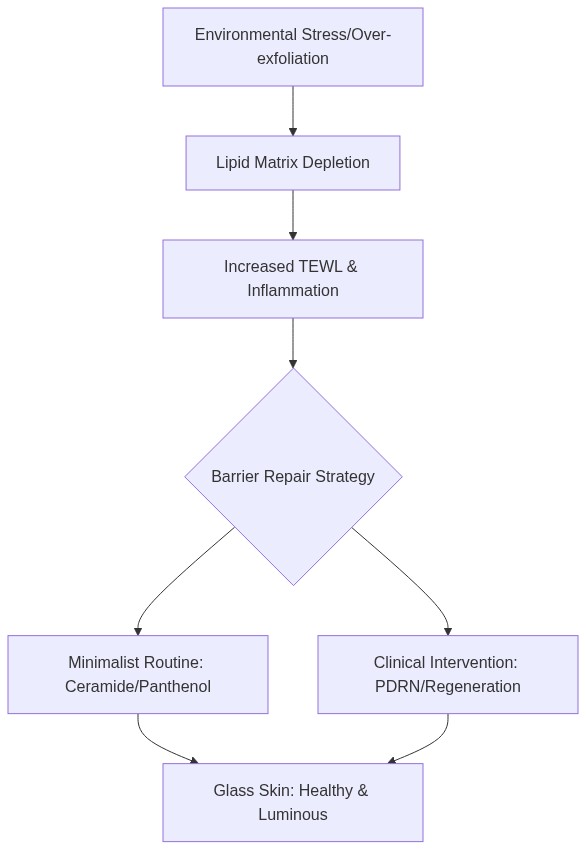
In this framework, your skin cells are the bricks. The mortar holding them together is the intercellular lipid matrix, a precise biological architecture made up of ceramides, free fatty acids, and cholesterol. When this matrix is intact, it acts like a reinforced concrete wall, locking hydration inside and keeping environmental aggressors out.
When you apply a high-strength chemical peel or scrub your face until it squeaks, you aren't just removing dead cells. You are dissolving the mortar.
The clinical consequences of this destruction are immediate. As the lipid matrix depletes, trans-epidermal water loss (TEWL) spikes. The skin panics, sending out inflammatory signals while desperately trying to overcompensate by pumping out surface oil. This is the exact biological trap that creates 수부지 (Subuji)—skin that feels oily and suffocated on the surface while remaining bone-dry and dehydrated underneath.
<div style="display:flex;flex-wrap:wrap;gap:16px;margin:28px 0;">
  <div style="flex:1;min-width:260px;background:#fff5f5;border:1px solid #ffd8d8;border-radius:8px;padding:18px 20px;">
    <p style="font-weight:700;color:#c53030;margin:0 0 8px;">⚠️ The Peel Trap (Old Paradigm)</p>
    <p style="font-size:14px;color:#3a3a3a;margin:0;line-height:1.6;">Constant exfoliation forces immediate surface smoothness by sacrificing the lipid matrix, triggering chronic micro-inflammation, redness, and accelerated sensitivity.</p>
  </div>
  <div style="flex:1;min-width:260px;background:#f0fdf4;border:1px solid #bbf7d0;border-radius:8px;padding:18px 20px;">
    <p style="font-weight:700;color:#16a34a;margin:0 0 8px;">✅ The Barrier-First Model (New Paradigm)</p>
    <p style="font-size:14px;color:#3a3a3a;margin:0;line-height:1.6;">Replenishing intercellular lipids allows the skin to shed naturally, producing a deep, sustainable light reflection from healthy cellular hydration.</p>
  </div>
</div>
The Golden Ratio of Recovery
If protecting the mortar is the goal, what ingredients actually rebuild it? Modern Korean formulation science has moved past single-ingredient trends to focus on biomimetic ratios.
Clinical research shows that topical ceramides alone are not enough if the surrounding matrix is unbalanced. The stratum corneum requires a strict physiological ratio of 1:1:1 or 3:1:1 among ceramides, cholesterol, and free fatty acids. When these three components are delivered in harmony, the skin recognizes the formula not as a foreign treatment, but as its own building blocks.
[K-Beauty 101] 피부 장벽 (Pibu Jangbyeok) — Skin Barrier. This term is treated as a fundamental state of health rather than just a biological layer. It implies that when the barrier is damaged, the skin is in a state of 'rehabilitation,' shifting the focus from aesthetic beautification to medical-grade recovery.
Accompanying this lipid trinity is the rise of panthenol—provitamin B5—which acts as a biological anchor for moisture while actively suppressing inflammatory cytokines such as IL-1α and IL-6. Instead of burning away imperfections, modern formulations soothe the underlying micro-tears that cause chronic redness and dullness.
🎵 K-Mono Lofi — Seoul Study Beats
Read deeper with Seoul lo-fi in the background — curated by K-Mono Lofi
The Shift Toward Skincare Minimalism
The pivot away from harsh peels birthed a broader cultural movement: 스킨케어 다이어트 (Skincare Diet), or skin minimalism.
For years, international consumers felt pressured to maintain exhausting ten-step regimens morning and night. But in Seoul's top dermatology clinics, the prescription for compromised skin is often radical simplification. During a barrier reset, patients are instructed to drop all active acids, retinoids, and multi-step essences. They strip their routine down to two items: a low-pH cleanser and a ceramide-rich emulsion.
| Metric | Traditional Exfoliation Approach | Modern Barrier-First Approach |
|---|---|---|
| Primary Goal | Instant cellular turnover and surface polish | Long-term lipid matrix restoration |
| Key Actives | High-percentage AHA, BHA, physical scrubs | Ceramides, Cholesterol, Panthenol, PDRN |
| Skin Response | Temporary reflection followed by chronic vulnerability | Deep inner glow (속광) and sustained resilience |
| Routine Structure | Multi-step active layering | Strategic minimalism (스킨케어 다이어트) |
This minimalist philosophy recognizes a simple biological truth: your skin is an organ of regeneration, not a canvas to be sanded down. When you stop interrupting its natural shedding cycle with harsh chemicals, the cells align more uniformly. Light hits a flat, unbroken surface instead of scattering across micro-fissures. That is the true biological origin of 꿀피부 (Kkul-pibu)—honey skin. It is not an optical illusion created by silicones; it is the physical byproduct of a healed, hydrated cellular wall.
The Hidden Cost of Chasing the Glow
There is an uncomfortable truth that many beauty editorials refuse to print: the pursuit of instant perfection often destroys the very thing you are trying to build.
When you chase the immediate gratification of a chemical peel, you borrow radiance from your future skin. The stinging sensation that many consumers mistake for "product efficacy" is often the sound of your skin barrier screaming under chemical assault. Over time, this chronic irritation thickens the stratum corneum improperly, creating a leathery, weather-beaten texture beneath the temporary surface shine.
The financial cost is equally punishing. Consumers trapped in the cycle of aggressive exfoliation find themselves buying barrier-repair creams to fix the damage caused by the very acids they bought the week before. Stepping off this treadmill requires patience. A true barrier reset takes a minimum of twenty-eight days—the standard human cellular turnover cycle. During the first two weeks, skin may look less polished as it sheds dead cells without artificial chemical assistance. Trust the process. The light that emerges at the end of that month does not wash off with your evening cleanser.
Frequently Asked Questions
Can I use exfoliating acids while repairing my skin barrier?
It is strongly recommended to pause all AHAs, BHAs, and high-strength retinoids for at least three to four weeks when your barrier is compromised. Introduce gentle enzymes or low-percentage polyhydroxy acids (PHAs) only after your skin no longer stings upon applying a basic hydrating toner.
How long does it actually take to restore a damaged skin barrier?
Clinical studies show that basic lipid replenishment begins within 48 to 72 hours, but a complete structural reset of the stratum corneum lipid matrix typically requires a full 28-to-30-day cellular turnover cycle.
What is the best way to test if my skin barrier is damaged?
If your skin instantly stings or turns red when you apply a bland, fragrance-free moisturizer or even plain water, your lipid matrix is compromised. Tightness, flaking, and sudden breakouts in areas where you never usually break out are also classic indicators.
⚠️ Disclaimer: This article is for informational and educational purposes only and does not constitute medical advice. Skincare formulations interact differently with every individual; always perform a patch test before introducing new lipid-repair or active ingredients to your routine. If you are managing chronic dermatological conditions such as eczema, rosacea, or severe dermatitis, consult a board-certified dermatologist before altering your regimen.
⚠️ Disclaimer: This article is for informational and educational purposes only and does not constitute medical, dermatological, or financial advice. Individual results vary — consult a board-certified dermatologist or physician before starting any new skincare routine, supplement, or procedure, especially if pregnant, nursing, or taking other medications. This article may contain affiliate links — if you buy through them, we may earn a small commission at no extra cost to you.
✓ Researched and compiled using verified data as of the publication date.
 Written by Jun Mi Jung for Quiet Korea | Contact: rsl.2001.1975@gmail.com