Beyond the Glass: Untangling K-Beauty Marketing Myths from Clinical Reality

Key Takeaways - The Regulatory Shield: South Korea’s Ministry of Food and Drug Safety (MFDS) enforces a strict dual classification system separating general and functional cosmetics, requiring rigorous scientific dossiers for claims regarding whitening, wrinkles, and skin barrier relief. - The Pivot from Quantity to Science: The legendary ten-step routine is evolving into a streamlined, high-performance paradigm focused on active-ingredient literacy and deep cellular repair. - The Hidden Trap of Over-Care: Without a precise understanding of ingredient synergy and Sok-geonjo (internal dryness), aggressive active layering can paradoxically trigger skin inflammation and compromise the lipid barrier.
Walk into any Olive Young at midnight, and you will see the modern ritual in motion: a customer pressing layer after layer of essence into their skin with the meticulous concentration of an archivist handling rare manuscripts. It is a sensory scene repeated from Seoul to Los Angeles. For over a decade, the global fascination with Korean skincare has sold a compelling narrative—that porcelain, luminous skin is merely a matter of accumulating enough steps, enough bottles, and enough exotic botanical extracts.
Yet, behind the glossy Instagram feeds and viral TikTok unboxings, a quieter and far more fascinating transformation is taking place.
The industry that once captured the global imagination with novelty animal sheet masks and ten-step regimens has matured into a multi-billion-dollar scientific powerhouse. With total export values hitting historical peaks, K-Beauty has successfully shed its early gimmicky reputation to become a global leader in results-oriented skincare. But as the market expands into Western territories under increasingly rigorous regulatory frameworks like the US Modernization of Cosmetics Regulation Act (MoCRA), a pressing question emerges for the modern consumer: where does clever marketing end, and clinical reality begin?
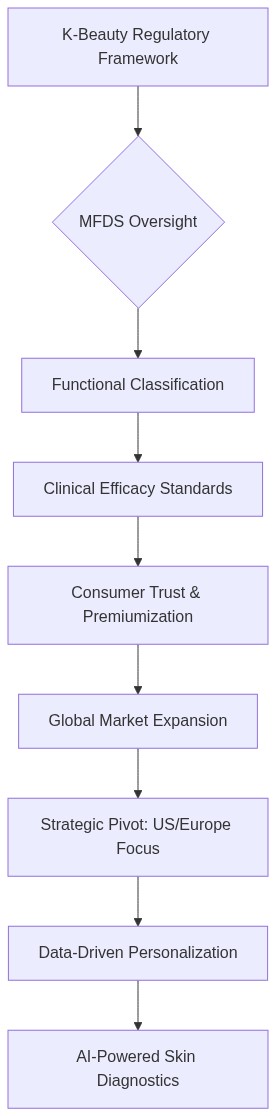
The Anatomy of a Regulatory Shield

The persistent myth that Korean skincare owes its efficacy purely to clever marketing ignores the heavy machinery of the South Korean regulatory apparatus. Unlike many international markets where cosmetic claims are largely self-certified by brands, the South Korean Ministry of Food and Drug Safety (MFDS) operates a sophisticated classification architecture.
In this system, cosmetics are sharply divided between general use and functional categories. If a brand wishes to market a product for wrinkle improvement, brightening, or mitigating acne and atopic symptoms, it cannot rely on subjective testimonials. It must either adhere to pre-defined standards set by the Korea Functional Cosmetics Codex (KFCC) or submit exhaustive pre-market dossiers complete with toxicity reports and clinical trial data.
[K-Beauty 101] 배합의의 (Baehap-uiui) — Rationale for formulation. A regulatory requirement proving the scientific necessity of each ingredient. It ensures that active components are functionally significant rather than just marketing fluff.
This administrative hurdle acts as a powerful quality filter. It forces formulators to justify the inclusion of every active molecule, shifting the industry standard away from surface-level illusions toward measurable, biochemical efficacy. When consumers look for products in Seoul, they are protected by an invisible scaffolding of state-mandated science that demands proof before promises.
Decoding the Language of Internal Dryness
Ask any veteran Korean beauty enthusiast about the root cause of premature aging, and they will likely bypass surface oiliness to diagnose a far more insidious culprit: Sok-geonjo (internal dryness).
This conceptual framework fundamentally changes how skincare is approached. Western regimens have historically treated oily skin with aggressive stripping agents and dry skin with heavy occlusives. The Korean dermatological philosophy, however, recognizes that skin can be suffocatingly slick on the surface while parched at a cellular level.
Addressing this requires a meticulous understanding of Hamsup-milpye—the delicate balance between humectants that draw moisture inward and occlusives that lock it in place. Rather than dumping raw hydration onto the face, formulations rely on dual-molecular weight hyaluronic acid compounds and advanced delivery systems like PDRN (purified DNA fragments) to ensure deep penetration without clogging pores.
The Trap of Over-Care and the Pivot to Minimalism
Despite these sophisticated formulation principles, the democratization of K-Beauty has birthed its own modern pathology: Obo-kea (over-care).
Fueled by the endless scroll of viral routines, consumers frequently subject their skin to a chemical barrage of high-strength retinoids, direct acids, and fluctuating botanical extracts simultaneously. The result is a paradox: in pursuit of glass skin, thousands of individuals compromise their lipid barriers, triggering chronic micro-inflammation, redness, and paradoxical oil production.
Recognizing this self-inflicted damage, the industry is witnessing a massive corrective wave toward educational marketing. Prominent formulators and independent researchers are dismantling the "more is better" fallacy, championing instead a minimalist ethos that prioritizes skin barrier integrity over product count.
| Marketing Myth | Clinical Reality |
|---|---|
| "Ten steps are mandatory for clear skin." | Layering is about viscosity and absorption; customized 3-to-4-step routines often outperform bloated regimens. |
| "Natural ingredients are always safer than synthetics." | Botanical extracts are complex mixtures that frequently trigger contact dermatitis; lab-synthesized actives often offer superior purity and stability. |
| "Glass skin happens overnight with the right serum." | True radiance is a reflection of cellular turnover and barrier health, requiring consistent weeks of targeted care. |
🎵 K-Mono Lofi — Seoul Study Beats
Read deeper with Seoul lo-fi in the background — curated by K-Mono Lofi
This shift is mirrored in the explosive growth of AI-driven skin diagnostics and personalized skincare markets, projected to reach unprecedented scales globally. Consumers are increasingly bypassing trial-and-error purchasing in favor of data-driven assessments that map their exact moisture levels, pigmentation distribution, and barrier strength.
The Quiet Evolution of the Global Shelf
As K-Beauty continues its rapid expansion across Western retail landscapes—anchored by the massive footprint of giants like Olive Young entering international markets—the core philosophy remains remarkably resilient. It is no longer defined by the novelty of snail mucin or quirky packaging, but by a rigorous commitment to ingredient transparency and skin-first science.
The true secret of the Korean skincare ethos does not lie in an exclusive bottle or a secret formula. It lies in the cultural habit of treating skincare as a daily practice of attentiveness—a willingness to listen to what the skin is communicating beneath the surface, and to adjust the routine with intelligence rather than impulse.
⚠️ Disclaimer: The information provided in this article is for educational and informational purposes only and does not constitute medical advice. Skincare formulations and active ingredients interact differently with every individual's skin barrier. Always perform a patch test before introducing new actives into your routine, and consult a board-certified dermatologist if you have underlying skin conditions or sensitivities.
⚠️ Disclaimer: This article is for informational and educational purposes only and does not constitute medical, dermatological, or financial advice. Individual results vary — consult a board-certified dermatologist or physician before starting any new skincare routine, supplement, or procedure, especially if pregnant, nursing, or taking other medications. This article may contain affiliate links — if you buy through them, we may earn a small commission at no extra cost to you.
✓ Researched and compiled using verified data as of the publication date.
 Written by Jun Mi Jung for Quiet Korea | Contact: rsl.2001.1975@gmail.com