Why Your Face Is Greasy but Screaming for Water: The Subuji Paradox and How to Fix It
It is 2:00 PM. You glance in the restroom mirror and find a frustrating, oily contradiction staring back at you. Your T-zone is shining with a slick layer of grease that has completely melted your foundation, yet your cheeks feel so tight they might crack if you smile. You reach for blotting papers to soak up the shine, but the moment you press them to your skin, the underlying tightness only intensifies. Your makeup is caked around tiny, invisible flakes, and your skin feels simultaneously suffocated and completely parched.
- The Physiology of the Double Agent: Why Oil Cannot Replace Water
- The Emergency Reset: How to Heal the Damage Tonight
- The Korean Pouch: What Locals Actually Use for Subuji Reset
- The Trap of Over-Correction: What to Avoid
- Frequently Asked Questions
- How can I tell the difference between truly oily skin and dehydrated oily skin?
- Can I still use my salicylic acid (BHA) wash while repairing my barrier?
- How long does it take to repair a compromised skin barrier?
- Will drinking more water fix my oily-dehydrated skin?
You are trapped in one of the most misunderstood dermatological loops in skincare: your skin is drowning in oil, but it is dying of thirst. Why does stripping your skin of oil actually make it greedier for grease? The secret isn't in your cleanser—it's in a desperate biological panic loop that most skincare routines completely ignore.
Key Takeaways * The Subuji Paradox: Dehydrated oily skin occurs when a damaged skin barrier allows water to evaporate, prompting sebaceous glands to overproduce surface oil as an emergency shield. * The Wrong Solution: Stripping the oil with harsh cleansers or clay masks only accelerates water loss and triggers more grease; the key is restoring hydration and lipids. * The Instant Reset: Tonight, halt all active exfoliants, switch to a low-pH cleanser, layer humectants on damp skin, and seal them with a lightweight multi-lamellar ceramide cream.
The Physiology of the Double Agent: Why Oil Cannot Replace Water
To understand why your skin is behaving like a double agent, you have to separate sebum from water. Sebum is an oil generated by your sebaceous glands to lubricate the skin surface. Hydration is the actual water content held deep within your epidermal cells, protected by a delicate "brick-and-mortar" barrier called the stratum corneum.
When this barrier is compromised—usually by over-cleansing, harsh scrubs, or aggressive acids—the lipid mortar (composed of roughly 30% to 50% ceramides, alongside cholesterol and free fatty acids) cracks. The result is a dramatic spike in Transepidermal Water Loss (TEWL). Healthy skin maintains a baseline TEWL generally under 10 g/m²/h, but a compromised barrier causes water evaporation rates to surge.
As deep water freely evaporates, your skin enters panic mode. Lacking water, it commands your sebaceous glands to flood the surface with sebum in a desperate, makeshift attempt to seal the breach. The surface oil is not a sign of health; it is a distress flare.
[K-Beauty 101] Subuji (수부지) — A portmanteau of soo-boon (moisture) and ji-sung (oily). It describes a paradoxical skin state where the surface is slick with sebum while the deeper layers suffer from acute water depletion, causing a tight, uncomfortable sensation known as sok-geonjo (inner tightness).
To visualize how these two distinct elements interact, compare their physiological profiles:
| Aspect | Sebum (Oil) | Hydration (Water) |
|---|---|---|
| Source | Sebaceous glands | Epidermal water retention |
| Function | Surface lubrication | Cellular plumpness & enzymatic function |
| Trigger | Hormones, heat, barrier panic | Humidity, humectants, lipid barrier integrity |
| Excess State | Shiny surface grease (gae-gi-reum) | Normal, bouncy, resilient skin |
| Deficit State | Dry, rough skin surface | Tight, parched interior (sok-geonjo) |
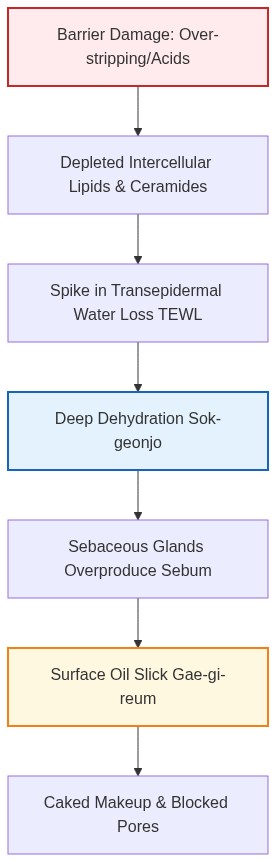
This cycle leaves millions of people treating the symptom (the oil) rather than the cause (the lack of water). But how do you break a cycle when your own skin is working against you?
🎵 K-Mono Lofi — Seoul Study Beats
Read deeper with Seoul lo-fi in the background — curated by K-Mono Lofi
The Emergency Reset: How to Heal the Damage Tonight
If you are dealing with a compromised, oily-yet-dehydrated barrier, you must implement an immediate "skinimalism" protocol. This means stripping your routine down to its bare essentials for at least 2 to 4 weeks—the typical cycle required for a single epidermal cell to regenerate.
Here is your tonight-ready, step-by-step prescription to close the loop on dehydration:
- Halt all active stripping agents immediately. Put away the salicylic acid (BHA), glycolic acid (AHA), benzoyl peroxide, retinol, and physical scrubs. Your barrier cannot rebuild while it is being actively dismantled.
- Switch to a low-pH, non-stripping cleanser. Avoid high-pH foaming washes that strip the skin's natural acid mantle. Look for milk, gel, or oil-to-foam cleansers that leave the skin soft and pliable, never squeaky clean.
- Layer humectants on damp skin within three seconds. Do not dry your face completely with a towel. Apply a lightweight, alcohol-free hydrating toner or serum containing hyaluronic acid, glycerin, or panthenol while the skin is damp. This binds water directly into the stratum corneum before it has a chance to evaporate.
- Seal with a multi-lamellar emulsion (MLE) or ceramide cream. Since your skin lacks the natural lipid mortar, you must supply a synthetic patch. Look for lightweight moisturizers that use ceramides, cholesterol, and fatty acids to mimic the skin's natural structure without clogging pores.
- Avoid the heavy oil trap. While very dry skin types can tolerate heavy occlusives like petroleum jelly (which can suppress TEWL by up to 99%), oily-dehydrated skin needs breathable, gel-cream barriers. Heavy oils can trap excess sebum and lead to deep congestion.
To see what is happening to your skin barrier during this transition, look at the difference between a damaged and a repaired lipid matrix:
🟢 Healthy Skin Barrier
- Low TEWL: Water remains locked in deep epidermal layers.
- Balanced Lipids: Intercellular ceramides form a tight, protective seal.
- Regulated Sebum: Glands produce only what is needed for surface defense.
- Result: Smooth texture, natural glow, and long-lasting makeup.
⚠️ The Subuji Barrier (Oily-Dehydrated)
- High TEWL: Deep moisture evaporates rapidly into the air.
- Depleted Lipids: Stripped ceramide mortar allows water to escape.
- Hyperactive Sebum: Glands panic-produce grease to seal the cracks.
- Result: Inner tightness, midday oil slick, and sliding makeup.
Once you stop fighting the oil and start supporting the water, the panic response subsides. But what should actually go on your face to make this happen?
The Korean Pouch: What Locals Actually Use for Subuji Reset
When Korean beauty consumers notice tteok-jjim (makeup clumping like rice cake) or mil-lim (products pilling and rolling off in flakes), they do not buy stronger mattifying primers or heavier powders. They know these are signs of a structural skin failure. Instead, they reach for targeted barrier-repair formulations that hydrate without adding weight.
Here is what is actually inside a Seoul local's pouch for this exact crisis:
- Torriden Dive-In Low Molecular Hyaluronic Acid Serum (~$15 - $18)
Why it works: This is a staple on the Korean beauty app Hwahae. It delivers five different molecular weights of hyaluronic acid straight to the deeper epidermal layers without a single drop of heavy oil. It absorbs in seconds, instantly relieving sok-geonjo (inner tightness) and stopping the sebaceous glands' panic response before it starts. - Real Barrier Intense Moisture Cream (~$24 - $28)
Why it works: This cult-classic cream uses patented MLE (Multi-Lamellar Emulsion) technology, which physically mimics the exact cross-layered lipid structure of healthy human skin. It patches the cracked mortar of your skin barrier without clogging oily-prone pores. - Round Lab Birch Juice Moisturizing Cream (~$20 - $24)
Why it works: Extremely popular for its lightweight, watery texture. It utilizes birch sap and tiny collagen capsules to release continuous hydration throughout the day, preventing midday gae-gi-reum (oil slick) from taking over your face.
The Trap of Over-Correction: What to Avoid
The biggest mistake you can make with oily-dehydrated skin is treating the grease with aggression. Using clay masks, alcohol-heavy astringents, or continuous blotting papers to dry out the surface oil feels satisfying for ten minutes, but it is a slow-motion disaster for your skin. You are essentially throwing fuel on the fire. Every time you strip that temporary oil seal, you force your skin to produce even more sebum to protect itself.
True balance is not about stripping; it is about negotiation. Give your skin the water it is desperate for, patch the barrier so it can hold onto that water, and your sebaceous glands will naturally quiet down.
Frequently Asked Questions
How can I tell the difference between truly oily skin and dehydrated oily skin?
Truly oily skin feels comfortable, soft, and flexible under its surface shine. Dehydrated oily skin (subuji) feels tight, itchy, or stretched underneath, particularly after cleansing, and is often accompanied by tiny dry flakes around the nose and mouth despite a greasy T-zone.
Can I still use my salicylic acid (BHA) wash while repairing my barrier?
No. During the active barrier-repair phase (usually 2 to 4 weeks), you must pause all active exfoliants, including BHA. Even gentle acne washes can strip the lipid mortar, prolonging the dehydration cycle. Reintroduce them slowly once the inner tightness (sok-geonjo) has completely resolved.
How long does it take to repair a compromised skin barrier?
For mild dehydration, you may feel relief within 3 to 7 days of starting a minimalist, hydration-first routine. However, complete barrier structural repair typically takes 28 days, which matches the natural turnover cycle of your skin cells.
Will drinking more water fix my oily-dehydrated skin?
While systemic hydration is important for overall health, drinking water cannot fix a broken skin barrier. If your stratum corneum lipid mortar is cracked, any water you drink will simply evaporate through the skin via Transepidermal Water Loss (TEWL). You must repair the outer barrier topically to lock that moisture in.
⚠️ Disclaimer: The information provided in this article is for educational and informational purposes only and does not constitute medical advice. Dehydrated or compromised skin can sometimes mimic more serious dermatological conditions like seborrheic dermatitis, eczema, or contact allergies. Always consult with a board-certified dermatologist before starting a new clinical skincare regimen or if skin irritation, redness, or burning persists.
⚠️ Disclaimer: This article is for informational and educational purposes only and does not constitute medical, dermatological, or financial advice. Individual results vary — consult a board-certified dermatologist or physician before starting any new skincare routine, supplement, or procedure, especially if pregnant, nursing, or taking other medications. This article may contain affiliate links — if you buy through them, we may earn a small commission at no extra cost to you.
✓ Researched and compiled using verified data as of the publication date.
 Written by Jun Mi Jung for Quiet Korea | Contact: rsl.2001.1975@gmail.com