Why You Are Buttering the Leaf: The Real Science of Korean Rice Water and Scalp Biology
Imagine buying an expensive, exotic plant, watching its leaves turn yellow, and deciding the solution is to paint the leaves green with heavy oils. It sounds absurd. Yet, this is exactly how millions of people treat their hair every single day. They spend fortunes on rich hair oils, leave-in serums, and heavy masks, slathering them onto dead protein strands while the living soil—the scalp—is left to suffocate under sebum and product buildup.
- The Dead Strand Illusion: Why Your Hair Care Is Failing
- The Biochemical Blueprint of Rice Water: pH, Inositol, and Cuticle Tension
- The Scalp Microbiome: Modulating the Living Soil
- Explore Scalp-First Rice Water Treatments
- The Protein Trap: When Ancestral Wisdom Goes Wrong
- The Clinically Safe Rice Water Protocol
- Frequently Asked Questions
- Can I leave rice water in my hair overnight?
- Does rice water smell bad when fermented?
- Can I use rice water if I have color-treated or chemically straightened hair?
- Will rice water cure my dandruff completely?
In the clinical landscape of Seoul, hair health is treated with the exact same anatomical respect as facial skincare. The strand is dead tissue; you cannot "cure" it. The scalp, however, is a living, breathing ecosystem. Lately, the global beauty market has become obsessed with a traditional remedy: rice water. But behind the viral TikTok videos and ancient folklore lies a complex biochemical reality. Rice water is not a magical overnight hair-growth potion, and if used incorrectly, it can leave your hair more brittle than before. To understand its true power, we have to look beneath the surface, past the marketing myths, and into the delicate microbiome of the human scalp.
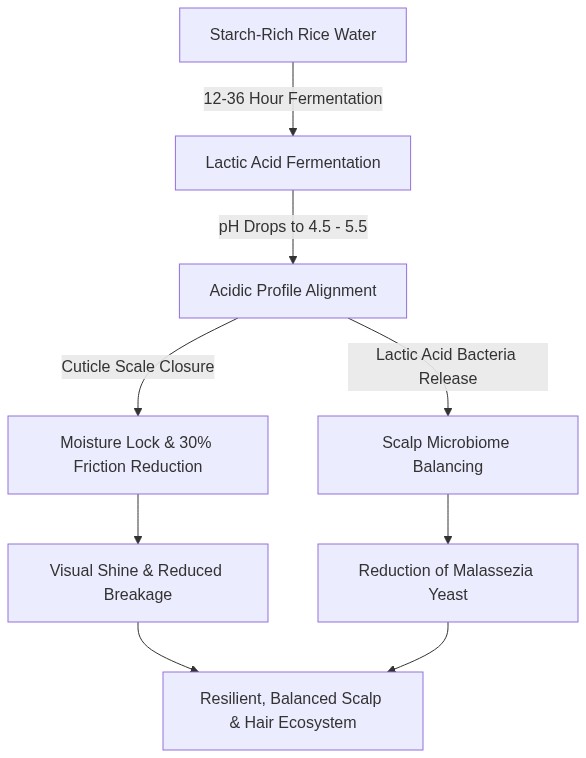
Key Takeaways * The Cuticle Illusion: Rice water does not chemically trigger new hair growth. Instead, a carbohydrate called inositol penetrates the hair shaft, reducing surface friction by up to 30% to prevent breakage and create the visual illusion of thicker hair. * The Fermentation Imperative: Raw rice water is alkaline (pH 6.0–7.0), which causes the hair cuticle to swell and frizz. Fermenting it for 12 to 36 hours drops the pH to an optimal acidic range of 4.5–5.5, which flat-lays the cuticle and locks in moisture. * The Scalp Microbiome: When fermented, rice water acts as a potent prebiotic, feeding beneficial lactic acid bacteria and balancing the scalp's microbiome to fight off dandruff-causing fungi like Malassezia.
The Dead Strand Illusion: Why Your Hair Care Is Failing
The global hair and scalp care market is experiencing an unprecedented "skinification." According to industry research, the global market is projected to grow from an estimated USD 88.2 Billion to USD 115.41 Billion in 2025, eventually scaling to between USD 150.45 Billion and USD 203.93 Billion by 2033–2034, moving at a steady compound annual growth rate (CAGR) of 6.14% to 7.70%. Much of this growth is driven by the Asia-Pacific region, which commands a massive 36.5% to 39.4% of the global market share.
But why this sudden, massive surge in scalp care? Because consumers are finally realizing that treating the hair shaft is a losing battle.
[K-Beauty 101] Dupi Seukaeling (Scalp Scaling) — A clinical deep-cleansing treatment designed to exfoliate the scalp, removing calcified sebum, dead skin cells, and product buildup that normal shampoos cannot dissolve. It treats the scalp with the same dermatological rigor as a facial peel.
[K-Beauty 101] Miansu — Traditional, home-brewed beauty waters made from grains or herbs used for centuries in Korea. It represents a heritage of simple, raw formulation focused on balancing the skin's natural barrier.
When you walk into a clinical head spa in Seoul, the specialist does not start by looking at your split ends. They pull out a microscopic camera to perform a thorough diagnostic scan of your scalp. What they are looking for is the health of the follicular opening. When the scalp is neglected, follicles become clogged with dead skin and synthetic silicone residues, choking out new hair growth.
To bridge the gap between traditional beauty and modern clinical science, we have to contrast how different cultures approach hair health.
⚠️ The Western Strand Focus
Focuses heavily on cosmetic alteration after the hair has left the follicle. Relies on heavy silicones, heavy botanic oils, and heat-activated polymer sealants to temporarily glue damaged cuticle layers back together. This treats symptoms while ignoring the living follicle.
🌱 The Korean Scalp Medicine
Treats the scalp as an extension of the face's skin barrier. Focuses on cellular turnover, balancing the oil-to-water ratio, keeping follicular pathways clear, and cultivating a healthy microbiome. The hair strand is viewed simply as the natural, healthy output of a balanced system.
By shifting our focus from the dead strand to the living scalp, traditional remedies like rice water take on an entirely new, scientifically backed meaning.
The Biochemical Blueprint of Rice Water: pH, Inositol, and Cuticle Tension
For centuries, women across East Asia—most famously the Yao women of Huangluo Village in China, and court ladies of the Korean Joseon Dynasty—used grain waters to wash their hair. They did not have access to modern laboratories, yet they observed that their hair remained exceptionally strong, dark, and long well into their senior years.
Today, we have the analytical tools to understand why. The secret of rice water lies in its unique molecular components, specifically a carbohydrate called inositol.
When you rinse your hair with rice water, inositol does not merely sit on top of the strand like a synthetic silicone. Instead, it is small enough to penetrate deep inside the hair shaft, filling in microscopic gaps in the damaged cuticle. This internal structural reinforcement makes the hair remarkably resilient. According to independent laboratory testing, rinsing with rice water can reduce surface friction along the hair shaft by up to 30%. Because friction is the primary driver of mechanical hair breakage (from brushing, sleeping, and styling), this 30% reduction significantly cuts down on daily hair fall, allowing the hair to grow longer and appear much denser over time.
However, the preparation method makes or breaks the entire chemical reaction. This is where many DIY enthusiasts ruin their hair.
| Metric / Property | Raw Rice Water | Fermented Rice Water |
|---|---|---|
| pH Level | 6.0 – 7.0 (Neutral to Alkaline) | 4.5 – 5.5 (Acidic) |
| Cuticle Interaction | Causes shaft to swell, exposing inner layers | Flattens cuticle scales, locking in hydration |
| Microbiome Effect | High starch content can feed pathogenic yeasts | Introduces beneficial lactic acid bacteria |
| Active Inositol | Locked in raw starch complexes | Highly bioavailable and enzymatically active |
Raw, unfermented rice water has a neutral-to-alkaline pH range of 6.0 to 7.0. Human hair and skin, however, are naturally acidic, hovering between 4.5 and 5.5. When you apply an alkaline liquid to your hair, it forces the overlapping scales of the hair cuticle to swell and lift. This open structure allows precious internal moisture to escape, leading to frizz, tangling, and long-term structural weakness.
This is why fermentation is absolutely mandatory. Allowing the rice water to ferment at room temperature for 12 to 36 hours initiates a biological transformation. Beneficial microorganisms consume the raw sugars, producing lactic acid as a byproduct. This biochemical process lowers the pH of the liquid to a highly compatible 4.5 to 5.5. When this acidic fermented rice water is applied to the hair, it immediately coaxes the raised cuticle scales to lay completely flat, sealing in moisture, reflecting light for an intense natural shine, and protecting the inner cortex from environmental stressors.
To fully appreciate this biochemical transition, it helps to slow down and clear your mind.
🎵 K-Mono Lofi — Seoul Study Beats
Read deeper with Seoul lo-fi in the background — curated by K-Mono Lofi
Let the soothing ambient music play in the background as we dive deeper into the microscopic world of your scalp's living microbiome.
The Scalp Microbiome: Modulating the Living Soil
The skin on your head is home to a diverse ecosystem of microscopic organisms. Just like your gut, your scalp relies on a delicate balance of bacteria and fungi to maintain its barrier function. When this ecosystem falls into a state of dysbiosis—where the balance is disrupted—disaster strikes.
The most common culprit behind scalp issues is a lipophilic (fat-loving) yeast genus called Malassezia. When the scalp's sebum production spikes, Malassezia populations explode, breaking down the sebum into irritating free fatty acids. This cascade triggers inflammation, accelerated skin cell shedding, and the highly frustrating aesthetic issue of dandruff (Bi-deum).
This is where fermented rice water shifts from a simple hair conditioner into a genuine dermatological therapeutic tool. During the 12-to-36-hour fermentation window, the liquid becomes a breeding ground for beneficial probiotics, particularly lactic acid-producing bacteria. When applied to the scalp, these live cultures act as prebiotics and probiotics, actively modulating the microbial population. They secrete antimicrobial peptides that keep pathogenic yeasts like Malassezia in check, effectively calming inflammatory pathways, eliminating stubborn dandruff, and reinforcing the delicate scalp skin barrier.
This article may contain affiliate links — if you buy through them, we may earn a small commission at no extra cost to you.
To skip the delicate, sometimes unpredictable process of home kitchen fermentation—which can occasionally attract unwanted bacterial contaminants if left unchecked—many opt for stabilized, clinically tested formulations.
The Protein Trap: When Ancestral Wisdom Goes Wrong
While the benefits of fermented rice water are deeply rooted in organic chemistry, we must address the critical dark side of this treatment. In our quest for stronger hair, it is incredibly easy to fall into the "more is better" trap. In clinical practice, this is known as protein overload.
Rice water is packed with proteins and starch complexes. While these molecules are excellent for patching up damaged spots along a frayed hair cuticle, they are not meant to remain on the hair indefinitely. If you apply rice water too frequently, or leave it on your head without rinsing it out completely, these proteins begin to build up on the surface of the hair shaft, forming a hard, impermeable barrier.
This rigid protein shell prevents external moisture from entering the inner cortex of the hair. Over time, the hair loses its natural elasticity, becomes highly rigid, and will literally snap like dry twigs under the slightest tension.
Furthermore, there is zero large-scale clinical evidence to suggest that rice water directly cures androgenetic alopecia (genetic male or female pattern baldness). While historical animal studies involving isolated inositol showed some promise in cellular regeneration, applying topically brewed rice water will not miraculously revive dead hair follicles or alter your genetic hair-loss profile. What it does do is improve the structural integrity of the existing hair you have, preventing premature breakage so that your hair can reach its full genetic length potential.
To enjoy the benefits of this ancestral ritual without falling victim to protein buildup or scalp irritation, follow this precise, clinically safe, step-by-step application protocol:
The Clinically Safe Rice Water Protocol
- The Gentle Rinse: Wash your hair with a mild, sulfate-free shampoo to clear away surface sebum and styling residues, preparing the cuticle to receive the treatment.
- The Controlled Application: Pour your fermented rice water (ideally fermented for 24 hours and diluted 1:1 with plain water to temper the strength) over your scalp and through the lengths of your hair.
- The Target Massage: Spend 5 minutes gently massaging your scalp with your fingertips to stimulate microcirculation and help the probiotics distribute evenly.
- The Time Limit: Leave the mixture on your hair for no longer than 15 to 30 minutes. This is the optimal chemical window; anything longer risks initiating protein rigidification.
- The Thorough Purge: Rinse your hair thoroughly with lukewarm water. Follow up with a very lightweight, hydrating conditioner to balance out the protein with essential moisture. Limit this treatment to once a week.
Frequently Asked Questions
Can I leave rice water in my hair overnight?
Absolutely not. Leaving rice water in your hair overnight is a recipe for severe protein buildup and bacterial growth on the scalp. The starch can dry into a hard film, suffocating the scalp and making the hair strands highly rigid and prone to severe snapping. Always rinse it out thoroughly within 15 to 30 minutes.
Does rice water smell bad when fermented?
Yes, natural fermentation produces a distinctly sour, slightly pungent aroma due to the production of organic acids and yeasts. To mask this smell during home preparation, you can add a few drops of natural essential oils, such as rosemary or lavender, which also offer secondary scalp-stimulating benefits.
Can I use rice water if I have color-treated or chemically straightened hair?
Yes, but with extreme caution. Chemically processed hair is highly porous and will absorb proteins far more rapidly than virgin hair, making it highly susceptible to protein overload. If your hair is heavily bleached or damaged, limit your rice water application to just 10 minutes once every two weeks, and always follow with a deep moisture mask.
Will rice water cure my dandruff completely?
If your dandruff is caused by mild scalp dysbiosis or a minor overgrowth of Malassezia yeast, the lactic acid bacteria in fermented rice water can help restore balance and reduce flaking. However, if your dandruff is a symptom of severe seborrheic dermatitis or psoriasis, you will require targeted medical treatments prescribed by a board-certified dermatologist.
⚠️ Disclaimer: The information provided in this article is for educational and informational purposes only and should not be construed as medical advice. Scalp conditions, hair loss, and severe dermatitis require professional diagnosis. Always consult with a board-certified dermatologist or trichologist before introducing intensive DIY treatments or supplements to your routine, particularly if you have an active scalp infection, open wounds, or a pre-existing dermatological condition. Always perform a localized patch test on your inner arm or a small patch of scalp before full application to rule out allergic contact dermatitis.
✓ Researched and compiled using verified data as of the publication date.
 Written by Jun Mi Jung for Quiet Korea | Contact: rsl.2001.1975@gmail.com