Why DIY Rice Water is Making Your Hair Brittle (And What Seoul's Head Spas Do Instead)
Imagine buying a rare, delicate plant, watching its leaves wilt, and deciding to fix it by painting the foliage with green gloss. It sounds absurd, yet millions of people perform the exact same ritual on their heads every single day. They buy heavy hair masks, coat their strands in expensive botanical oils, and soak their hair in cloudy bowls of DIY fermented rice water.
- Treating the Soil, Not the Leaves: The Scalp Revolution
- The Physics of the Hair Cuticle: Why 13,000 Daltons Cannot Fit Into a 1,000-Dalton Door
- The Solution: The Science of Hydrolyzed Peptides
- Explore Hydrolyzed Hair Peptides
- How Seoul's Head Spas Treat the Living Ecosystem
- 1. Scalp Scaling (Exfoliation)
- 2. Double Cleansing with Target Actives
- 3. Deep Hydration & Peptide Delivery
- Frequently Asked Questions
- Can I use DIY fermented rice water if I only leave it on for a short time?
- What are the main signs of protein overload in hair?
- How often should I perform scalp scaling?
- Will hydrolyzed rice protein make my hair feel greasy or heavy?
They are treating dead tissue. The hair strand emerging from your scalp is already biologically dead—it is a collection of keratinized proteins that cannot heal, regenerate, or metabolize nutrients. Meanwhile, the living "soil" from which it grows, the scalp, is completely ignored.
In Seoul’s elite scalp clinics, this strand-obsessed approach is viewed as a fundamental misunderstanding of biology. A sudden surge in global social media trends has popularized DIY rice water rinses as an ancient, miracle cure-all for hair growth and shine. But clinical reality paints a far more troubling picture. What begins as an innocent kitchen beauty hack often ends in brittle, snapping hair and inflamed follicles.
Key Takeaways * The Molecular Barrier: Hair cuticles can only absorb proteins smaller than 1,000 Daltons (Da). DIY rice water contains giant proteins (13,000 to 30,000 Da) that sit on the surface, causing "protein overload" and blocking crucial moisture. * The Scalp-First Shift: Modern Korean hair care treats the scalp with the same clinical rigor as facial skincare (the "skinification" of hair), focusing on living follicles rather than dead strands. * Hydrolysis is Key: True structural repair requires enzymatic hydrolysis to break proteins down into tiny, positively charged peptides that can actually enter the hair shaft and rebuild its core.
Treating the Soil, Not the Leaves: The Scalp Revolution
For decades, the global hair care industry has sold a lie: that you can wash, condition, and oil your way to thick, lustrous hair. But your hair is merely a reflection of your scalp's health. In South Korea, this realization has fueled a massive cultural and scientific shift toward "skinification"—treating the scalp with the exact same focus, active ingredients, and clinical precision as facial skin.
According to industry research, the global scalp care market reached approximately 104.1 billion USD in 2025, driven largely by consumers demanding science-backed wellness rituals over superficial cosmetic cover-ups.
When you walk into a clinical center in Seoul, practitioners do not look at your split ends. They pull out a microscopic camera to perform a detailed scalp diagnosis. They examine the follicular openings, the sebum production levels, and the micro-vascular circulation.
[K-Beauty 101] 두피 (Du-pi) — The scalp. In Korean beauty philosophy, the scalp is treated as an extension of the face. It requires regular exfoliation, hydration, and barrier protection to support healthy hair growth.
When the scalp is clogged with excess sebum, dead skin cells, and product buildup, the hair follicles literally suffocate. This leads to a gradual thinning of the hair shaft, premature shedding, and localized inflammation. Applying heavy oils or starch-heavy DIY mixtures to a congested scalp is like pouring wax over a clogged drain. It might look shiny for an hour, but underneath, you are accelerating follicle decay.
🎵 K-Mono Lofi — Seoul Study Beats
Read deeper with Seoul lo-fi in the background — curated by K-Mono Lofi
The Physics of the Hair Cuticle: Why 13,000 Daltons Cannot Fit Into a 1,000-Dalton Door
The primary argument for using rice water is its high protein content, which is supposed to strengthen the hair shaft. While the premise is scientifically sound, the execution fails due to basic physics.
Your hair fiber is protected by an outer layer of overlapping scales called the cuticle. To pass through these scales and reach the inner cortex—where structural repair actually takes place—an ingredient must have a molecular weight of under 1,000 Daltons (Da).
DIY rice water is packed with starch and raw proteins. However, these proteins are massive, ranging in molecular weight from 13,000 to 30,000 Da.
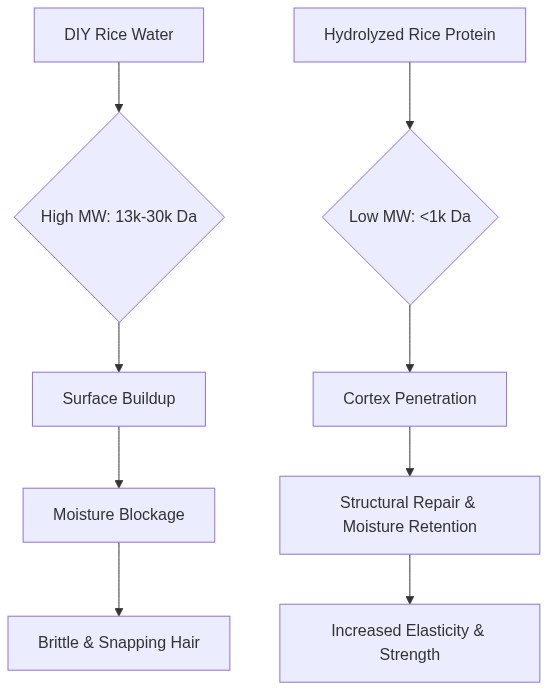
Because these proteins are physically too large to penetrate the cuticle, they have nowhere to go. They deposit on the outside of the hair shaft, drying into a rigid, plastic-like film. This phenomenon is known as protein overload.
Instead of strengthening your hair, this stubborn coating blocks external moisture from entering the hair shaft. Over time, the hair beneath this protein shield becomes profoundly dehydrated, loses its natural elasticity, and begins to snap under the slightest tension.
Furthermore, DIY fermented rice water is an unstable, unpreserved mixture. Leaving it to ferment at room temperature invites opportunistic bacteria and wild yeasts to colonize the liquid. Pouring this raw, microbe-dense starch onto your scalp can easily disrupt your delicate microbiome, triggering conditions like seborrheic dermatitis, flaky buildup, and painful follicular inflammation.
The Solution: The Science of Hydrolyzed Peptides
To get the benefits of rice without the structural damage, the protein must be chemically or enzymatically altered. This is where clinical green chemistry steps in.
Through a process called enzymatic hydrolysis, scientists break down those giant 30,000 Da protein chains into tiny, fragments known as hydrolyzed peptides. These peptides easily slide under the 1,000 Da threshold.
Because these peptides are so small, they can slip between the cuticle scales, penetrate deep into the cortex, and bind directly to the damaged areas of the hair fiber. Clinical trials demonstrate that using hydrolyzed rice protein can increase hair volume by up to 20% after just five uses, reinforcing the hair's internal architecture without leaving a heavy, suffocating buildup on the surface.
⚠️ DIY Rice Water Rinse
- Molecular Weight: 13,000 – 30,000 Da (Too large to penetrate)
- Effect: Sits on the surface, forming a rigid, brittle coating
- Scalp Risk: Encourages yeast overgrowth, clogs follicles, triggers flaking
- Result: Dry, snapping strands and potential scalp irritation
✅ Hydrolyzed Rice Protein
- Molecular Weight: Under 1,000 Da (Deeply bioavailable)
- Effect: Fills micro-gaps inside the hair cortex
- Scalp Risk: Zero buildup, leaves the follicular ecosystem clean
- Result: Increased elasticity, natural volume, and genuine repair
This article may contain affiliate links — if you buy through them, we may earn a small commission at no extra cost to you.
How Seoul's Head Spas Treat the Living Ecosystem
If you walk into a professional clinic in Gangnam, you will not find bowls of kitchen starch. Instead, you will experience a highly structured, medical-grade ritual designed to optimize the scalp micro-environment.
[K-Beauty 101] 헤드스파 (Head Spa) — A comprehensive, multi-step professional scalp treatment. It combines deep exfoliation, steam therapy, and target micro-massage to relieve stress and revitalize hair follicles from the root.
To replicate the core principles of a professional Korean scalp treatment at home without damaging your hair, follow this scientific clinical sequence:
1. Scalp Scaling (Exfoliation)
Before you can nourish the follicles, you must clear the path. Use a scalp scaling formula containing salicylic acid (BHA). Salicylic acid is oil-soluble, meaning it can penetrate deep into the hair follicle to dissolve hardened sebum, dead skin cells, and product residues that regular shampoos leave behind. Gently massage it into a dry scalp before washing.
2. Double Cleansing with Target Actives
Wash your hair using a focused scalp care formula. Look for clinical ingredients like zinc pyrithione to maintain microbial balance and prevent dandruff, and dexpanthenol (Provitamin B5) to soothe and strengthen the skin barrier. Focus your fingertips entirely on the scalp, not the hair strands.
3. Deep Hydration & Peptide Delivery
Instead of coating your hair in heavy, occlusive silicones or raw starches, apply a lightweight, watery scalp scaling tonic or a hydrolyzed peptide serum directly to your clean scalp. These formulations use low-molecular-weight ingredients to hydrate the skin barrier and deliver structural building blocks directly to the hair roots without causing buildup.
Frequently Asked Questions
Can I use DIY fermented rice water if I only leave it on for a short time?
Even a short exposure can cause starch and large protein molecules to bind to the outer cuticle of your hair, especially if your hair has high porosity. Furthermore, leaving an unpreserved, fermented kitchen mixture on your scalp for any duration carries a risk of introducing harmful bacteria and yeast to your hair follicles.
What are the main signs of protein overload in hair?
The most common signs of protein overload include hair that feels unusually stiff, dry, or straw-like, a total loss of natural shine, and strands that snap easily when gently pulled rather than stretching and returning to their original shape.
How often should I perform scalp scaling?
For normal to oily scalps, performing a scalp scaling treatment once a week is highly effective for removing buildup. If you have an extremely dry or sensitive scalp, limit scaling to once every two weeks using a gentle, soothing formula.
Will hydrolyzed rice protein make my hair feel greasy or heavy?
No. Because hydrolyzed proteins are broken down into exceptionally small molecules (under 1,000 Daltons), they penetrate directly into the hair fiber rather than sitting on the surface. This provides structural strength and volume without weighing down the hair.
⚠️ Disclaimer: The information provided in this article is for educational purposes only and should not be taken as professional medical advice. If you are experiencing severe hair loss, persistent scalp flaking, or painful inflammation, please consult a board-certified dermatologist or a licensed trichologist to obtain a personalized diagnostic treatment plan.
✓ Researched and compiled using verified data as of the publication date.
 Written by Jun Mi Jung for Quiet Korea | Contact: rsl.2001.1975@gmail.com