The Global Sourcing Blueprint: Navigating the High-Stakes World of K-Beauty Imports and Authenticity
A package arrives at your doorstep, sealed with the clean, minimalist typography of a cult-favorite Korean brand. To the untrained eye, it is a triumph of direct purchasing—a seamless transaction that bypassed traditional retail markups. But in the modern global beauty supply chain, this package represents a high-stakes gamble. Customs clearance bottlenecks, unregulated parallel imports, and highly sophisticated counterfeit operations are quietly shifting the risk onto the consumer. Without a rigorous, data-driven approach to product verification, the line between a genuine clinical formulation and a compromised counterfeit is dangerously thin.
- The Regulatory Firewall: Demystifying the MFDS and the Functional Divide
- The Chemistry of Deception: How to Spot a Counterfeit Before It Touches Your Skin
- 1. The Typography and Packaging Decalcomania
- 2. The "Only Young" Phenomenon and Retail Mimicry
- 3. Structural and Physical Formulary Audits
- Customs Engineering: Mastering the Logistics of Direct Purchasing (Jik-gu)
- Frequently Asked Questions
- How can I verify if a K-Beauty product has been officially approved by the Korean government?
- What should I do if my shipment is held up at customs?
- Can a counterfeit product look identical to an authentic one?
This article may contain affiliate links — if you buy through them, we may earn a small commission at no extra cost to you.
Key Takeaways * The 20% Hazard: Roughly one in five cosmetics purchased through unverified cross-border channels fail basic safety standards, harboring banned raw materials or heavy metals. * Taxation & Codes: Securing shipments requires navigating the Personal Customs Clearance Code (PCCC) system and staying strictly under the $150 USD threshold to bypass heavy duties. * Physical & Regulatory Auditing: True verification relies on cross-referencing batch numbers with official Market Authorization Holders rather than trusting holographic stickers alone.
The Regulatory Firewall: Demystifying the MFDS and the Functional Divide
To safely acquire authentic Korean skincare, one must first understand the state-level apparatus that governs its creation. The South Korean cosmetic market is not a self-regulated free-for-all; it is a highly policed ecosystem overseen by the Ministry of Food and Drug Safety (MFDS), headquartered in Cheongju. Unlike Western regulatory bodies that often rely on post-market intervention, the MFDS enforces a strict, binary division of all cosmetic products entering or circulating within the domestic market.
This system splits products into two categories: General Cosmetics and Functional Cosmetics. While general cosmetics—such as basic cleansers, simple hydrating toners, and standard moisturizers—do not require pre-market product registration, any formula making active therapeutic claims is subjected to intense regulatory scrutiny.
<div style="display:flex;flex-wrap:wrap;gap:16px;margin:28px 0;">
  <div style="flex:1;min-width:260px;background:#f4f7f6;border-left:4px solid #1e3a8a;border-radius:4px;padding:18px 20px;box-shadow:0 1px 3px rgba(0,0,0,0.05);">
    <p style="font-weight:700;color:#1e3a8a;margin:0 0 8px;font-family:system-ui,sans-serif;">Authorized Distribution Channel</p>
    <p style="font-size:14px;color:#334155;margin:0;line-height:1.6;font-family:system-ui,sans-serif;">Monitored by a registered Market Authorization Holder. Products undergo rigorous batch-level testing, carry standardized English/Korean labels, and are backed by legal accountability under the MFDS framework.</p>
  </div>
  <div style="flex:1;min-width:260px;background:#fffaf0;border-left:4px solid #b45309;border-radius:4px;padding:18px 20px;box-shadow:0 1px 3px rgba(0,0,0,0.05);">
    <p style="font-weight:700;color:#b45309;margin:0 0 8px;font-family:system-ui,sans-serif;">Grey Market & Unverified Jik-gu</p>
    <p style="font-size:14px;color:#334155;margin:0;line-height:1.6;font-family:system-ui,sans-serif;">Bypasses official import channels. Zero batch-level safety checks. According to regulatory data, approximately 1 in 5 of these parallel imports contain unlisted, expired, or prohibited substances.</p>
  </div>
</div>
Any formulation claiming to improve wrinkles, whiten the skin, protect against ultraviolet radiation, alleviate hair loss, or mitigate acne-prone skin is classified under this functional umbrella. These formulas require pre-market approval or exhaustive reporting through the National Institute of Food and Drug Safety Evaluation (NIFDS).
Furthermore, foreign entities cannot simply ship mass quantities of these products into the country or sell them without local accountability. The law mandates that every product sold must be tied to a registered local entity known as the Market Authorization Holder. This entity holds ultimate legal liability for batch-level safety, raw material compliance, and adverse event reporting.
[K-Beauty 101] Hwajangpum Chaekim Panmae Upja (Responsible Cosmetic Distributor) — The entity legally accountable for cosmetic safety and quality in Korea. This regulatory Market Authorization Holder holds ultimate liability for post-market surveillance, ingredient safety, and compliance with the Ministry of Food and Drug Safety.
[K-Beauty 101] Gineungseong Hwajangpum (Functional Cosmetics) — A specific regulatory category for products claiming active therapeutic effects, such as anti-aging, hyperpigmentation correction, or UV protection. This classification mandates a rigorous, evidence-based pre-market approval process through the National Institute of Food and Drug Safety Evaluation.
When global consumers bypass this authorized network through direct parallel importing, they are effectively bypassing the legal shield built by these regulations. Without a registered distributor taking responsibility for the batch, the consumer assumes 100% of the risk regarding ingredient purity, transport temperature controls, and structural stability.
🎵 K-Mono Lofi — Seoul Study Beats
Read deeper with Seoul lo-fi in the background — curated by K-Mono Lofi
The Chemistry of Deception: How to Spot a Counterfeit Before It Touches Your Skin

The scale of global demand for K-Beauty has transformed counterfeit manufacturing from a backyard packaging operation into a multi-billion-dollar shadow industry. This shift is deeply tied to the evolution of digital retail. According to cross-border e-commerce data, transaction volumes within content-driven social media ecosystems surged from 6.7% in 2022 to an astonishing 28.4% in 2024. This rapid migration of consumer attention to social marketplaces has created a highly fragmented supply chain, making it incredibly easy for bad actors to blend in.
Counterfeiters do not target random products; they target high-volume, cult-status items—particularly sunscreens, soothing gels, and barrier-repair serums. Market analysis indicates that these operations specifically exploit younger demographics like Gen Z and Millennials, drawing them in with aggressive pricing structures that sit roughly 30% below standard retail values.
But the real danger of a counterfeit cosmetic is not the financial loss; it is the chemical profile. Industrial analyses of seized counterfeit cosmetics consistently reveal the presence of banned heavy metals (such as lead, arsenic, and cadmium), high microbial contamination, and industrial-grade bulking agents used to mimic the texture of premium formulas.
To identify these fraudulent products before they compromise your skin barrier, you must employ a systematic physical and digital audit.
1. The Typography and Packaging Decalcomania
Counterfeiters often replicate packaging using digital scans of original boxes, which inevitably results in a loss of resolution. Inspect all text under high magnification. Genuine packaging features crisp, razor-sharp vector printing. Counterfeit boxes frequently exhibit micro-bleeding around the edges of Korean characters, inconsistent letter spacing, or subtle grammatical errors.
2. The "Only Young" Phenomenon and Retail Mimicry
The threat is no longer confined to hidden online warehouses. In some global markets, physical retail spaces have emerged that mimic the corporate visual identity, green-and-olive color schemes, and interior layouts of major Korean health and beauty franchises like Olive Young. These copycat stores—often operating under deceptive names like "Only Young"—sell unverified parallel imports and outright counterfeits to consumers who assume they are stepping into an official flagship store. Authentic Korean cosmetics should only be purchased from globally recognized retailers or directly from verified brand storefronts.
3. Structural and Physical Formulary Audits
If a product has already been unboxed, analyze its physical properties before application. Authentic Korean formulations are engineered by world-class Original Development Manufacturing (ODM) facilities that optimize surfactant stability and lipid distribution. Counterfeit serums often exhibit phase separation (oil pooling at the top), an intensely artificial or chemical fragrance designed to mask raw industrial ingredients, or a watery, low-viscosity texture that indicates the heavy use of cheap bulking agents.
To assist in your on-the-spot inspections, utilize this direct verification framework:
| Verification Vector | Authentic Standard | Counterfeit Red Flag |
|---|---|---|
| Holographic Seals | Destructible, tamper-evident seals that tear or leave a distinct residue upon opening. | Simple, non-destructive metallic stickers that peel off intact. |
| Tracking Codes | Unique GS1 DataMatrix or QR codes that link directly to secure, brand-owned verification databases. | Static QR codes that redirect to generic search engines or dead URLs. |
| Batch Code Alignment | Crisp, laser-etched or ink-jet batch codes on both the outer carton and the bottle base that match perfectly. | Printed, easily smudged batch codes or mismatched numbers between the box and the container. |
| Viscosity & Color | Homogeneous, stable emulsion with zero phase separation; consistent color and rapid skin absorption. | Watery, separated, or highly synthetic smelling liquid; greasy residue that sits on top of the skin. |
Customs Engineering: Mastering the Logistics of Direct Purchasing (Jik-gu)
For the global consumer, purchasing directly from Korean domestic platforms—a process known in Korea as Jik-gu—is the ultimate way to bypass localized markups and access fresh batches. However, entering this domestic pipeline requires you to act as your own import broker. Navigating the logistics of international shipping and customs clearance is a highly technical process governed by strict national thresholds and identifier protocols.
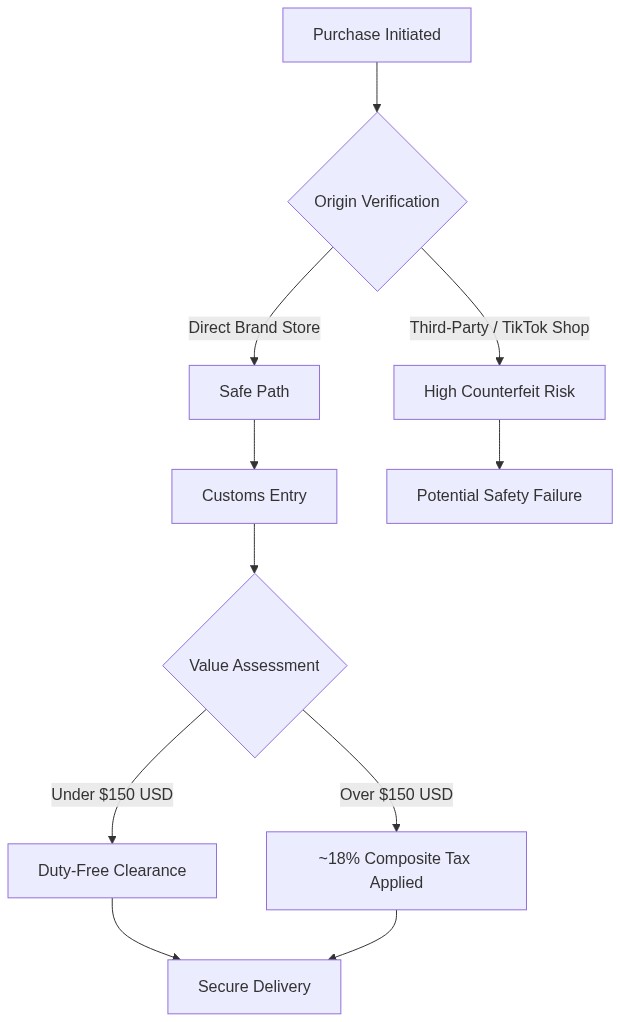
The first and most critical hurdle is the Personal Customs Clearance Code (Gaein-tonggwan-goyu-buho). This unique alphanumeric code, issued by the Korea Customs Service, is mandatory for clearing personal imports through Korean customs. When utilizing a third-party shipping forwarder (Baedaeji) to receive goods from a domestic-only Korean website and route them to your home country, you must ensure that your customs documentation is flawlessly aligned with your registration details.
Furthermore, direct purchasers must carefully calculate their order values to avoid unexpected tax liabilities. Korea Customs enforces strict tax-exemption thresholds for incoming personal shipments:
- Standard Cross-Border Direct Purchases: Up to $150 USD is exempt from import duties and VAT, provided the goods are for personal use.
- China-Originating Sourcing: If you are sourcing products that physically ship from warehouses in China, the tax-exemption threshold is set at $200 USD under specific bilateral trade guidelines.
- The Tax Penalty: Exceeding these thresholds, even by a single dollar, subjects the entire shipment to a composite tax rate of approximately 18% (derived from an 8% basic customs duty and a 10% value-added tax).
Beyond financial thresholds, there is a profound safety risk associated with unverified direct importing. Official regulatory investigations by the MFDS reveal a sobering reality: approximately one in five cosmetic products purchased directly from overseas via unverified cross-border e-commerce channels are deemed "inappropriate" or unsafe for human use. These failed products typically contain banned preservatives, unlisted active pharmaceutical ingredients, or heavy metals that exceed legal safety limits.
To protect both your skin and your capital, always cross-reference potential purchases with the MFDS harmful ingredient database, and strictly buy from platforms that require batch-level traceability.
Frequently Asked Questions
How can I verify if a K-Beauty product has been officially approved by the Korean government?
You can search the product or its local Market Authorization Holder directly on the official Ministry of Food and Drug Safety (MFDS) cosmetic portal. If it is classified as a Functional Cosmetic, it must have an active registration number proving it has undergone rigorous pre-market safety and efficacy evaluations.
What should I do if my shipment is held up at customs?
Customs delays are usually caused by a mismatched Personal Customs Clearance Code (PCCC), an incorrect value declaration, or containing a product with banned ingredients. You should immediately contact your shipping forwarder (Baedaeji) or the designated customs broker to submit corrected identification documents or pay the outstanding composite tax.
Can a counterfeit product look identical to an authentic one?
Yes. Modern counterfeit operations use highly sophisticated printing tech that can perfectly replicate outer box designs. This is why physical packaging checks must always be paired with digital tracking verification, such as scanning the GS1 DataMatrix code or checking the official batch number against the brand's authorized database.
⚠️ Disclaimer: The information provided in this guide is for educational and logistical planning purposes only. Importing cosmetics involves navigating complex, frequently updated international customs regulations and safety standards. Always perform a patch test on any newly acquired cosmetic product to ensure skin compatibility, and consult with a board-certified dermatologist if you experience adverse skin reactions.
✓ Researched and compiled using verified data as of the publication date.
 Written by Jun Mi Jung for Quiet Korea | Contact: rsl.2001.1975@gmail.com