Beyond the Plump: Why Seoul's Elite Are Trading Instant Fillers for Cellular Reprogramming

Walk into any high-end clinic waiting room in Cheongdam-dong, and you will notice a striking silence. It is not just the absence of noise; it is the absence of the "puffy" face. For the past decade, global beauty culture was dominated by instant gratification: dermal fillers that ballooned cheeks, paralyzed foreheads, and ironed out every human expression within thirty minutes. But in the quietest, most exclusive corners of Seoul, that aesthetic is dead.
- The Backlash Against the Gangnam Sister
- The Molecular Software Update: PDRN vs. Exosomes
- PDRN: The Structural Repair DNA
- Exosomes: Intercellular Communication Pods
- The Delivery Protocol: Deep and Wide
- The Factory Trap: Surviving the Seoul Clinic Ecosystem
- The Reality of Clinical-Grade Topical Skincare
- Explore Science-Backed Derma-Cosmetics
- Frequently Asked Questions
- Can I use PDRN or Exosome serums if I have active acne?
- How long does it take to see visible results from regenerative treatments?
- What is the difference between a clinic-grade booster and a retail serum?
- Are collagen-stimulating injectables safe?
The city's most sought-after dermatologists are quietly retiring temporary synthetic gels. Instead, they are filling their syringes with transparent, watery bio-liquids that show absolutely no results on day one. Why would anyone pay premium clinic prices for a treatment that leaves them looking exactly the same when they walk out the door?
The answer lies in a fundamental, biological shift from masking aging to cellular reprogramming.
Key Takeaways * The Death of Over-Filling: Seoul's aesthetic elite are abandoning traditional dermal fillers in favor of bio-regenerative agents that trigger the body’s own cellular repair mechanisms. * The Power of PDRN & Exosomes: Clinical data reveals that PDRN and Exosomes do not merely hydrate; they actively reprogram fibroblasts, resulting in documented increases of up to 312% in Type I collagen and 487% in elastin. * Navigating the Clinic Minefield: To safely harness these medical innovations, consumers must learn to distinguish high-volume "factory-style" clinics from bespoke medical practices, while avoiding the sales traps of non-medical consultation staff.
The Backlash Against the Gangnam Sister
For years, a specific caricature haunted the streets of Seoul’s cosmetic districts: the Gangnam Unni (Gangnam Sister). Characterized by over-filled under-eyes, unnaturally high cheekbones, and a glassy forehead that stretched so tight it reflected light like plastic, this look became a cautionary tale. It was the physical manifestation of an over-intervened face—a sign that the patient had treated their skin like a structural canvas to be stuffed, rather than a living organ to be nurtured.
The modern consumer has grown deeply cynical of this synthetic look. The global dermal filler market, though still massive and projected to grow from its $5.1 billion to $8.5 billion valuation in 2025 up to potentially $34.6 billion by 2035, is experiencing an internal identity crisis. Patients are discovering the dark side of long-term fillers: migration, late-onset inflammatory nodules, and the unnatural "pillow face" caused by water-retaining hyaluronic acid gels stretching the delicate facial ligaments over time.
Instead, the new holy grail is Mulgwang-pibu (water-glow skin) that originates from within. The target is no longer superficial volume, but the eradication of Sok-geonjo (inner-dryness)—a deep, dermal dehydration that no topical cream, regardless of its luxury price tag, can reach. To cure this, Seoul has turned to the emerging field of derma-cosmetics and injectable skin boosters.
🎵 K-Mono Lofi — Seoul Study Beats
Read deeper with Seoul lo-fi in the background — curated by K-Mono Lofi
The Molecular Software Update: PDRN vs. Exosomes

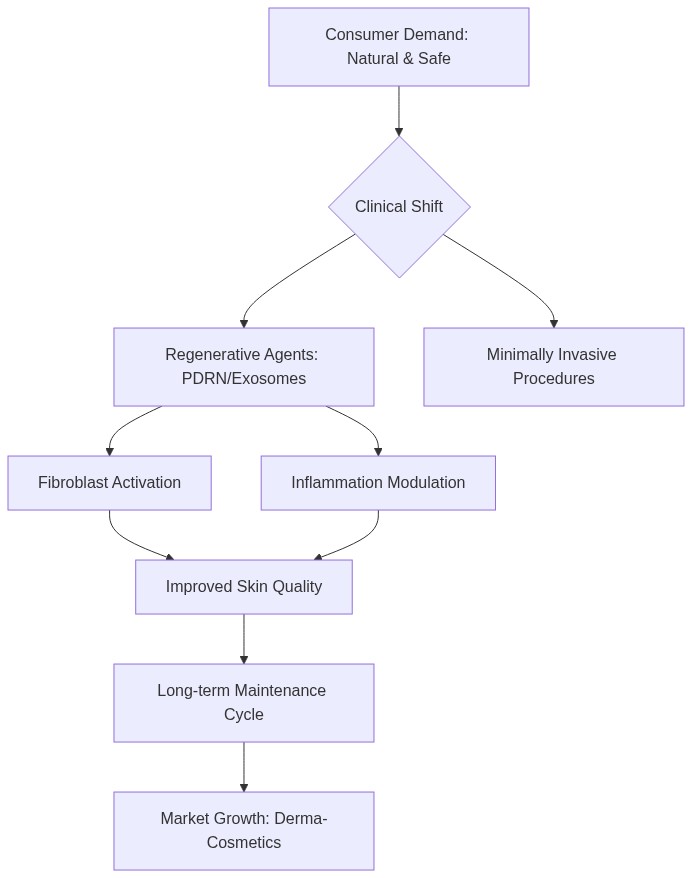
The transition to science-backed beauty is spearheaded by two primary bio-regenerative ingredients: PDRN (Polydeoxyribonucleotide) and Exosomes. Rather than sitting in the tissue as inert space-fillers, these molecules act as biological messengers, delivering a literal "software update" to aging, damaged skin cells.
To understand their power, we must look at how they interact with fibroblasts—the tiny cellular factories responsible for producing collagen and elastin.
PDRN: The Structural Repair DNA
Derived from salmon DNA (which closely mirrors human DNA sequence compatibility), PDRN acts as a cellular rescue signal. When micro-injected into the deep dermis, PDRN binds to specific A2A adenosine receptors. This binding triggers a cascade of physiological events: it dramatically accelerates tissue repair, down-regulates inflammatory cytokines, and stimulates rapid blood vessel formation (neovascularization).
The hard data behind this regenerative capacity is staggering. Biopsy studies show that ninety days post-treatment, PDRN application yields: * A 312% increase in Type I collagen synthesis. * A 487% increase in elastin fiber density.
This is not a temporary optical illusion. It is the literal physical rebuilding of the dermal matrix.
Exosomes: Intercellular Communication Pods
If PDRN is the raw material for repair, Exosomes are the project managers. Exosomes are microscopic, lipid-wrapped vesicles secreted by cells. Think of them as tiny envelopes packed with biological instructions—containing microRNA, growth factors, and proteins.
When applied to compromised skin, Exosomes fuse with target cells, releasing their cargo directly into the cytoplasm. They instantly quiet the chronic, low-grade inflammation that drives aging—a process clinically known as inflammaging—while telling adjacent cells to accelerate barrier recovery. In clinical trials evaluating acne scar revision, a protocol of three sessions of Exosome microneedling yielded a 79% improvement in scar depth and skin texture.
The Delivery Protocol: Deep and Wide
Clinicians in Seoul do not treat these ingredients as interchangeable. They employ a strategic "deep and wide" delivery mechanism. PDRN is typically administered via precise intradermal microinjections directly into the deep dermis where structural support is needed most.
Exosomes, however, are highly sensitive biological entities. Because of regulatory landscapes (where they are largely approved for topical cosmetic application rather than direct injection), they are most effectively delivered following micro-injury procedures. Devices like fractional lasers or microneedling pens create thousands of microscopic open channels, allowing topically applied Exosome solutions to flood the skin barrier and accelerate healing from the outside in.
🧬 Regenerative Science (PDRN/Exosomes)
Reprograms existing cells to produce their own structural proteins. Results develop over 4 to 12 weeks, yielding completely natural contours and restored skin health with zero risk of migration.
💉 Traditional Dermal Fillers (HA Gels)
Occupies physical space under the skin to mimic lost volume. Provides instant results, but carries risks of lymphatic blockage, water puffiness, and long-term tissue displacement.
The Factory Trap: Surviving the Seoul Clinic Ecosystem
While South Korea boasts some of the world's most sophisticated dermatological minds, the commercialization of this industry has created a highly polarized clinical landscape. For a global consumer traveling to Seoul, navigating this ecosystem requires immediate de-escalation of marketing hype.
The primary hazard is the rise of the high-volume clinic model, known locally as the Gongjang-hyeong.
[K-Beauty 101] Gongjang-hyeong (Gongjang-hyeong Pibugwa) — High-volume, low-cost "factory-style" dermatology clinics. These establishments operate on razor-thin margins, prioritizing extreme patient turnover and standardized treatment templates over individual medical assessments.
In a factory clinic, the medical doctor is often treated like a mechanical operator. You may only see the physician for the brief minutes they hold the laser handpiece or the syringe. The actual diagnostic work and treatment planning are entirely delegated to non-medical sales staff.
[K-Beauty 101] Sangdam-siljang (Clinic Consultation Manager) — Non-medical clinic sales representatives. In many commercial clinics, their compensation is heavily commission-based. Their primary objective is to upsell patients into multi-session treatment packages, regardless of whether the patient's skin barrier can tolerate the cumulative trauma.
When an untrained consumer sits in front of a persuasive consultation manager, they are frequently pushed into aggressive Package deals: combinations of high-intensity lasers, microneedling, and multiple skin boosters all performed in a single afternoon.
For an compromised skin barrier, this excessive intervention is a recipe for disaster. It can trigger severe post-inflammatory hyperpigmentation (PIH), prolonged contact dermatitis, or—in the case of poorly administered collagen-stimulating boosters like Juvelook—the formation of hard, subcutaneous nodules. These nodules are not "extra volume"; they are a localized, foreign-body inflammatory reaction to improperly diluted or unevenly distributed product.
To safely navigate your clinical journey, you must approach aesthetic procedures with a highly defensive mindset.
The Reality of Clinical-Grade Topical Skincare
As the global derma-cosmetics market surges from $76.4 billion in 2025 toward a projected $138.5 billion by 2033, skincare brands have capitalized on this clinical shift. Store shelves are now crowded with "clinic-inspired" retail products: serums packaged in sterile ampoules, creams utilizing syringe-shaped applicators, and labels boasting active-ingredient percentages that sound impressively medical.
But here is the cynical truth from the formulation laboratory: a retail serum cannot replicate a clinical procedure.
Topical skincare is bound by the laws of transdermal delivery. The stratum corneum—the outermost layer of your skin—is an incredibly efficient waterproof shield. Its primary job is to keep the outside world out. Large macromolecules, such as raw hyaluronic acid or unformulated PDRN, have molecular weights far too massive to penetrate this lipid barrier. When you apply a basic PDRN serum at home, the vast majority of those expensive molecules simply sit on the surface, acting as humectants before being washed down the drain.
This does not mean topical derma-cosmetics are useless. Rather, their true role is barrier maintenance and post-procedure preservation.
To achieve genuine dermal penetration at home, look for formulations utilizing advanced delivery technologies: * Micro-Liposomes & Nano-Emulsions: These wrap active compounds in microscopic lipid spheres that can slip between the skin's intercellular pathways. * Low-Molecular-Weight Fractions: Ingredients like hydrolyzed hyaluronic acid or fragmented DNA chains that are physically small enough to pass the stratum corneum. * Synergistic Calming Agents: Ingredients like Centella Asiatica (Cica) and Panthenol that support the skin barrier, allowing active scientific ingredients to work without triggering inflammatory responses.
By aligning your home routine with authentic molecular science rather than marketing theatricality, you protect both your wallet and your skin barrier.
This article may contain affiliate links — if you buy through them, we may earn a small commission at no extra cost to you.
Frequently Asked Questions
Can I use PDRN or Exosome serums if I have active acne?
Yes, but with strict parameters. PDRN is highly anti-inflammatory and can accelerate the healing of post-acne lesions. However, Exosome products derived from certain stem cell mediums can sometimes be overly rich for highly congested, oil-prone skin. Always opt for lightweight, water-based fluid formulas rather than heavy, oil-dense creams when dealing with active breakouts.
How long does it take to see visible results from regenerative treatments?
Because bio-regenerative treatments rely on your body's natural cellular production rather than artificial volume, patience is required. While you may notice an improved "glow" within a week due to hydration, the true structural remodeling of collagen and elastin peaks between 4 to 12 weeks post-treatment.
What is the difference between a clinic-grade booster and a retail serum?
The difference lies in concentration, molecular weight, and delivery depth. Clinic-grade boosters use highly concentrated, sterile, non-crosslinked formulations designed for direct dermal delivery via micro-needles or injections. Retail serums use much lower concentrations, must contain preservatives to survive shelf life, and are formulated to remain primarily within the epidermal layers.
Are collagen-stimulating injectables safe?
They are highly effective but carry user-dependent risks. Products like Juvelook stimulate your natural collagen production over several months. However, if they are injected too superficially, or if the practitioner fails to dilute the product correctly, it can result in small, hard lumps under the skin. Always ensure these procedures are performed by a board-certified dermatologist with extensive experience in collagen stimulators.
⚠️ Disclaimer: The information provided in this article is for educational and informational purposes only and does not constitute medical advice. Aesthetic procedures, clinical ingredients, and injectable skin boosters carry inherent risks, including infection, scarring, and vascular complications. Always consult with a board-certified dermatologist or qualified medical professional for a personalized skin assessment and treatment plan before undergoing any clinical procedure or introducing highly active clinical-grade skincare products.
✓ Researched and compiled using verified data as of the publication date.
 Written by Jun Mi Jung for Quiet Korea | Contact: rsl.2001.1975@gmail.com