Beyond the 10-Step Myth: Why Korean Formulas Behave Differently on Western Skin
Walk into any global beauty retailer, and the shelf division is stark. On one side, Western clinical brands display stark, laboratory-style packaging screaming high-percentage acids, clinical retinols, and immediate "resurfacing" solutions. On the other side sit the soft, minimalist bottles of Korean skincare, whispering of fermentation, root extracts, and deep hydration.
- The Battlefield vs. The Ecosystem: Two Worlds of Skin Philosophy
- The Korean Regulatory Fortress: How the Gosi System Protects the Barrier
- Decoding Se-Col-Ji: The Holy Trinity of Skin Architecture
- The Dark Side of the Glass Skin Dream: When Over-Care Backfires
- Explore Barrier-Supporting K-Beauty Formulas
- Frequently Asked Questions
- Can I use Korean skincare if I am already using a prescription retinoid?
- Why do some Korean products feel sticky on my skin?
- Are fermented ingredients safe for all skin types?
- How do I know if a product is certified as a "Functional Cosmetic" in Korea?
For years, global consumers believed the secret of Korean skincare lay simply in the discipline of the famous ten-step routine. Yet, many who imported these extensive routines found their skin suddenly rebelling. Others, accustomed to the aggressive peeling agents of the West, dismissed K-Beauty formulas as "too gentle" to yield real clinical results.
The truth is far more complex than a simple multi-step checklist. The real variance lies in a fundamental clash of skincare philosophies, biological assumptions, and regulatory frameworks. Why do these formulas behave so differently when applied to Western skin? The answer is not found in any single bottle, but in the biological and structural architecture of how these products are built.
Key Takeaways * The Philosophy Clash: Western skincare operates on a corrective "battlefield" model using high-potency actives, whereas Korean skincare treats the skin as an "ecosystem" prioritizing preventative barrier health. * The Regulatory Fortress: Korea's unique Ministry of Food and Drug Safety (MFDS) Gosi system mandates tight active ingredient ranges, preventing the "percentage arms race" common in Western brands. * The Barrier Trinity: Korean formulas are engineered around Se-col-ji (Ceramides, Cholesterol, Fatty Acids) and pH-balanced bases, protecting skin from the chronic inflammation that high-percentage Western acids often trigger.
The Battlefield vs. The Ecosystem: Two Worlds of Skin Philosophy
To understand why Korean formulas behave differently on Western skin, one must first look at the cultural and clinical paradigms that shape them. Western dermatology has historically treated the skin as a canvas to be corrected. When a skin issue arises—be it acne, hyperpigmentation, or fine lines—the Western impulse is to attack it with high-potency, singular active ingredients. Skin is treated almost like a battlefield: strip the old layer, force rapid cellular turnover, and rebuild.
In contrast, the Korean approach views the skin as a living, delicate ecosystem that must be gently guided, nourished, and protected. Rather than waiting for damage to appear and then correcting it, the focus is on rigorous prevention and maintenance.
This difference in philosophy directly impacts how products are formulated. Where a Western serum might utilize a staggering 10% or 15% glycolic acid to peel away the stratum corneum, a Korean formula is more likely to use a mild, low-percentage PHA (polyhydroxy acid) paired with anti-inflammatory botanical extracts like Eoseongcho (Houttuynia cordata) or green tea.
[K-Beauty 101] Sok-geonjo (속건조) — Inner dryness. The specific skin state where the deep epidermal layers are dehydrated, even while the surface remains oily, slick, or compromised.
When Western skin—which is statistically more prone to transepidermal water loss (TEWL) and barrier disruption due to a thinner stratum corneum in certain phototypes—is subjected to aggressive Western active ingredients, the lipid barrier frequently collapses. When these individuals switch to a Korean routine, they often experience a profound sense of relief. This is not because K-beauty lacks efficacy, but because it addresses Sok-geonjo (inner dryness) by systematically layering hydration rather than stripping the skin's natural defenses.
🎵 K-Mono Lofi — Seoul Study Beats
Read deeper with Seoul lo-fi in the background — curated by K-Mono Lofi
The Korean Regulatory Fortress: How the Gosi System Protects the Barrier
Many global beauty consumers do not realize that Korean skincare is governed by one of the strictest regulatory bodies in the world: the Ministry of Food and Drug Safety (MFDS). In Korea, cosmetics are legally divided into general cosmetics and "Functional Cosmetics" (Gineungseong Hwajangpum).
To make an anti-aging, brightening, or sun protection claim, a brand must navigate the MFDS’s rigorous Gosi (Notification) system.
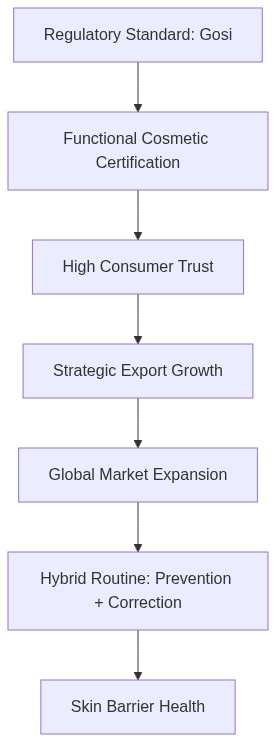
Under this system, if a manufacturer uses ingredients at the exact concentrations predetermined by the government to be both safe and effective, they bypass the need for expensive, individual clinical trials. These concentrations are mathematically balanced to deliver results without causing irritation:
- Arbutin (Brightening): Standardized at a precise 2% concentration.
- Adenosine (Anti-Wrinkle): Standardized at a precise 0.04% concentration.
- Niacinamide (Barrier & Brightening): Regulated between a 2% to 5% range.
This regulatory framework effectively prevents the "percentage arms race" seen in the Western market, where brands compete by offering increasingly volatile concentrations of actives (such as 10% retinol or 20% niacinamide). While a 10% niacinamide serum might sound superior to a consumer, dermatological consensus in Seoul suggests that concentrations above 5% significantly increase the risk of contact dermatitis without offering proportional therapeutic benefits.
By keeping concentrations within the scientifically proven Gosi sweet spot, Korean formulas allow Western consumers to experience functional benefits without triggering the chronic, low-grade inflammation that accelerates cellular aging. This safety-first regulatory culture has paid off massively: global K-Beauty market scale reached an estimated $14.7 Billion in 2024, with exports growing by 19.3% in Q3 of 2024 alone.
To illustrate how these formulation philosophies translate into physical products, let us examine the structural differences in how Western and Korean laboratories design skincare:
⚠️ Typical Western Active Formula
Optimized for rapid correction. Often features single, high-concentration actives (e.g., 12% Glycolic Acid, high-percentage Retinol) in simple, low-viscosity vehicle bases. Can disrupt the skin's acidic mantle if overused, leading to redness and barrier flaking.
✅ Korean "Gosi-Compliant" Formula
Optimized for daily barrier harmony. Combines standardized functional actives (e.g., 2% Niacinamide, 0.04% Adenosine) with soothing botanical vehicles like Centella Asiatica or fermented broths. Delivers long-term improvement without compromising lipid integrity.
Decoding Se-Col-Ji: The Holy Trinity of Skin Architecture
When Korean cosmetic chemists design barrier-repair formulas, they do not simply throw random oils into a cream. They design around a biological concept known colloquially in the Korean research community as Se-col-ji.
[K-Beauty 101] Se-col-ji (세콜지) — Ceramide, Cholesterol, and Fatty Acids. The biological shorthand for the three essential lipids that form the skin’s natural intercellular matrix.
The stratum corneum’s lipid barrier is composed of these three key lipids. However, simply having them in a formula is not enough; they must be present in a specific physiological ratio (typically 3:1:1 or 1:1:1 depending on the skin condition) to mimic the skin's natural lamellar structure.
[Healthy Skin Barrier]
   ├── Ceramide (Se)   <──┐
   ├── Cholesterol (Col) <─┼── Optimized "Se-Col-Ji" Ratio
   └── Fatty Acids (Ji)  <─┘
While many Western moisturizing creams rely heavily on occlusive agents like petrolatum or heavy mineral oils to sit on top of the skin and trap moisture, Korean formulas are highly sophisticated emulsion systems. They utilize micro-fluidics and bio-mimetic lipids that penetrate the intercellular spaces, repairing the lipid matrix from within.
This architectural difference explains why Western consumers with combination or acne-prone skin often find Western barrier creams "too heavy" or comedogenic, while Korean barrier creams feel remarkably lightweight yet provide far superior, long-lasting hydration.
Furthermore, Korean cleansing culture focuses heavily on maintaining the acid mantle. In the third quarter of 2024, South Korea's exports of personal cleansers to the US market skyrocketed by 106%. This surge was driven by a global realization: Western foaming cleansers often utilize harsh surfactants that strip the skin's natural lipids, whereas Korean cleansers emphasize weakly acidic (pH 5.5) formulations, often utilizing bubble milks or oil-to-foam transitions that cleanse without disrupting the delicate Se-col-ji matrix.
To see how these variables balance across typical daily routines, consider this direct comparison of routine structures and formulation priorities:
| Metric / Feature | Western Skincare Paradigm | Korean Skincare Paradigm |
|---|---|---|
| Primary Goal | Clinical Correction & Resurfacing | Prevention, Hydration & Barrier Support |
| Active Concentrations | High (e.g., 10-20% Niacinamide, 1-2% Retinol) | Balanced (e.g., 2-5% Niacinamide, 0.04% Adenosine) |
| Cleansing Philosophy | Deep stripping / High-foaming surfactants | Weakly acidic (pH 5.5) / Double cleansing |
| Key Barrier Approach | Surface occlusion (Petrolatum, heavy silicones) | Intercellular replenishment (Se-col-ji emulsions) |
| Innovation Velocity | Slow, traditional formulation cycles | Rapid (utilizing Gosi standardizations) |
The Dark Side of the Glass Skin Dream: When Over-Care Backfires
While the preventative, hydration-first approach of Korean skincare offers undeniable benefits, it is not without its risks. The global obsession with achieving "glass skin"—a translucent, hyper-dewy complexion—has led many consumers into a trap known in Korea as Over-care.
When a consumer with Western skin (which may already be compromised by dry climates or hard water) attempts to apply a complex, 10-step routine containing multiple layers of ferments, botanical essences, and heavy creams, the skin can become overwhelmed.
- The Fermentation Pitfall: Fermented ingredients (like Galactomyces or Bifida) are highly celebrated in K-Beauty for their ability to increase ingredient bioavailability and gently brighten the skin. However, for individuals prone to fungal acne (Malassezia folliculitis) or highly sensitive skin, fermented elements can act as a food source for yeast, triggering stubborn, itchy micro-bumps that are often misdiagnosed as standard acne.
- The Botanical Sensitivity Risk: Many K-beauty formulas rely on rich amalgams of natural extracts. While ingredients like Eoseongcho or Centella Asiatica are clinically proven to soothe, introducing fifteen different plant extracts simultaneously via multiple routine steps increases the statistical probability of developing a contact allergy.
Therefore, the key to successfully integrating Korean skincare into a Western lifestyle is not blind adoption of a multi-step routine, but thoughtful hybridization. One should keep the corrective Western actives that work for their specific concerns (such as a nightly prescription retinoid), but swap out harsh Western cleansers and basic occlusive moisturizers for pH-balanced Korean cleansers and structured Se-col-ji barrier creams.
This article may contain affiliate links — if you buy through them, we may earn a small commission at no extra cost to you.
Frequently Asked Questions
Can I use Korean skincare if I am already using a prescription retinoid?
Yes, and in fact, it is highly recommended. The soothing, barrier-supportive ingredients common in Korean skincare (such as Centella Asiatica, Panthenol, and Ceramides) are excellent for mitigating the dryness, flaking, and irritation typically caused by prescription retinoids like Tretinoin.
Why do some Korean products feel sticky on my skin?
Because Korean skincare relies heavily on humectants (like Hyaluronic Acid, Glycerin, and Beta-Glucan) to pull moisture deep into the skin, they can feel temporarily tacky upon application, especially in humid climates. To prevent this, apply smaller amounts to damp skin and pat gently until fully absorbed before layering the next product.
Are fermented ingredients safe for all skin types?
While fermented ingredients are highly beneficial for anti-aging and deep hydration, they should be avoided by individuals who suffer from fungal acne (Malassezia folliculitis). Fermented byproducts can exacerbate this condition, leading to small, uniform bumps across the forehead and jawline.
How do I know if a product is certified as a "Functional Cosmetic" in Korea?
Look for the term Gineungseong Hwajangpum (기능성 화장품) on the packaging, or check if the product prominently lists MFDS-approved concentrations of active ingredients like Adenosine, Arbutin, or Niacinamide. This certification ensures the formula has met strict government-mandated efficacy and safety standards.
⚠️ Disclaimer: The clinical and scientific information presented in this article is for educational and informational purposes only. It is not intended as medical advice. Before introducing new active ingredients or changing your dermatological routine, always perform a patch test and consult with a board-certified dermatologist, especially if you have pre-existing skin conditions or are using prescription topical treatments.
✓ Researched and compiled using verified data as of the publication date.
 Written by Jun Mi Jung for Quiet Korea | Contact: rsl.2001.1975@gmail.com