Behind the Glass: The Silent Industrial Alliance Powering Modern K-Beauty

Walk into any Olive Young in Seoul's bustling Myeongdong district at midnight, and you will witness a silent, intense ritual. Young consumers stand before glowing shelves, eyes darting between their phone screens and product labels. They are not looking at brand names or celebrity endorsements. Instead, they are running searches on Hwahae—Korea's hyper-critical ingredient analysis app—dissecting chemical formulas with the precision of clinical researchers.
- The Invisible Engine Behind the Bottle
- The Fall of the Ten-Step Myth
- Crowdsourced Science and the "Honey Combinations"
- The Friction in the Machine: When Rapid Innovation Carries Risks
- Frequently Asked Questions
- What is the difference between a brand and an ODM in K-Beauty?
- Why is the 10-step skincare routine no longer recommended?
- How do I practice "Hamsup-milpye" (moisture-attracting and sealing) correctly?
- What should I look for in a K-Beauty "Special Planning Set" (Gihoek-set)?
- Navigating Your Skincare Selection
- Explore Scientifically Validated K-Beauty Formulas
This is the true face of modern Korean beauty culture. The romanticized global image of ancient herbal secrets brewed in quiet mountain villages has largely given way to a high-speed, data-driven ecosystem. Behind the sleek packaging and the promises of radiant "glass skin" lies a highly sophisticated industrial machine that has transformed skincare from a routine into an exact science. But to truly understand why these products perform the way they do, one must look past the polished marketing narratives and examine the structural alliance that makes it all possible.
Key Takeaways * The Trinity Model Decoupling: Most cult-favorite K-Beauty brands do not own factories; they rely on mega-manufacturers (ODMs) that act as the software-like infrastructure of the beauty world. * The Rise of Skip-Care: Consumers are abandoning the famous 10-step routine in favor of barrier-protecting minimalism focused on moisture-attracting and sealing mechanisms. * Community-Driven Formulations: Real innovation in Korea is crowdsourced through user-tested product pairings and curated retail selections rather than closed corporate laboratories.
The Invisible Engine Behind the Bottle
The global market has watched K-Beauty balloon into a powerhouse, with valuation estimates tracking between $11.1 billion and $16.26 billion in 2026, and projected to scale to anywhere from $21.5 billion to $42.62 billion by the 2030s. Social commerce has accelerated this growth, with platforms like TikTok Shop recording a staggering 430% year-on-year sales surge across major Western markets, primarily driven by consumers aged 18 to 34 who make up roughly 60% of the market.
Yet, if you were to trace the physical origin of the most viral serums, you would not arrive at the headquarters of the indie brands on the label. You would find yourself in the massive, high-tech facilities of Original Design Manufacturers (ODMs) like Cosmax or Korea Kolmar.
This is what industry insiders call the "Trinity" model—a structural innovation that completely decouples formulation research, manufacturing, and brand marketing.

In this ecosystem, the ODM functions as the cloud-computing infrastructure of beauty. They maintain vast, pre-formulated libraries of clinically validated bases. When an indie brand identifies a rising consumer need, they do not spend years in basic research. They partner with an ODM, select a high-performance base, customize the active botanical extract, and bring a finished product to market in a fraction of the time required by traditional Western beauty conglomerates. This agility allows Korean brands to respond to global consumer feedback loops in weeks rather than fiscal quarters.
The Fall of the Ten-Step Myth
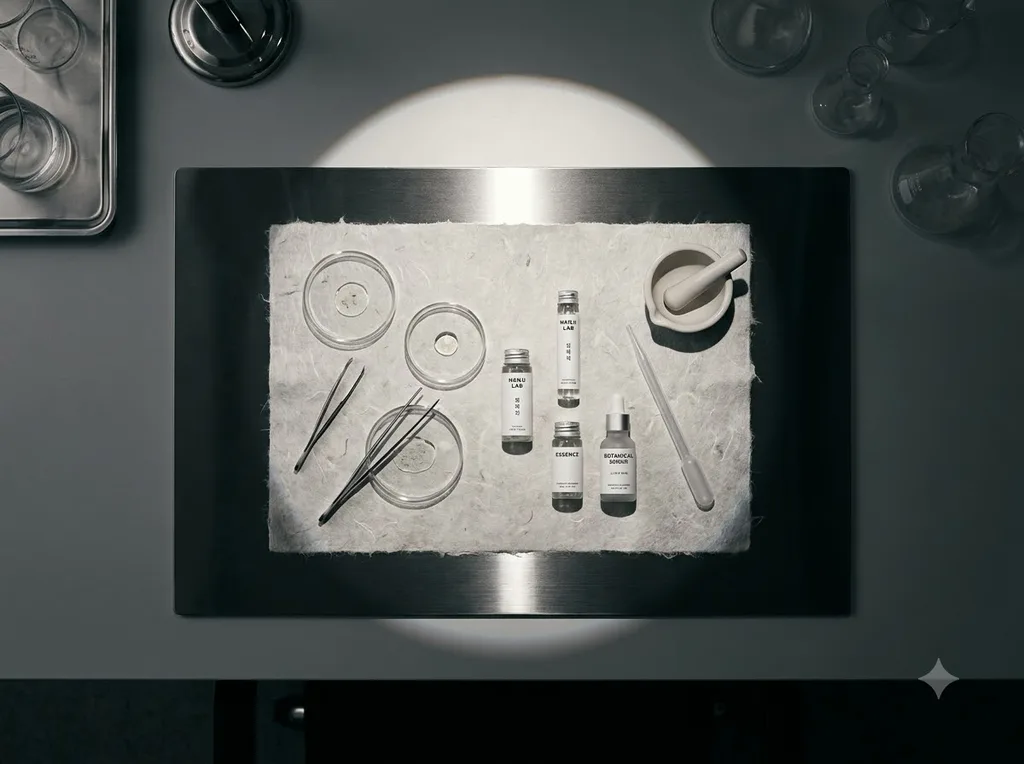
For years, global beauty media propagated the myth of the laborious 10-step Korean skincare routine. It was a brilliant marketing narrative, but within Korea, the philosophy has matured into something far more refined.
[K-Beauty 101] Skip-care (스킵케어) — Minimalist skincare. This term describes the modern Korean shift away from multi-step layering toward simplified, highly efficient regimens that prioritize skin barrier integrity over product volume.
The driving force behind this evolution is a deeper understanding of how the skin actually processes hydration. Rather than overloading the stratum corneum with half a dozen competing formulas, the focus has shifted to a foundational pedagogical concept known as hamsup-milpye.
[K-Beauty 101] Hamsup-milpye (함습밀폐) — Moisture-attracting and sealing. This principle emphasizes the precise balance between humectants (which draw water into the skin layers) and occlusives (which lock that water in place to prevent trans-epidermal water loss).
When you strip away the marketing noise, effective skincare relies on this dual-action synergy. Applying multiple layers of watery toners without an adequate lipid barrier to seal them is a recipe for dehydration. Conversely, heavy occlusive creams applied to parched skin simply trap dryness underneath.
The modern Korean approach optimizes this relationship in fewer steps, using highly concentrated, multi-functional formulas.
❌ The 10-Step Legacy Approach
- Repetitive layering of low-concentration toners
- High risk of skin sensitization from preservative buildup
- Focus on product consumption and ritual complexity
- Excessive friction from constant manual application
✅ The Modern Skip-Care Approach
- Targeted delivery of multi-functional active agents
- Preservation of the natural acid mantle and lipid barrier
- Focus on clinical synergy (Hamsup-milpye)
- Simplified routines that lower skin stress levels
Crowdsourced Science and the "Honey Combinations"
In Seoul, the laboratory is not a closed room—it is a public square. Korean consumers do not passively receive products; they actively experiment, blending formulas to address specific skin concerns. This community-led behavior has birthed the phenomenon of kkul-johap, or "Honey Combinations."
These are user-tested, highly synergistic product pairings that gain viral traction online before being adopted by the brands themselves. For instance, pairing a deeply hydrating low-molecular-weight hyaluronic acid serum (like the Torriden Dive-In Serum) with a soothing, lipid-replenishing recovery cream (such as the Dr.G Red Blemish Cream) has become a classic community blueprint for repairing a compromised skin barrier.
[Torriden Dive-In Serum] (Deep Humectant / Hydration)
         +
[Dr.G Red Blemish Cream] (Soothe & Seal / Occlusive)
         =
[Optimized Skin Barrier Recovery]
Retailers have adapted to this behavior by offering highly curated selections. The most coveted retail seal of approval in Korea is the Ol-Young Pick, a designation given to products handpicked by Olive Young based on real-time sales data, search trends, and community reviews.
To make these high-performance pairings accessible, brands frequently bundle their star products into gihoek-set (special planning sets). These packages typically include a full-sized treatment alongside complimentary travel-sized formulas, allowing consumers to experience complete, synergistic routines without committing to multiple expensive individual purchases.
🎵 K-Mono Lofi — Seoul Study Beats
Read deeper with Seoul lo-fi in the background — curated by K-Mono Lofi
The Friction in the Machine: When Rapid Innovation Carries Risks
While the hyper-accelerated pace of Korean skincare formulation delivers cutting-edge ingredients to the global market at remarkable speeds, it is not without its systemic challenges. The pressure on brands to constantly release new, exciting products has created a culture of rapid formulation cycles that can sometimes mimic the dynamics of fast fashion.
This rapid-fire iteration can lead to market saturation with copycat formulations, where minor botanical variations are marketed as revolutionary breakthroughs. For the consumer, this presents a distinct risk. Layering too many active ingredients, or constantly switching products to chase the latest trend, can easily overwhelm the skin.
Furthermore, while traditional ingredients like Ginseng boast impressive clinical backing—showing up to an 82% improvement in wrinkle depth and a 36% increase in skin elasticity in controlled trials—or Centella Asiatica, which can demonstrate a 65% reduction in key inflammatory markers, these results depend entirely on formulation integrity. A product that contains only a microscopic trace of an active ingredient, padded with synthetic slip agents and heavy fragrances to create an immediate sensory illusion of smoothness, will not deliver true physiological change.
To navigate this market safely, consumers must look past the initial aesthetic experience and demand transparent clinical validation. The goal should always be to identify stable, well-formulated products that respect the skin’s biological limits.
Frequently Asked Questions
What is the difference between a brand and an ODM in K-Beauty?
An ODM (Original Design Manufacturer) like Cosmax or Korea Kolmar designs, develops, and manufactures the actual liquid formulation. The brand name on the bottle is responsible for the product packaging, marketing concept, and distribution. This allows indie brands to bring high-quality, scientifically advanced formulas to market without needing to build their own industrial factories.
Why is the 10-step skincare routine no longer recommended?
Applying too many layers of different products can overload the skin, increase the risk of contact dermatitis from preservative buildup, and compromise the skin barrier. Modern K-Beauty focuses on "Skip-Care"—using fewer, highly targeted products that deliver synergistic active ingredients without overwhelming the skin's natural ecosystem.
How do I practice "Hamsup-milpye" (moisture-attracting and sealing) correctly?
First, apply a humectant-rich product (like a low-molecular-weight hyaluronic acid or beta-glucan serum) to damp skin to draw water deep into the surface layers. Immediately follow with an emollient or occlusive cream containing ceramides, fatty acids, or squalane to lock that moisture in and prevent it from evaporating into the air.
What should I look for in a K-Beauty "Special Planning Set" (Gihoek-set)?
Look for sets that pair a full-sized version of a corrective treatment (like a soothing ampoule) with mini-sized barrier support products (like a gentle cleanser and a barrier cream). This provides a complete, balanced routine designed to work together without risking ingredient conflicts.
Navigating Your Skincare Selection
If you are ready to move past the marketing stories and build a functional, results-driven routine, follow these practical steps:
- Audit Your Current Shelf: Look at your products and categorize them into humectants (water-attractors) and occlusives (water-sealers). If you have four different hydrating toners but no structured cream to lock them in, your routine is unbalanced.
- Prioritize Barrier Integrity: If your skin feels tight, red, or sensitized, strip your routine back to a basic gentle cleanser, a simple hydrating serum, and a barrier-repairing cream. Avoid active exfoliating acids or high-strength retinoids until your barrier feels resilient.
- Analyze Before You Buy: Use community platforms and ingredient databases to check the concentration of key active ingredients. Ensure that traditional botanicals like Centella Asiatica or Ginseng sit high on the ingredient list rather than at the very bottom beneath synthetic fillers.
This article may contain affiliate links—if you buy through them, we may earn a small commission at no extra cost to you. Our editorial content remains strictly independent and focused on objective formulation analysis.
⚠️ Medical Disclaimer: The scientific and cultural insights shared in this article are for educational and informational purposes only. Skincare needs are highly individual and depend on genetics, environment, and overall health. Always perform a patch test on your inner arm for 48 hours before introducing a new formula to your face. If you have chronic skin conditions such as eczema, severe acne, or rosacea, consult a board-certified dermatologist before altering your skincare regimen.
✓ Researched and compiled using verified data as of the publication date.
 Written by Jun Mi Jung for Quiet Korea | Contact: rsl.2001.1975@gmail.com