What is the Daiso-tem phenomenon in Korean beauty culture?
Walk into any Daiso in Seoul at 2:00 PM on a Tuesday, and you won’t just see students hunting for stationery. You will see a woman in her 40s, dressed in professional tailoring, meticulously comparing the ingredient labels of two 3,000 KRW ($2.25 USD) toners. This isn’t a sign of economic despair; it is the front line of a retail revolution. As of this month, the "Daiso-tem" phenomenon has transformed the Korean beauty landscape, turning what was once a budget discount store into the world's most aggressive beauty laboratory.
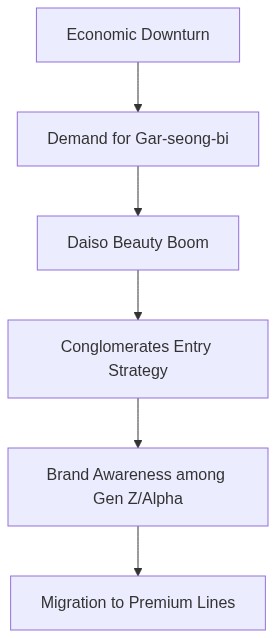
Key Takeaways * Daiso Korea has pivoted from a general discount shop to a strategic beauty incubator, now stocking over 1,400 items from 150+ brands. * Major conglomerates like Amorepacific are using Daiso to capture Gen Z/Alpha loyalty through high-efficacy, low-cost entry points. * The "Daiso-tem" culture is driven by Gar-seong-bi (value for money)—a performance-first consumer mindset that rejects brand prestige in favor of clinical results.
The crack in the foundation of the global K-Beauty myth is this: you believe you need to spend premium prices to access premium innovation. The reality on the ground in Seoul is the opposite. Major conglomerates—the same titans behind your $100 luxury serums—are quietly flooding the Daiso shelves with exclusive, stripped-down lines. They aren't doing this to cannibalize their prestige sales; they are doing it to intercept you at your first point of skincare curiosity. They are betting that if they win your trust at 3,000 KRW, you will be a customer for life.

The Anatomy of the 5,000 KRW Innovation
For years, the "Daiso-tem" (Daiso-item) was synonymous with "cheap." But that ended with the breakout success of high-functionality items like the VT Reedle Shot. When a product using a sophisticated micro-needling delivery system hits the shelf at 3,000 KRW ($2.25 USD), the entire industry has to pivot.
Why are these products moving so fast? It comes down to the aggressive pace of the Korean OEM/ODM industry. Companies are investing millions into GMP (Good Manufacturing Practice) facilities, allowing them to produce at scale while keeping costs near the floor. They remove the expensive glass packaging, the elaborate marketing campaigns, and the celebrity endorsements, leaving only the formulation.
However, the "dark side" of this accessibility is the reliance on bulking agents. To hit that 3,000 KRW price point, chemists often utilize thicker textures and simpler surfactants that, while functional, lack the refined skin-feel of a $50 luxury serum. If you have a compromised lipid barrier or reactive skin, these products are not always the "dupes" they claim to be. They are tactical skincare, designed for speed and performance, not necessarily for the indulgent, sensory ritual of high-end beauty.
The Global Logistics Wall
If you are reading this from abroad, you are likely looking for a way to get these items into your own medicine cabinet. Here is the uncomfortable truth: the legal landscape for "Daiso-tem" is a minefield.
In Korea, the industry is governed by strict regulations for the Hwajangpum Chaekim Panmae-eopja (Cosmetic Responsible Seller). Most of the small-scale resellers you find on social media are operating in a grey zone. When you purchase through a Baedaeji (shipping agency), you are taking on the role of the importer. If a product causes an adverse reaction, there is no corporate safety net for you to fall back on.
🎵 K-Mono Lofi — Seoul Study Beats
Read deeper with Seoul lo-fi in the background — curated by K-Mono Lofi
Before you commit to a bulk haul, consider this: many of these viral items are formulated for the specific climate and skin-density profiles common in Seoul. The 3,000 KRW Matchum-hyeong Hwajangpum (customized cosmetics) are brilliant for the local shopper who can walk into a store, test the texture, and walk out. For the global shopper, it is a high-stakes gamble.
The Future of the Shelf
Daiso isn't going anywhere. It has successfully moved from being a Cheonnyang-shop (the 1,000-won shop of the past) to a legitimate competitor to the "Korean Sephora" experience. But it requires a different kind of reader—one who prioritizes ingredient utility over the experience of unboxing a heavy, gold-trimmed bottle.
If you are heading to Seoul, skip the department store counters for one afternoon. Walk into a Daiso, head to the beauty aisle, and look for what the locals are actually grabbing. Look for the products that are consistently restocked, not the ones being pushed by signage. That—the quiet, functional, performance-driven choice—is the true secret of the Korean shelf.
⚠️ Disclaimer: This article is for educational purposes regarding beauty retail trends and does not constitute medical advice. Skincare formulations, particularly budget-tier products, can contain varying concentrations of actives; always perform a patch test before applying new products to your face. If you have pre-existing skin conditions, consult with a dermatologist before integrating new, high-efficacy formulations into your routine.
⚠️ Disclaimer: This article is for informational and educational purposes only and does not constitute medical, dermatological, or financial advice. Individual results vary — consult a board-certified dermatologist or physician before starting any new skincare routine, supplement, or procedure, especially if pregnant, nursing, or taking other medications. This article may contain affiliate links — if you buy through them, we may earn a small commission at no extra cost to you.
✓ Researched and compiled using verified data as of the publication date.
 Written by Jun Mi Jung for Quiet Korea | Contact: rsl.2001.1975@gmail.com