The TSMC of Skincare: Why Your Fifteen Dollar Korean Serum Might Be Identical to a One Hundred Fifty Dollar Luxury Cream

The global beauty marketplace is currently flooded with a dizzying array of options, but a quiet anxiety runs beneath the surface for the modern consumer. You spend hours researching ingredients, only to find yourself staring at an online checkout cart, frozen by two nagging questions: Is this cheap formulation actually going to work, or is it just a bottle of useless filler? And worse: If I buy this from a third-party seller, am I putting a toxic, unregulated counterfeit directly onto my skin?
- The Super-Foundries of Seoul: Inside the Korean ODM Industry
- The Regulatory Equalizer: Why Price Does Not Dictate Performance
- Bypassing the Middlemen: The Logistics of Safe Sourcing
- Frequently Asked Questions
- Is a cheaper K-Beauty product from the same ODM always identical to its luxury counterpart?
- How can I verify if my K-Beauty product is authentic?
- What is Jikgu, and why should I use a Baedaeshi?
- Are functional ingredients like PDRN and Beta-Sitosterol regulated differently in Korea?
We have been conditioned to believe that premium price tags guarantee superior molecular science, while budget alternatives are merely watered-down imitations. In the world of South Korean skincare, however, this logic is completely inverted. The true engine of K-Beauty is not a collection of competing, secretive laboratories, but a highly centralized, hyper-efficient manufacturing matrix that functions remarkably like the semiconductor industry.
Key Takeaways * The Foundry Model: The vast majority of Korean skincare—both indie and ultra-luxury—is manufactured by the same massive Original Development Manufacturing (ODM) giants like Cosmax and Kolmar Korea, sharing identical high-performance formulation libraries. * Regulatory Parity: South Korea’s Ministry of Food and Drug Safety (MFDS) strictly regulates therapeutic claims under a rigid "Functional Cosmetics" system, ensuring that active ingredient efficacy is standardized regardless of retail price. * Logistical Security: Bypassing western third-party marketplaces through direct-to-consumer domestic platforms is the only foolproof method to guarantee product authenticity and avoid hazardous counterfeit formulations.
The Super-Foundries of Seoul: Inside the Korean ODM Industry
To understand why a budget-friendly Korean product can deliver identical clinical results to a luxury brand, one must understand the structural reality of the global beauty supply chain. The cosmetics market is no longer a collection of independent houses mixing potions in private labs. Instead, it relies heavily on Original Development Manufacturing (ODM).
In 2024, the global cosmetics ODM market stood at approximately USD 8.41 Billion. By the early 2030s, this figure is projected to skyrocket to between USD 22 Billion and 34 Billion, growing at a compound annual growth rate (CAGR) of 5.6% to 15.1%. In South Korea, the epicenter of this industrial shift, ODMs are responsible for the development and manufacturing of roughly 60% of all new brand launches.
The two undisputed titans of this space are Cosmax and Kolmar Korea. They operate exactly like TSMC (Taiwan Semiconductor Manufacturing Company) does in the tech world. They do not merely print someone else's recipe; they own massive, proprietary R&D libraries filled with pre-formulated, clinically tested, and government-approved emulsions.
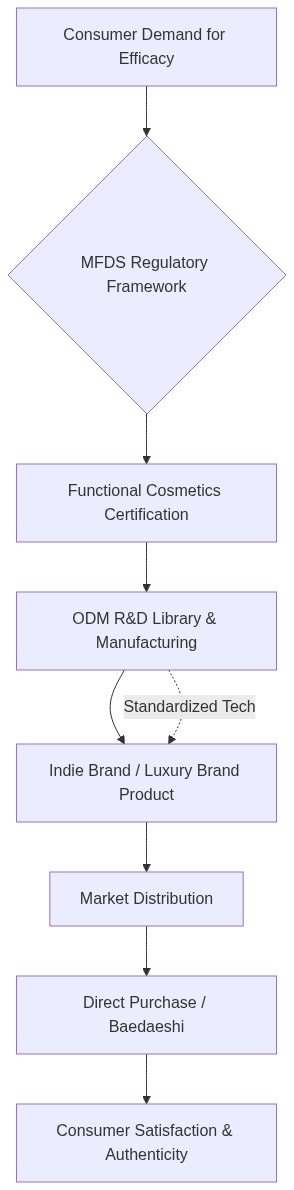
When a brand—whether it is a newly launched indie label trending on social media or a heritage luxury house sold in Gangnam department stores—wants to launch a new niacinamide serum, they do not build it from scratch. They walk into the showroom of an ODM titan, select a base formulation from the library, customize the scent, color, and packaging, and place an order. Because these massive manufacturers operate on thin average operating margins of about 4.5% and manage an average debt ratio of 69%, they rely on extreme volume to maintain profitability. This means the exact same high-performance base formula is regularly sold to both the $15 indie brand and the $150 luxury label.
[K-Beauty 101] Gineungsung Hwajangpum — Cosmetics legally certified by the South Korean Ministry of Food and Drug Safety (MFDS) for specific physiological efficacy. This represents the gold standard of skincare validation, guaranteeing that a formula does exactly what it claims to do, bypassing marketing hype.
🎵 K-Mono Lofi — Seoul Study Beats
Read deeper with Seoul lo-fi in the background — curated by K-Mono Lofi
The Regulatory Equalizer: Why Price Does Not Dictate Performance
In many Western markets, cosmetic claims are largely self-regulated until something goes wrong. In South Korea, the system is designed to protect the consumer from day one. The MFDS enforces a strict regulatory class known as Gineungsung Hwajangpum (Functional Cosmetics).
If a product claims to brighten hyperpigmentation, reduce wrinkle depth, or provide UV protection, it cannot simply rely on marketing copy. It must undergo a rigorous, government-supervised clinical evaluation, or utilize an ODM formulation that has already been pre-certified by the MFDS.
This creates an unprecedented level of quality stabilization across the market. The active concentrations of powerhouses like low-molecular-weight hyaluronic acid, barrier-restoring beta-sitosterol, or regenerative PDRN are held to the same analytical standards whether they are packaged in a minimalist plastic bottle or an ornate glass jar.
The real differentiator between high-end and budget formulations is rarely the active compound itself. Instead, it lies in two areas: the reduction of "bulking" agents and the luxury sensory experience.
Cheap, unverified cosmetics often utilize high percentages of low-cost bulking agents—synthetic thickeners and simple purified water—to pad out the volume of the product without adding biological value. Premium ODM formulations, by contrast, replace these fillers with nutrient-dense botanical extracts or multi-weight humectant complexes.
However, because indie brands share access to the same ODM libraries as luxury giants, they can offer these high-quality, low-bulk formulations without the massive marketing, packaging, and department-store distribution markups that drive luxury prices into the hundreds of dollars.
The $15 Indie "Smart-Buy"
- Formulation: Leverages the ODM's standardized R&D library. Highly active, clinically validated.
- Packaging: Minimalist, standard stock bottles, basic paper boxes.
- Markup: Low retail margins (often targeted around 4.5% ODM operating profits).
The $150 Luxury Alternative
- Formulation: Often the exact same active base, with minor proprietary scent or texture tweaks.
- Packaging: Custom-molded heavy glass, gold foil, sensory-weighted caps.
- Markup: Massive marketing overhead, department store commissions, and prestige pricing.
Bypassing the Middlemen: The Logistics of Safe Sourcing
Because the price-to-performance ratio of authentic K-Beauty is so disruptive, a massive secondary market of counterfeit products has emerged on global e-commerce platforms. Unverified third-party sellers frequently copy popular packaging designs and fill them with dangerous, unsterile, and inactive bulk liquids. For the global consumer, the risk of buying a fake is far higher than the risk of buying an ineffective authentic budget product.
To guarantee you are putting genuine, clinically backed formulations on your face, you must master the supply chain. The most reliable method is executing a Jikgu (direct purchase) from authorized domestic Korean platforms or using a trusted Baedaeshi (delivery proxy service).
By sourcing your skincare directly from the domestic Korean market, you ensure the product has passed through the strict quality control mechanisms mandated by the MFDS for local distribution.
[K-Beauty 101] Jikgu — Direct purchase from overseas. The act of global consumers buying directly from South Korean domestic storefronts to bypass unverified middleman distributors. This is the ultimate cost-saving and authenticity-guaranteeing strategy in modern K-beauty logistics.
To safeguard your skincare routine, use this analytical checklist before making any purchase:
- Verify the Manufacturer: Turn the bottle over. Look for "Manufactured by Cosmax" or "Manufactured by Kolmar Korea." If it is made by one of the major Korean ODMs, the foundational chemistry is highly secure.
- Check for Security Seals: Genuine, high-demand K-Beauty products increasingly utilize advanced digital authentication labels, such as NEMOIN QR codes or holographic tamper-evident seals. Scan them immediately upon arrival.
- Inspect the Labeling: Legitimate Korean products destined for the domestic market will feature clear, precise printing with detailed ingredient lists in both Korean and English, alongside a clearly stamped lot number and expiration date in the
YYYY.MM.DDformat. - Bypass Open Marketplaces: Avoid purchasing trending skincare from unverified storefronts on Amazon, eBay, or unauthorized social commerce platforms where inventory tracking is co-mingled.
The table below outlines the stark differences between safe, direct supply chains and high-risk secondary distribution channels:
| Sourcing Route | Authenticity Guarantee | Pricing Structure | Shipping Time | Best Suited For |
|---|---|---|---|---|
| Direct Domestic (Jikgu / Baedaeshi) | 100% Secure (Direct from certified Korean retail inventory) | Lowest retail cost (bypasses import markup) | 7 to 14 business days | High-volume buyers, rare indie releases, maximum safety |
| Authorized Global Partners | High Security (Direct contracts with Korean brands) | Moderate markup (covers global logistics and customs) | 3 to 7 business days | Convenient restocking, standard routines |
| Third-Party Open Marketplaces | Extremely Low (Co-mingled inventory from unverified sellers) | Often suspiciously cheap or highly inflated | 1 to 2 days | Not Recommended (High risk of counterfeit/expired products) |
The pursuit of healthy skin should never require you to compromise on safety or overpay for marketing illusions. When you step away from the glossy ad campaigns and look directly at the manufacturing data, the truth becomes clear: elite skincare science has been democratized. By learning to navigate the logistics of direct purchasing and understanding the power of the Korean ODM system, you can build a highly effective, clinical-grade routine without ever paying a premium for a luxury logo.
This article contains affiliate links — if you buy through them, we may earn a small commission at no extra cost to you.
We believe that transparency is the ultimate form of respect. If you want to dive deeper into the actual logistics, the hidden supply chains, and the unvarnished truths of the beauty industry that brands pay millions to keep hidden, join our inner circle. No spam, no marketing fluff—just the cold, hard data you need to protect your skin and your wallet.
Frequently Asked Questions
Is a cheaper K-Beauty product from the same ODM always identical to its luxury counterpart?
Not completely identical, but the core therapeutic efficacy is often virtually indistinguishable. While the active delivery systems and base emulsions are pulled from the same standardized ODM libraries, luxury brands may pay for custom sensory additives, proprietary natural fragrances, or more premium packaging. However, the physiological impact on your skin barrier remains fundamentally the same.
How can I verify if my K-Beauty product is authentic?
Always check for holographic security seals, such as NEMOIN digital authentication tags, on the packaging. Additionally, verify that the manufacturer listed on the back is a reputable Korean firm (like Cosmax, Kolmar Korea, or Neopharm) and ensure the expiration date is printed in the standard Korean format of YYYY.MM.DD. Sourcing directly from verified retailers is the best preventative measure.
What is Jikgu, and why should I use a Baedaeshi?
Jikgu refers to purchasing products directly from South Korean domestic online storefronts. Because many of these local shops do not offer international shipping, consumers use a Baedaeshi (a shipping proxy or forwarding service) which provides a local Korean address to receive the package and then forwards it globally. This process guarantees you receive authentic products formulated for the strict domestic Korean market.
Are functional ingredients like PDRN and Beta-Sitosterol regulated differently in Korea?
Yes. Under the Ministry of Food and Drug Safety (MFDS), any product utilizing these active ingredients to claim specific physiological benefits—such as wrinkle repair or skin barrier regeneration—must be certified as a Functional Cosmetic (Gineungsung Hwajangpum). This requires the formulation to meet strict, clinically proven concentration thresholds before it can legally be sold.
⚠️ Disclaimer: The information provided in this article is for educational and informational purposes only. Skincare formulations, particularly active functional cosmetics, can affect different skin types uniquely. Always perform a patch test before introducing new products into your routine, and consult with a board-certified dermatologist for personalized medical advice regarding specific skin conditions.
✓ Researched and compiled using verified data as of the publication date.
 Written by Jun Mi Jung for Quiet Korea | Contact: rsl.2001.1975@gmail.com