The Ultimate Seoul Beauty Intelligence: authentic K-Beauty skincare routines, ingredient science, and glass skin secrets — verified by real Korean sources.
The Spatial Illusion: Why K-Idol Individual Clusters Defeat Full Strip Lashes (and the Olive Young Secret to Applying Them)
on July 25, 2026
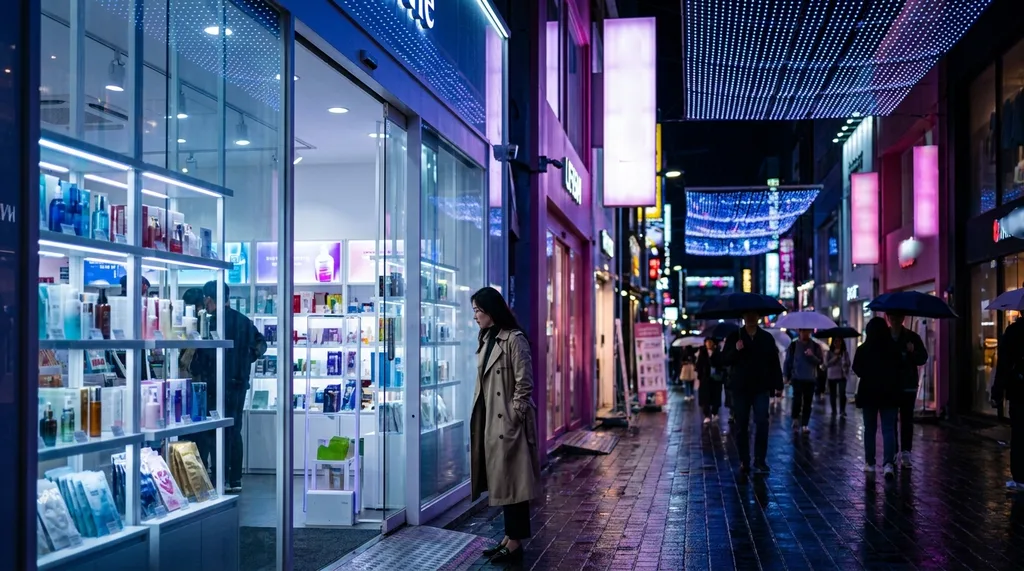
Imagine walking down the neon-lit, midnight aisles of an Olive Young in Myeongdong. You will see beauty lovers systematically bypassing the heavy, dramatic full strip lashes that dominate Western beauty counters. Instead, their baskets are filled with tiny, delicate trays of individual lash clusters—the exact tool behind the gravity-defying, crystalline gaze of K-Pop idols. This shift is not just a passing trend; it is a fundamental rejection of the heavy, mask-like makeup philosophy in favor of a skin-first, light-reflective spatial illusion.
> **Key Takeaways**
> * **The Spatial Shift:** Traditional strip lashes suffocate the eyes with uniform, heavy volume; K-Idol individual clusters (*Gadak-soknun-sseop*) create a "popped" doll-like effect by leaving deliberate, light-reflective gaps.
> * **The Invisible Anchor:** The "under-lash" technique places clusters *under* the natural lash line, hiding the lash band completely for a seamless, flawless finish.
> * **Professional Application Hacks:** Combatting the "clumsy hand" (*Ttong-son*) barrier requires simple backstage tricks like oil-blotting the eyelids and using professional matte-steel tweezers.
---
## Stage 1: The Local Intelligence — Why Seoul Abandoned Strip Lashes
The modern K-beauty philosophy prioritizes light-reflective, breathable skin over heavy makeup awnings.
Why did the Korean beauty community systematically divorce themselves from the heavy, strip-lash aesthetic? The answer lies in the cultural shift toward a highly luminous, skin-first look. When your skin is a fresh canvas of light-reflective moisture, a thick, dark, uniform synthetic strip acting as a heavy awning over your eyes looks completely jarring. It blocks natural light, casts a dark shadow on the delicate under-eye area, and immediately breaks the illusion of natural, effortless youth.
> **[K-Beauty 101]** *Gadak-soknun-sseop* — Individual cluster lashes designed for a spiky, defined look. This term captures the essence of the K-Idol aesthetic, which rejects the uniform volume of strip lashes. It emphasizes an intentional, "separated" lash look that mimics the doll-like, high-definition eyes seen in K-pop performances.
The individual lash market has absolutely exploded, reaching a global market value of $1.3B to $1.8B in 2024, and is projected to skyrocket to $2.7B to $4.5B by 2030–2035, growing at a CAGR of 3.9% to 8.7%. This movement is heavily driven by consumers aged 18 to 44, with a powerful concentration in the 25–34 sweet spot. In Seoul, professional eyelash salon return rates within three weeks are as high as 80%. However, the sheer cost and time commitment of bi-weekly salon visits have forced a massive shift toward home application. The average consumer wants the high-definition, red-carpet look without the high-end price tag.
But for many, attempting this at home leads directly to a common frustration.
> **[K-Beauty 101]** *Ttong-son* — Clumsy or unskilled hands in the context of beauty application. A self-deprecating term used in Korean beauty communities to describe the struggle of mastering complex techniques. It highlights the high barrier to entry for professional-level makeup and creates a demand for beginner-friendly products.
To bypass this barrier, beauty enthusiasts have traded the clumsy, heavy strip lash for hyper-customized individual clusters that allow for absolute control over eye shape and density.
---
## Stage 2: The Honest Breakdown — Cluster Anatomy vs. Strip Awning
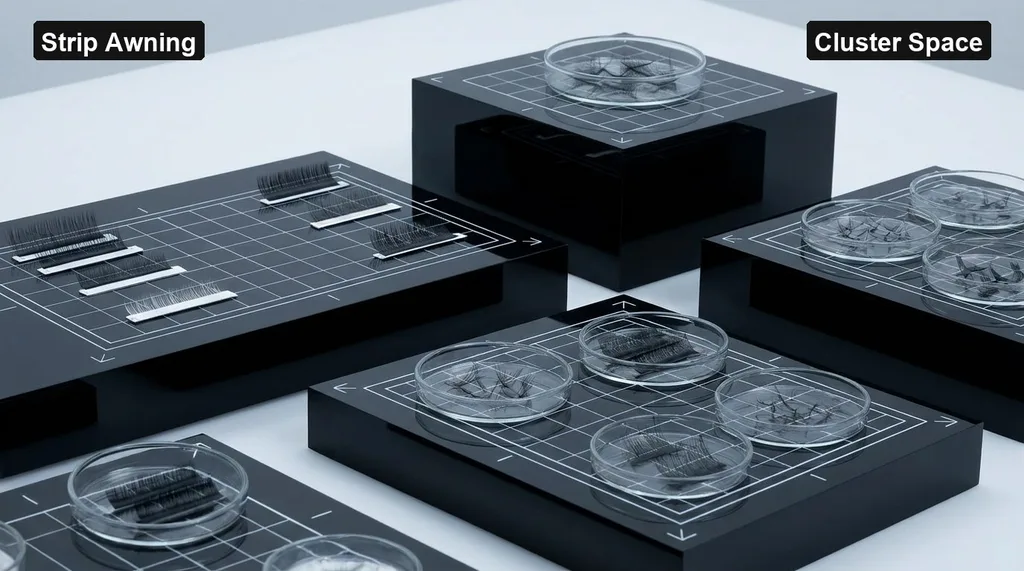
Architectural negative space: comparing stiff traditional strip bands with airy, customizable individual clusters.
Traditional strip lashes are built on a solid black or clear band that runs the entire length of the eyelid. This band acts like a stiff wire, fighting the natural 3D curvature of the eye. It lifts at the corners, pinches the sensitive inner corners, and requires a thick layer of eyeliner to conceal.
Clusters, or *Gadak-soknun-sseop*, operate on a completely different physical principle: architectural negative space. Instead of a solid wall of fibers, they are tiny points of contact placed selectively along the lash line. Backstage artists map them precisely to key anatomical coordinates: the exact center of the pupil (to open the eye vertically) and the outer edge of the iris (to elongate the eye without drooping). This leaves natural gaps between the clusters, allowing light to pass through. The result is a sparkling, wide-eyed look that feels light, airy, and impossibly real.
Delivers a weightless, highly-defined "spiky" look that opens the gaze naturally.
Safety Profile
Requires high-quality, low-irritation adhesives compliant with ISO 10993 standards to protect the delicate periorbital skin.
Value Rating
★★★★★ (Highly reusable, drastically reduces reliance on expensive salon extensions)
Best For
Anyone seeking a customized, "transparent" makeup look that enhances natural eye shape without heavy weight.
However, applying anything near the periorbital area carries inherent risks. Standard, cheap strip lash glues are often packed with harsh latex and formaldehyde-releasing preservatives that can trigger severe contact dermatitis. To combat this, the modern K-Beauty industry has shifted heavily toward rigorous safety protocols. High-quality lash adhesives are now formulated to meet ISO 10993-5 (evaluating cytotoxicity to ensure cells aren't damaged) and ISO 10993-10 (evaluating sensitization to prevent delayed allergic reactions).
Many premium Korean adhesive formulas incorporate soothing botanical agents like Witch Hazel and Cactus Extract to calm the skin. But even with these medical-grade precautions, the application technique itself dictates the safety level.
The premier backstage method is the "under-lash" technique. Instead of pasting the lash cluster onto the sensitive skin of the eyelid, you tuck the cluster *beneath* your natural lash line, anchoring it roughly 1 millimeter away from the wet waterline, directly onto the root of the natural lashes. This keeps the adhesive away from the delicate glands of the eyelid, but it demands an exceptionally clean, stable formula that will not flake or run into the eye.
---
## Stage 3: The Global Access Guide — Sourcing Clean Adhesives
For those outside of Seoul, accessing these specialized cluster trays and clean adhesives has become significantly easier through dedicated global platforms. While the Olive Young Global Mall is the premier source for specific Korean lash brands, sourcing high-grade, low-irritation adhesives and precision tools requires a broader approach.
This article may contain affiliate links — if you buy through them, we may earn a small commission at no extra cost to you.
If you are looking for clean, dermatologically tested adhesives and eye-area prep products with rapid global shipping, platforms like iHerb offer an exceptional range of professional-grade alternatives.
✦ Partner Recommendation
Clean Eyelash Tools & Adhesives
If you want to try the cluster lash technique with skin-safe, low-irritation formulas, explore professional adhesives and precision tweezers on iHerb. Use code QAK3042 for an extra discount.
Read deeper with Seoul lo-fi in the background — curated by K-Mono Lofi
---
## Stage 4: The Upgrade Path — Backstage Techniques for Flawless Wear
Once you have secured your cluster lashes and a safe, low-irritation adhesive, you need the right technical strategy to overcome the clumsy hand barrier. Backstage makeup artists rely on a sequence of precise steps to ensure these microscopic clusters lock into place and stay there all day.
> **[K-Beauty 101]** *Kkul-tip* — A highly effective, insider beauty hack or shortcut. Derived from "honey" and "tip," it implies advice that is as sweet and valuable as honey. It represents the collective intelligence of the K-beauty community in simplifying intricate professional techniques for everyday users.
Here is the ultimate professional sequence to upgrade your lash application:
1. **The Oil-Blotting Prep:** Eyelids are naturally prone to oil buildup, which is the primary enemy of lash adhesives. Before touching your lashes, take a small, fluffy brush loaded with translucent mineral powder and lightly dust the roots of your natural lashes. This absorbs excess sebum and creates a perfectly dry anchor point.
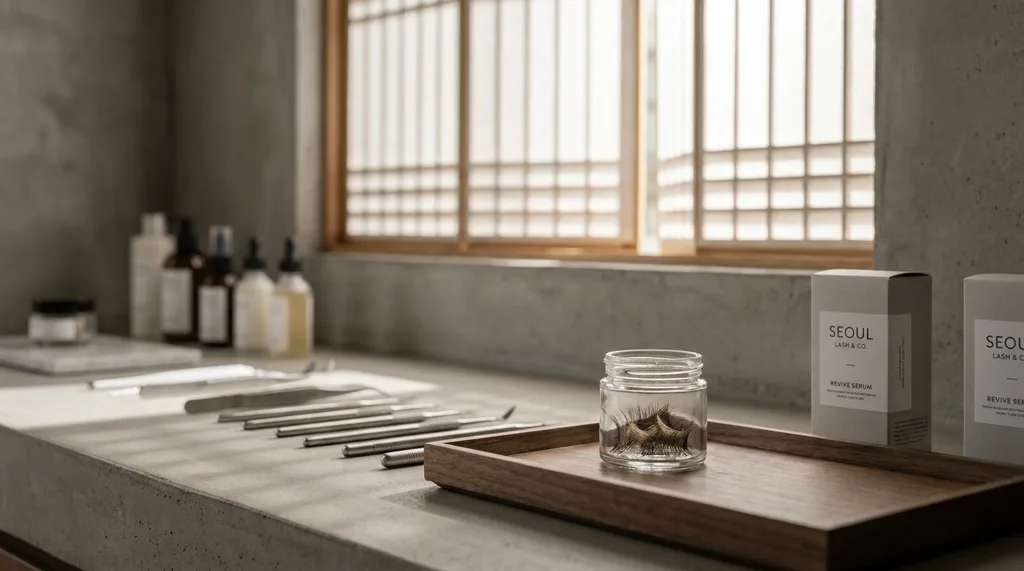
2. **The Matte-Steel Grip:** Avoid plastic or blunt-tipped tweezers. Professional artists use ultra-fine, curved matte-steel tweezers. This allows you to grasp the cluster lash at its very base without crushing or bending the delicate synthetic fibers.
3. **The Pinch Technique:** Once your cluster is anchored under your natural lash and the glue is semi-dry (about 30 seconds), use the flat side of your tweezers to gently press your natural lashes and the cluster together. This fuses them into a single, cohesive unit.
4. **The Wet-Look Finish:** To achieve the hyper-defined, spiky "doll lash" peak seen on stage, dip the tip of your tweezers into a tiny droplet of clear lash gel or serum. Gently pinch the very tips of two or three adjacent clusters together. This groups the fibers into clean, sharp points that capture the light beautifully.
Backstage beauty is a game of microscopic margins. The difference between a lash application that looks heavy and synthetic and one that looks like a flawless, light-reflective extension of your own eyes is a series of tiny, guarded techniques. To unlock the full, uncensored blueprint of elite K-beauty artistry—delivered directly from the premier salons of Seoul—join our inner circle below.
**Read next:**
→ [The Spatial Illusion: Why Your K-Beauty Makeup Looks Incomplete](https://www.k-beautyvault.com/2026/07/the-spatial-illusion-why-your-k-beauty.html)
(Discover how K-pop artists manipulate light and negative space to reshape facial structures without heavy contouring.)
---
## Frequently Asked Questions
### Can I reuse individual lash clusters?
Yes, high-quality synthetic clusters are highly reusable if cleaned gently. Soak them in a small cup of micellar water for five minutes to dissolve any adhesive residue, slide the softened glue off the base with tweezers, rinse with water, and let them air-dry on a clean paper towel.
### Is the under-lash technique safe for sensitive eyes?
The under-lash technique is safe provided the clusters are anchored to the natural lash hair, approximately 1 millimeter away from the wet waterline. You must never place the adhesive directly on the wet waterline or the skin of the lid, as this can block the eye's natural oil-producing glands.
### How do I remove cluster lashes without damaging my natural lashes?
Never pull or tug at the clusters when they are dry. Soak a cotton pad in an oil-based makeup remover, press it gently against your closed eyelid for 30 to 45 seconds to dissolve the adhesive bond completely, and then gently slide the lashes downward.
---
> **⚠️ Disclaimer:** The information provided in this article is for educational and aesthetic purposes only. When applying cosmetic adhesives near the periorbital area, always perform a patch test on your wrist or behind your ear to rule out allergic contact dermatitis. If you experience persistent redness, swelling, or irritation, discontinue use immediately and consult a board-certified dermatologist or eye care specialist.
 Written by Jun Mi Jung for Quiet Korea | Contact: rsl.2001.1975@gmail.com