The Great Ingredient Inquisition: Why Your Skin Is Starving While Your Apps Are Glowing

Key Takeaways - The EWG Skin Deep database operates on hazard-based models that ignore real-world concentrations, transforming potential chemical properties into modern panic. - South Korea’s MFDS framework prioritizes risk-based toxicology and clinical evidence over binary "safe versus toxic" internet badges. - Constantly chasing "clean" labels on apps like Hwahae triggers chemical anxiety, causing product-hopping that destroys the skin barrier faster than any synthetic preservative ever could.
Table of Contents
- The Fallacy of the Red Flag: Hazard Versus Risk
- The Regulatory Divide: Marketing Apps Versus Clinical Law
- The Cost of the Endless Search
- Explore Barrier-Repair and Clinical Skincare
- Frequently Asked Questions
- Are products with red or yellow EWG ratings unsafe to use?
- Why do Korean skincare products sometimes feel different from Western "clean" formulations?
- How do I know if my skin barrier is damaged from product-hopping?
Walk down the fluorescent-lit aisles of Gangnam or scroll through any global skincare forum, and you will witness a ritual of digital self-flagellation. A consumer holds up a serum bottle, opens a mobile ingredient analyzer, and watches the screen flash amber or red. A cold panic sets in. A warning label has appeared. A microscopic trace of a paraben or a synthetic emulsifier has been unmasked, and the product is instantly condemned as toxic waste.
It is a theatrical tragedy played out millions of times a day across the screens of terrified beauty obsessives.
For years, the multi-billion-dollar luxury marketing apparatus has trained you to believe that skincare is a moral battleground. On one side stand pristine, plant-derived saviors; on the other, terrifying synthetic chemicals lurking in the shadows of the ingredient declaration label. But beneath the polished surfaces of Sephora displays and the algorithmic panic of mobile safety apps lies a very different reality—one written not in marketing copy, but in the cold, unyielding equations of toxicology.
What if the very apps you trust to protect your skin are actually keeping you trapped in a perpetual cycle of irritation? What if the expensive, "clean" formulations failing to fix your complexion are built on a scientific illusion?
The Fallacy of the Red Flag: Hazard Versus Risk
To understand why your skin feels like a battleground of chronic irritation, you have to look past the glowing green checkmarks and understand how safety ratings are actually manufactured.
The Environmental Working Group’s Skin Deep database—the foundational oracle for modern clean beauty—operates on a hazard-based model. It asks a simple, terrifying question: Does this chemical, in its absolute, unadulterated, hundred-percent concentrated form, possess any inherent property that could cause harm?
If the answer is yes, the chemical receives a harsh score. It is flagged, branded, and exiled from the routines of millions.
[K-Beauty 101] Hwa-hae (화해) — A popular South Korean mobile app that analyzes cosmetic ingredients. It is the primary tool for Korean consumers to check for '20 Cautionary Ingredients.' It represents a cultural shift toward radical ingredient transparency, though it is often criticized for prioritizing consumer sentiment over clinical toxicological data.
In real-world toxicology, however, context is everything. The foundational rule established by Paracelsus centuries ago still stands: the dose makes the poison.
An ingredient that acts as a severe irritant in a pure chemical vat behaves entirely differently when stabilized at a 0.05% concentration inside an emulsion. It passes through the skin's natural physical barrier—the stratum corneum—in quantities so infinitesimal that the body processes and metabolizes them without a ripple of disruption. Yet, hazard-based scoring systems completely ignore concentration, formulation chemistry, and dermal penetration limits. They treat a drop of preservative in a hundred-milliliter moisturizer with the same apocalyptic alarm as a chemical spill in a laboratory.
The result is a phenomenon known as chemophobia: an irrational, marketing-induced terror of safe, highly effective cosmetic chemistry.
🎵 K-Mono Lofi — Seoul Study Beats
Read deeper with Seoul lo-fi in the background — curated by K-Mono Lofi
The Regulatory Divide: Marketing Apps Versus Clinical Law

While global consumers obsess over crowdsourced hazard scores, South Korea operates under a radically different legal architecture. The South Korean Ministry of Food and Drug Safety (MFDS) does not rely on crowd-sourced panic or binary safety tags.
| Metric | EWG Skin Deep | MFDS (South Korea) |
|---|---|---|
| Evaluation Basis | Hazard-based (inherent chemical properties) | Risk-based (toxicological dosage & safety) |
| Methodology | Internal non-public algorithmic scoring | Clinical data & KGMP regulatory compliance |
| Primary Utility | Precautionary consumer guidance | Legally enforced manufacturing standards |
| Market Status | Marketing benchmark / advocacy tool | Mandatory legal standard for functional cosmetics |
When a functional cosmetic enters the market in Seoul, it must satisfy the exacting standards of the Korean Good Manufacturing Practice (KGMP). The focus shifts from abstract hazard identification to actual physiological interaction. Clinical trials must prove that the product performs as claimed without compromising the skin's structural integrity.
Apps like Hwahae serve a valuable purpose in mapping out specific individual allergens for sensitive skin types, but they are frequently weaponized by consumer anxiety. They reflect the subjective preferences of a massive, hyper-vocal consumer base rather than absolute international toxicological consensus. When a brand alters a formulation simply to shave a point off its online safety score—often replacing a thoroughly tested, highly stable preservative with an unproven natural alternative that spoils in the summer heat—they are bowing to algorithms at the direct expense of your skin health.
The Cost of the Endless Search
The human toll of this digital audit culture is visible on millions of inflamed, compromised faces.
Driven by the fear of a single red flag on an ingredient list, consumers enter a relentless cycle of experimentation. They buy a product, scan it, find a minor caution flag, panic, discard it, and move on to the next viral sensation. In Korea, this restless population has a distinct name.
[K-Beauty 101] Yumokmin (유목민) — Nomads; consumers who constantly switch between beauty products. This term reflects the anxiety of the saturated Korean beauty market where consumers are in a perpetual, exhausting search for the 'perfect' product that won't cause breakouts.
This constant product-hopping destroys the skin faster than any synthetic additive ever could. The skin barrier requires stability to repair its lipid matrix. When you strip, shock, and switch your routine every two weeks in search of an immaculate, zero-risk ingredient profile, you prevent the skin from ever reaching homeostasis.
That sudden, granular cluster of tiny bumps across your forehead—often misdiagnosed as an allergic reaction to a "toxic" ingredient—is frequently nothing more than barrier fatigue caused by chemical whiplash.
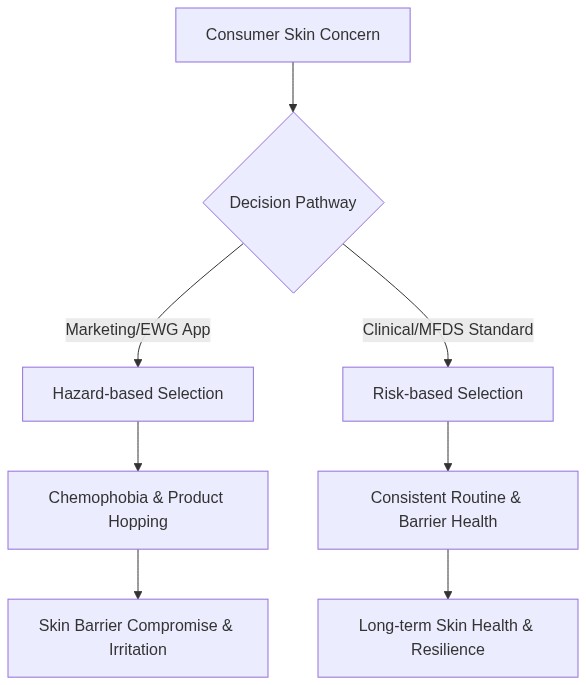
It is time to stop apologizing for using well-formulated, scientifically validated products just because an algorithm assigned them a yellow or orange badge. The multi-billion-dollar clean beauty marketing machine profits immensely from your anxiety, selling you the illusion that purity equates to efficacy.
Your skin does not need a clean score sheet. It needs stability, proven concentrations, and a barrier left in peace to do its job.
Frequently Asked Questions
Are products with red or yellow EWG ratings unsafe to use?
Not necessarily. EWG ratings measure inherent chemical hazards rather than real-world risk or concentration. Many effective preservatives and penetration enhancers receive higher hazard scores simply due to raw chemical properties, even when stabilized at safe, non-irritating levels in finished products.
Why do Korean skincare products sometimes feel different from Western "clean" formulations?
Korean formulations heavily prioritize functional performance, elegant textures, and barrier support regulated by strict MFDS manufacturing standards. While clean beauty brands often remove functional synthetics to satisfy marketing checklists, Korean dermatology focuses on whether the active ingredients actually deliver results in clinical settings.
How do I know if my skin barrier is damaged from product-hopping?
Signs of a compromised stratum corneum include sudden stinging when applying basic hydrating toners, persistent redness, a tight feeling after cleansing, and an influx of tiny, non-inflamed bumps. If your skin reacts poorly to products that previously caused no issues, stop exploring new formulas and strip your routine back to basic, fragrance-free hydration for at least two weeks.
⚠️ Disclaimer: This article is for informational and educational purposes only and does not constitute medical or dermatological advice. Ingredient sensitivities vary widely by individual. Always patch-test new products on your inner arm or jawline for 24–48 hours before full facial application, and consult a board-certified dermatologist if you experience persistent skin irritation or inflammatory conditions.
⚠️ Disclaimer: This article is for informational and educational purposes only and does not constitute medical, dermatological, or financial advice. Individual results vary — consult a board-certified dermatologist or physician before starting any new skincare routine, supplement, or procedure, especially if pregnant, nursing, or taking other medications. This article may contain affiliate links — if you buy through them, we may earn a small commission at no extra cost to you.
✓ Researched and compiled using verified data as of the publication date.
 Written by Jun Mi Jung for Quiet Korea | Contact: rsl.2001.1975@gmail.com