The End of the Ten-Step Myth: What Korean Glass Skin Actually Demands
Key Takeaways * "Glass skin" is not a byproduct of product accumulation; it is the physiological result of maintaining stable skin homeostasis and minimizing daily inflammatory fluctuations. * Modern Korean skincare has largely moved past cumbersome ten-step routines, pivoting instead toward a strategic, science-backed triad: toner pads, high-performance serums, and barrier-protecting moisturizers. * Understanding ingredient delivery—such as molecular weights in hyaluronic acid and optimal concentration thresholds for niacinamide—matters infinitely more than the brand name on the bottle.
Walk into any Olive Young in Seoul at midnight, and you will see someone pressing their seventh layer of toner into their cheeks with the focus of a bomb defuser. For years, global beauty culture watched this ritual through a distorted lens, turning Korean skincare into an endurance sport of excess. More layers equaled more glow. More bottles equaled more devotion.
Except the people walking out of those stores with skin that genuinely resembled polished glass weren't drowning their faces in ten distinct liquids. They were managing something far more subtle.
According to experts and data from platforms like Hwahae, the cultural obsession is undergoing a quiet revolution. Korean beauty enthusiasts report a sharp pivot away from the exhaustion of over-care and toward a concept rooted in hard biology. It turns out that luminous skin has very little to do with how many products crowd your vanity, and everything to do with how well your stratum corneum maintains its structural integrity against a relentless outside world.
The Anatomy of Daily Volatility
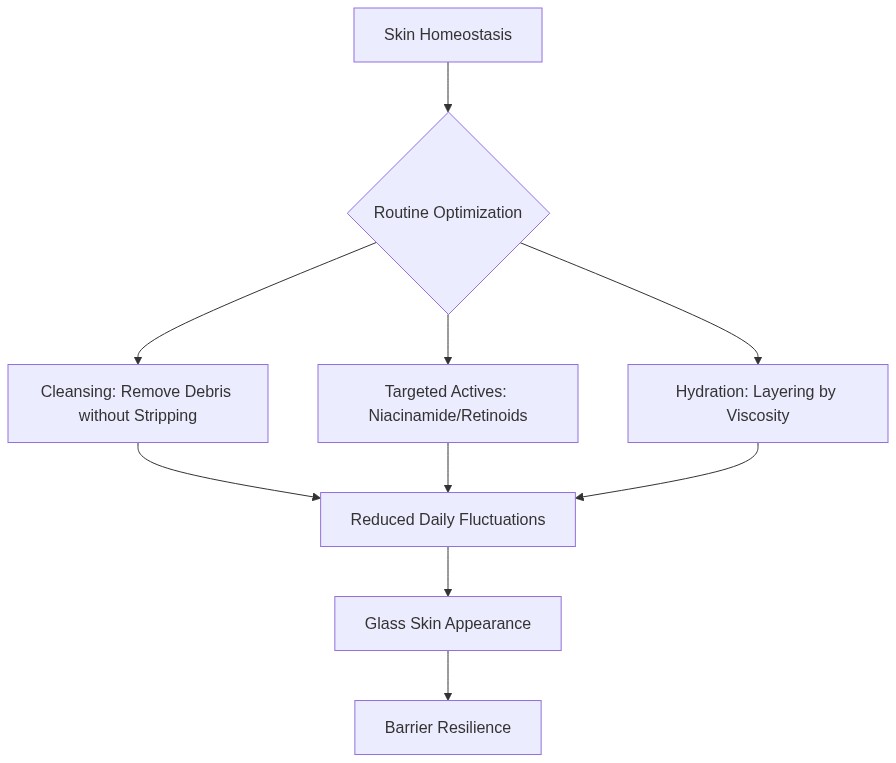
To understand why traditional routines often backfire, we have to look at what the skin actually experiences between morning and night. Research shows that skin undergoes predictable daily fluctuations in pore area, surface roughness, and micro-redness. Wind, indoor heating, UV exposure, and pollution conspire to pull the skin away from its baseline stability.
When skincare becomes an exercise in piling on conflicting actives, it amplifies that volatility rather than calming it.
This is where the traditional Korean practice of Jin-jeong—the deliberate, restorative act of soothing and calming irritated tissue—offers a vital course correction. The goal is not to aggressively resurface the complexion into submission. The goal is to return it to a state of quiet equilibrium. When you stop fighting your skin, the frantic pursuit of radiance gives way to something much more permanent: a resilient, calm surface that naturally reflects light.
[K-Beauty 101] Jin-jeong (Jin-jeong) — The act of soothing or calming irritated skin. More than just temporary relief, it implies a restorative process that returns the skin to a stable, healthy state, reflecting the K-beauty focus on barrier health.
The Chemistry Behind the Glow
If the ten-step routine is more marketing mythology than biological requirement, what actually delivers the transformation? The answer lies in molecular design and precise concentrations.
Take niacinamide, a ubiquitous fixture in modern formulations. Skincare enthusiasts love to chase higher percentages, assuming that if five percent is good, ten or twenty percent must be miraculous. Clinical data tells a different story. Research demonstrates that a modest two to three percent concentration is more than enough to regulate sebum production and reduce transepidermal water loss. Push that to four or five percent, and you hit the clinical sweet spot for addressing hyperpigmentation and stimulating endogenous ceramide production.
Exceeding those thresholds rarely yields superior oil control. Instead, it frequently triggers irritation—turning a barrier-repairing hero into a source of chronic inflammation.
| Active Ingredient | Effective Concentration / Form | Primary Biological Mechanism |
|---|---|---|
| Niacinamide | 2% – 3% | Reduces transepidermal water loss, regulates sebum production |
| Niacinamide | 4% – 5% | Inhibits melanosome transfer, stimulates ceramide synthesis |
| Hyaluronic Acid | High Molecular Weight (>500 kDa) | Forms a surface humectant film for immediate visual plumping |
| Hyaluronic Acid | Low Molecular Weight (<50 kDa) | Penetrates the dermis, signaling fibroblast activity |
Hyaluronic acid suffers from a similar disconnect between marketing and molecular reality. High molecular weight hyaluronic acid sits strictly on the surface, acting as a temporary water magnet that plumps fine lines through sheer surface hydration. Low molecular weight variants sink deeper, interacting with cellular machinery.
Yet, as skin researchers note, applying hyaluronic acid to dry skin in a low-humidity environment can produce a cruel paradox: drawing moisture out of the deeper layers of the skin rather than the air. The legendary glass skin finish is unlocked only when these humectants are applied to damp skin and immediately sealed with a proper occlusive barrier.
Decoding the Minimalist Shift
The modern Korean routine has simplified into an elegant, three-step framework: a gentle toner pad, a targeted serum, and a dependable barrier cream. This minimalist pivot reflects a growing collective awareness of sok-dang-gim—the phenomenon of deep-layer dehydration masked by an oily surface.
[K-Beauty 101] Sok-dang-gim (Sok-dang-gim) — Inner tightness or deep-layer dehydration. A critical concept distinguishing between surface oiliness and deep-layer dryness. It highlights the Korean beauty priority of 'filling' the skin with moisture rather than just coating it.
When consumers learn to diagnose inner tightness rather than simply piling on heavier creams, their entire approach transforms. Instead of chasing instant brightness with aggressive exfoliants, they turn to botanical and bio-fermented extracts that modulate inflammation at the cellular level. Galactomyces ferment filtrate and soothing herbal infusions like eoseongcho (Houttuynia cordata) have become pantry staples for this very reason. They stabilize the microbiome and reinforce tight junctions, minimizing the daily fluctuations that make skin look tired and dull.
🎵 K-Mono Lofi — Seoul Study Beats
Read deeper with Seoul lo-fi in the background — curated by K-Mono Lofi
Navigating the Noise
The global appetite for K-beauty shows no signs of slowing, with market projections climbing steadily through the decade. But growth invites noise. Viral ingredients and celebrity endorsements flood social media daily, promising overnight transformations that defy the laws of human biology.
The defense against this noise is simple: treat your skincare routine like an active education rather than a passive purchase. Pay attention to how your skin feels at three in the afternoon, not just three minutes after applying a serum. If your face feels tight by lunchtime, your barrier is crying out for repair, no matter how glassy it looked under bathroom lighting that morning.
True radiance isn't a veneer painted on by twelve different bottles. It is the quiet, steady hum of skin that has finally been given what it needs to heal itself.
⚠️ Disclaimer: The information provided in this article is for educational and informational purposes only and does not constitute medical advice. Skincare formulations interact differently with every individual's skin barrier and microbiome. If you suffer from chronic skin conditions, persistent inflammation, or adverse reactions to topical actives, consult a board-certified dermatologist before introducing new products or high-concentration ingredients into your routine.
⚠️ Disclaimer: This article is for informational and educational purposes only and does not constitute medical, dermatological, or financial advice. Individual results vary — consult a board-certified dermatologist or physician before starting any new skincare routine, supplement, or procedure, especially if pregnant, nursing, or taking other medications. This article may contain affiliate links — if you buy through them, we may earn a small commission at no extra cost to you.
✓ Researched and compiled using verified data as of the publication date.
 Written by Jun Mi Jung for Quiet Korea | Contact: rsl.2001.1975@gmail.com