Navigating the Gangnam Grid: How to Spot Seoul's Factory Clinics and Safely Book Real Clinical Excellence
- The Illusion of the Gangnam Beauty Factory
- The Regulatory Shield: How to Verify Your Clinic
- Cracking the Price Code: Navigating the "Foreigner Tax"
- Active Aftercare: The Key to Post-Procedure Success
- Planning Your Seoul Recovery Base
- Find Your Seoul Recovery Base
- Book Seoul Wellness & Transfers
- Frequently Asked Questions
- How can I verify if a clinic's dermatologist is actually board-certified?
- Can I get clinical treatments in Seoul if I do not speak any Korean?
- How long should I stay in Seoul after getting a laser or skin booster treatment?
Step off the subway at Gangnam Station, exit 10, and you are instantly greeted by a sprawling vertical city of aesthetic medicine. Towering glass buildings are clad in multi-story advertisements showing pristine, poreless skin. The air smells faintly of clinical-grade antiseptic mixed with premium diffusers, and it is entirely normal to pass people casually nursing iced americanos with small flesh-colored bandages taped to their temples or jawlines.
This is the undisputed global capital of medical aesthetics. But behind the sleek, minimalist waiting rooms lies a highly complex, multi-billion-dollar ecosystem. For a foreign traveler, navigating this grid is a high-stakes challenge. The English-facing information landscape is heavily dominated by commission-driven brokers, paid influencers, and aggressive social media marketing campaigns.
A major shift occurred when South Korea restructured its medical tourism policies, phasing out the historic cosmetic VAT tax refund system. This marked a deliberate transition by regulatory bodies away from positioning clinical treatments as "duty-free discount shopping" and toward a strict focus on premium, safety-first clinical excellence.
If you are planning to travel to Seoul for your skin, you need to know how to separate the high-volume "beauty factories" from the genuine medical boutiques.
Key Takeaways * Audit the Business Model: Learn to distinguish high-volume "factory" clinics from specialized, board-certified dermatologist boutiques where the doctor actually designs your treatment plan. * Demand Legal Proof: Always verify that a clinic holds an official government registration certificate for treating foreign patients, protecting you under Korean medical law. * Bypass the Middlemen: Use authentic local digital platforms to research transparent, equal pricing and read unmanipulated, self-funded patient reviews.
The Illusion of the Gangnam Beauty Factory
To understand Seoul’s clinical landscape, one must understand the two fundamentally different business models operating side-by-side in districts like Gangnam and Apgujeong.
On one side are the high-volume clinics, often referred to by locals as "factory clinics." These establishments operate on massive economies of scale. They utilize aggressive online marketing, ultra-low pricing on basic procedures like botox or simple laser toning, and high-throughput styling. When you enter, the process feels highly optimized, almost like an assembly line: you check in via QR code, meet briefly with a sales consultant (not a doctor) who recommends a package of treatments, get numbed in a communal room with dozens of others, and are finally ushered onto a treatment bed where a doctor you have never seen before performs the procedure in a matter of minutes.
On the other side are the specialized, private boutique clinics, typically led by board-certified dermatologists. Here, the process is highly individualized. The doctor performs the initial assessment, evaluates your skin barrier health under specialized diagnostic imaging, customizes the energy levels of the devices to your specific anatomy, and closely monitors your recovery.
While factory clinics serve a purpose for basic, low-risk "maintenance" treatments, they carry distinct risks for complex energy-based devices (like Ultherapy or Thermage) or advanced skin boosters. When devices are operated at high speeds with standardized settings to maximize patient turnover, the risk of burns, fat loss, or systemic barrier compromise increases dramatically.
To protect foreign patients from predatory, unlicensed operators, the South Korean government enforces strict regulatory guardrails.
[K-Beauty 101] 외국인환자 유치기관 등록증 (Oegugin-hwanja Yuchi-gigwan Deungnok-jeung) — Certificate of Registration for Foreign Patient Attraction. This official government certificate issued by the Ministry of Health and Welfare (MOHW) is the single most important document a clinic must possess to legally treat international travelers. It guarantees the clinic meets strict safety standards and carries mandatory malpractice insurance.
Before booking any appointment or paying a deposit, a patient has the absolute right to request proof of this registration. If a clinic or an independent agent hesitates to provide this credential, walk away.
To help you visualize the structural differences between these two clinical experiences, compare their core operating metrics below:
⚠️ The High-Volume Factory Clinic
- Consultation: Conducted entirely by a sales manager/coordinator focused on upselling.
- Doctor Contact: Minimal. The physician enters the room only after you are numbed, performs the treatment, and exits immediately.
- Device Customization: Standardized, low-to-medium energy parameters to ensure speed and prevent obvious errors.
- Wait Times: Often 1 to 2 hours past your scheduled appointment time due to overbooking.
✅ The Premium Dermatological Boutique
- Consultation: Deep, 1:1 diagnostic consultation directly with a board-certified dermatologist.
- Doctor Contact: Continuous. The same physician designs, executes, and reviews your entire treatment protocol.
- Device Customization: Highly tailored energy levels, pulse widths, and pass counts matched to your tissue density.
- Wait Times: Minimal. Appointments are strictly capped to allow dedicated attention per patient.
The Regulatory Shield: How to Verify Your Clinic
The growth of medical travel in Seoul has been accompanied by rigorous legislative oversight designed to protect patient safety.
One major milestone is the landmark Surgery Room CCTV Law. Under this regulation, any medical facility performing procedures under general anesthesia or deep sedation must have operational CCTV cameras in the operating theaters. Patients have the explicit legal right to request that their procedure be recorded, serving as an absolute deterrent against the unethical practice of "Shadow Doctors" (where an unlicensed practitioner or a different surgeon substitutes for the primary physician while the patient is asleep).
Additionally, the government administers the KAHF (Korean Accreditation Program for Hospitals Serving Foreign Patients). This accreditation evaluates clinics on over 130 safety, hygiene, and service standards. Booking a KAHF-certified clinic ensures you are stepping into an institution vetted at the absolute highest level.
To ensure your journey is safe, structured, and free from predatory intermediaries, follow this verification pipeline before finalizing any medical travel plans:
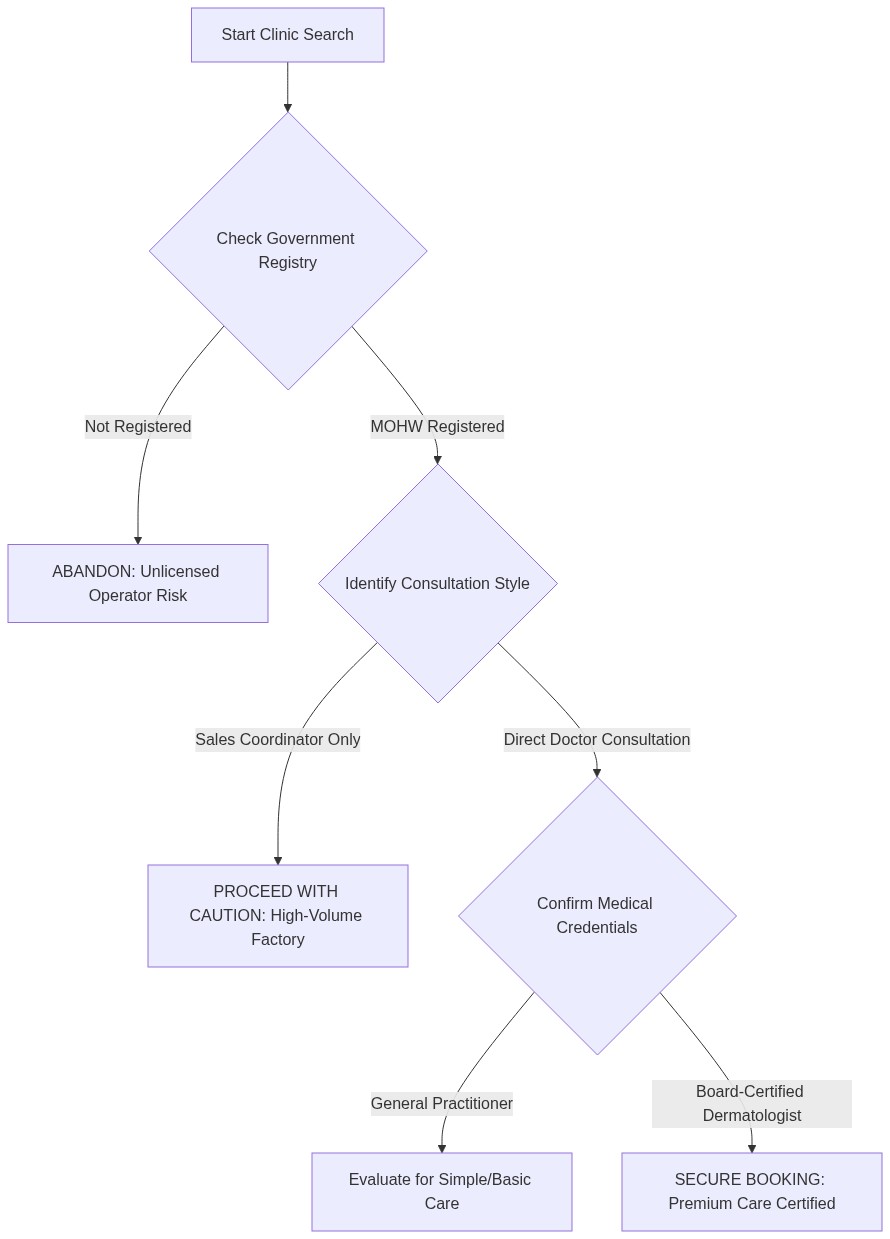
These steps require active diligence, but they are your shield against the unregulated broker networks that populate social media platforms, often steering unsuspecting tourists toward clinics that offer the highest referral commissions rather than the safest clinical outcomes.
🎵 K-Mono Lofi — Seoul Study Beats
Read deeper with Seoul lo-fi in the background — curated by K-Mono Lofi
Cracking the Price Code: Navigating the "Foreigner Tax"
A common anxiety for international patients is the fear of the "foreigner tax"—the practice of charging non-Korean patients double or triple the rate listed on local Korean-language menus.
Historically, this discrepancy was defended by clinics as a necessary premium to cover the overhead costs of dedicated medical translators, airport transfer logistics, and international coordination staff. However, with the rise of modern medical transparency platforms, this pricing gap has shrunk significantly.
To protect yourself, it is essential to understand the true local cost of popular dermatological treatments. While elite, highly specialized clinics in Apgujeong will naturally command premium pricing due to the credentials of their board-certified staff and the use of ultra-premium imported devices, knowing the standard market ranges helps you spot flagrant overcharging immediately.
| Treatment Category | Common Local Price Range (USD Equivalent) | Key Factors Influencing Cost |
|---|---|---|
| Pico Toning / Laser Toning | $80 – $250 per session | Number of passes, laser brand (e.g., PicoWay vs. local devices), and doctor's experience level. |
| Juvelook / Skin Boosters | $250 – $600 per treatment | Volume injected (cc), manual hand-injection technique vs. automatic injector gun, and inclusion of targeted cryo-soothing. |
| Ultherapy (High-Intensity Focused Ultrasound) | $800 – $1,800 (for 300-400 lines) | Authenticity of the transducer tips (genuine Ulthera tips are costly), doctor's mapping precision, and clinic location. |
| Thermage FLX (Radiofrequency) | $1,200 – $2,500 (for 600 shots) | Use of certified, single-use tips (always ask to see the tip box and activation certificate), and customized cooling protocols. |
To navigate these prices like a local, you must look for the ultimate stamp of authenticity.
[K-Beauty 101] 내돈내산 (Naedonnaesan) — Literally translated as "My money, my purchase." This is a culturally vital term used across the Korean web to denote completely authentic, self-funded, unsponsored reviews. When researching on local forums or translating clinic reviews, look for this tag to filter out disguised advertisements.
To bypass opaque broker pricing entirely, many international travelers now utilize localized digital platforms. Apps like Gangnam Unni (which features robust English interfaces) allow you to compare real-time pricing menus, view promotional packages, and read verified reviews. These platforms enforce "Equal Price" policies, meaning the clinic is legally bound to honor the digital price shown, effectively eliminating the risk of arbitrary foreigner upcharges.
Active Aftercare: The Key to Post-Procedure Success
The journey does not end when you step out of the treatment room. In fact, what you do in the 72 hours following a clinical procedure in Seoul is just as critical to your final result as the doctor's skill.
Dermatological lasers, high-intensity lifting devices, and micro-needling treatments work by inducing controlled micro-injuries in the skin to stimulate the body's natural healing and collagen production cascades. However, this temporarily compromises your natural lipid barrier, leaving your skin highly vulnerable to environmental aggressors, hyperpigmentation, and trans-epidermal water loss.
In Korea, clinical follow-up care is taken incredibly seriously.
[K-Beauty 101] 사후 관리 (Sahu Gwanri) — Post-procedure aftercare. In Korean aesthetic medicine, this refers to a comprehensive suite of immediate clinical soothing treatments—such as LDM (Local Dynamic Micro-massage), cryo-electroporation, and specialized modeling masks—designed to rapidly calm inflammation and accelerate barrier repair.
The most common mistake international travelers make is neglecting this recovery phase. Because their travel itinerary is packed, they will undergo an intense ablative laser or skin booster treatment and immediately spend the next day walking under the intense Seoul sun, or board a long-haul flight back home where the pressurized, desert-dry cabin air completely saps the skin of moisture.
To protect your clinical investment, plan for a dedicated "quiet window" post-procedure. Ensure your routine is stripped down to the bare essentials: a ultra-gentle, non-stripping cleanser, a ceramide-rich barrier repair cream, and a high-performance, post-procedure physical sunscreen that leaves zero room for UV damage.
If you are feeling overwhelmed by the sheer volume of choices, clinics, and logistical challenges of planning a clinical beauty trip to Seoul, you do not have to navigate it alone. Our community of dedicated insider experts compiles real-time, uncompromised, and completely independent guides on the best-vetted medical facilities, translation support, and recovery spaces in Seoul.
Planning Your Seoul Recovery Base
When executing a medical beauty tour, your physical environment plays a massive role in your comfort and healing. Choosing an accommodation located within the primary clinic hubs of Gangnam or Apgujeong minimizes transit stress, allowing you to easily return to your room to rest while numbed or immediately following intensive treatments.
This article may contain affiliate links — if you buy through them, we may earn a small commission at no extra cost to you.
To complete your itinerary, consider booking hassle-free airport transfers or relaxing, low-intensity wellness experiences (like traditional Korean scalp treatments and head spas) to help relieve travel fatigue without compromising your recovering facial skin.
Frequently Asked Questions
How can I verify if a clinic's dermatologist is actually board-certified?
In Korea, you can verify a doctor's credentials through the official Korean Dermatological Association database. Genuine board-certified dermatologists will always display "Dermatologist" (피부과전문의) on their building signs, clinic websites, and business cards, whereas general practitioners are legally required to write "Clinic, Specialist in [Other Field]" or "Clinic, Department of Dermatology" in a smaller font size.
Can I get clinical treatments in Seoul if I do not speak any Korean?
Yes, many premium clinics in Gangnam and Apgujeong employ dedicated, in-house medical translators fluent in English, Chinese, and Japanese. However, you should confirm during your booking process whether an interpreter will be physically present with you during the doctor's consultation and the actual procedure, or if they only assist during the sales check-in phase.
How long should I stay in Seoul after getting a laser or skin booster treatment?
For minor, non-ablative treatments (like Pico Toning or simple hyaluronic acid injections), you can safely fly within 24 to 48 hours, provided you maintain extreme sun protection and barrier hydration. For deep ablative lasers, surgical procedures, or extensive micro-needling, it is highly recommended to remain in Seoul for at least 5 to 7 days to attend scheduled follow-up care and receive professional clearance from your doctor before boarding a flight.
⚠️ Medical & Financial Disclaimer: The information provided in this guide is for educational and informational purposes only and does not constitute formal medical or financial advice. Aesthetic medical procedures carry inherent clinical risks, including burns, scarring, infection, and asymmetrical results. Always consult with a board-certified dermatologist or plastic surgeon to evaluate your personal skin health and suitability for any treatment. All financial estimates, price ranges, and regulatory policy details are subject to change by individual clinics and local governing authorities.
✓ Researched and compiled using verified data as of the publication date.
 Written by Jun Mi Jung for Quiet Korea | Contact: rsl.2001.1975@gmail.com